Science · Key Stage 3 · £4.99
Year 9 Science
Scheme of Work
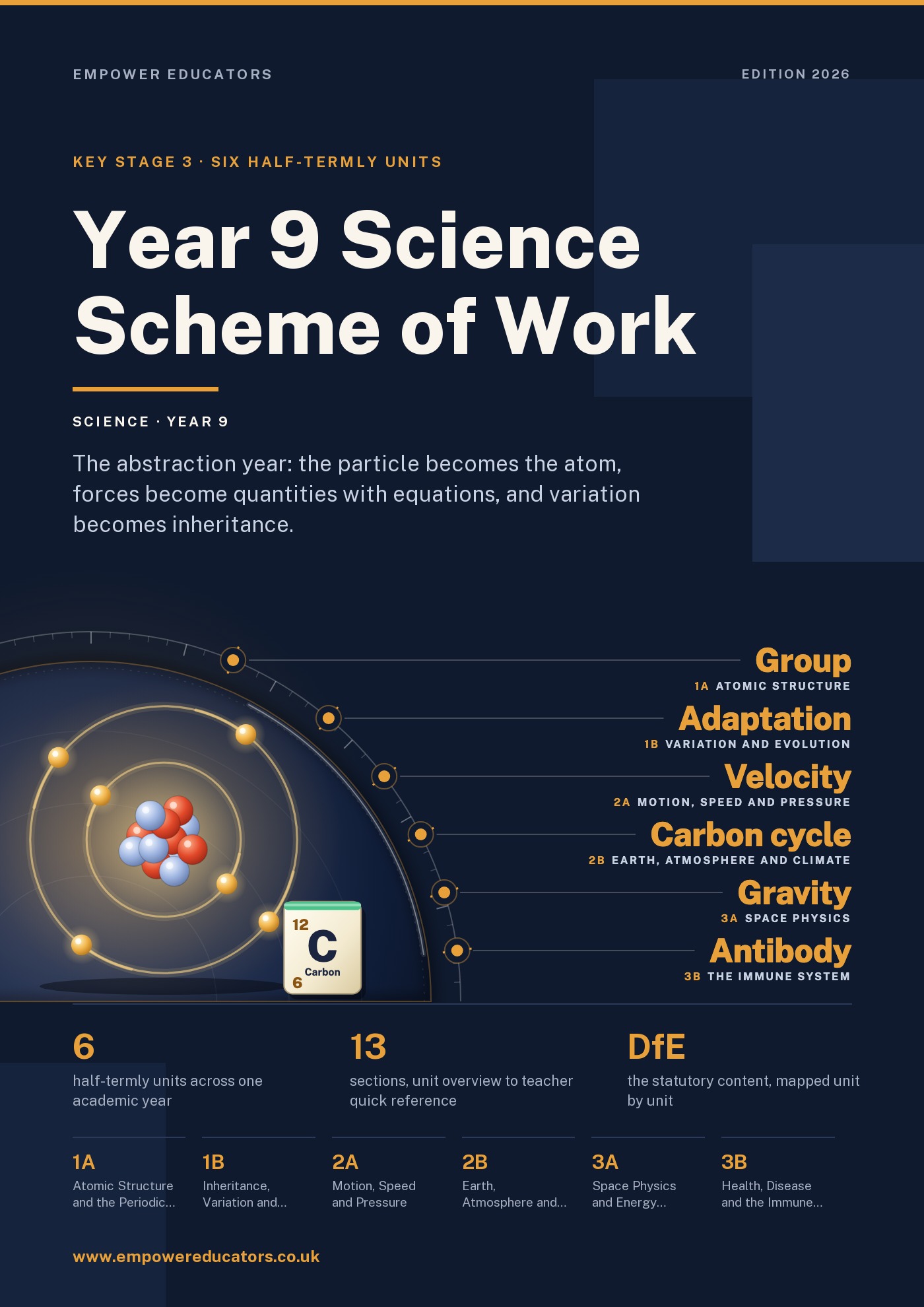
Six half-termly units across one academic year, forming the bridge to GCSE. The abstraction year: the particle becomes the atom, forces become quantities with equations, and variation becomes inheritance. Unit 1a explains the reactivity series Year 8 built from evidence.
£4.99The Year 9 scheme: 6 half-termly units, 42 pages
- A4 PDF
- first 8 pages free to read
- instant download
Teaching all of Key Stage 3? Year 7, Year 8 and Year 9 as one set: £11.99, saving £2.98.
One purchase covers the school that buys it. Print it, copy it, hand it round your department. Not for passing to other schools or uploading anywhere.
PDF download, ready straight after payment. Downloading it ends the 14-day right to cancel; a file that is faulty or not as described is always refunded. Refunds
Read before publication by the serving head of that department and by senior leaders, in school.
5.0 from 24+ reviews on Google
Schools that have bought from Empower Educators include Nottingham High School, Northampton High School GDST and Sutton Valence School.
Complete your Science
The whole key stage: KS3 Science scheme of work
Everything else this site has for Science: Science teaching resources
- 1aAtomic Structure and the Periodic Table
- 1bInheritance, Variation and Evolution
- 2aMotion, Speed and Pressure
- 2bEarth, Atmosphere and Climate
- 3aSpace Physics and Energy Resources
- 3bHealth, Disease and the Immune System
Ten sections per unit, in the same order every time. Phases rather than single lessons, because science is timetabled at about three hours a week.
A pattern observed and then explained is science; a pattern explained and then observed is a lesson. Unit 1a is placed where it is for that reason. Year 8 built the reactivity series from its own evidence and could not say why, and this is the answer. Unit 2a is placed after the mathematics department teaches rearranging equations, and it uses their method: formula triangles are not used in this department, because they produce students who can find speed and cannot rearrange anything else.
Unit 2b carries the most transferable lesson in the key stage — telling measured, inferred and projected apart, on climate data, where students meet all three in public argument treated as equally certain.
Every duration, context and assessment word is a strong default rather than a fixed rule. Year 9 means ages 13–14, or S2–S3 in Scotland.
- Written to
- The statutory programme of study for key stage 3 science (DfE, 2013)
- Intended for
- heads of science, subject leaders, technicians and every teacher who has to deliver it
- Extent
- 42 pages · 13 sections
The sequence
What this scheme of work covers, unit by unit
The 6 units of the Year 9 Science Scheme of Work, in teaching order, with the term each one runs in and the question it is built to answer.
1a
Atomic Structure and the Periodic Table
Autumn 1 · approx. 7 weeks · September – October
Why does the reactivity series look the way it does?
1b
Inheritance, Variation and Evolution
Autumn 2 · approx. 7 weeks · November – December
Why are you like your parents but not identical to them?
2a
Motion, Speed and Pressure
Spring 1 · approx. 7 weeks · January – February
Two cars pass the same sign at the same speed. Is anything about them the same?
2b
Earth, Atmosphere and Climate
Spring 2 · approx. 7 weeks · March – April
The atmosphere is 0.04% carbon dioxide. How can that possibly matter?
3a
Space Physics and Energy Resources
Summer 1 · approx. 7 weeks · April – May
Coal, wind and hydroelectricity are all stored sunlight. Which resources are not, and why?
3b
Health, Disease and the Immune System
Summer 2 · approx. 7 weeks · June – July
You meet thousands of pathogens a day and are almost never ill. Why not?
Look inside
Real pages, straight from the PDF
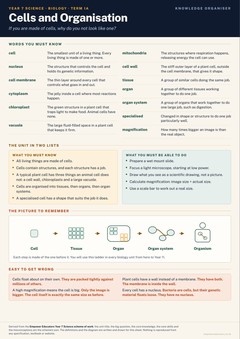
Click any page to see it full size.
Contents
All 13 sections
Taken from the book’s own contents page, so the page numbers are the real ones.