
Physics · KS3 to A Level £4.99
Physics Key Terms
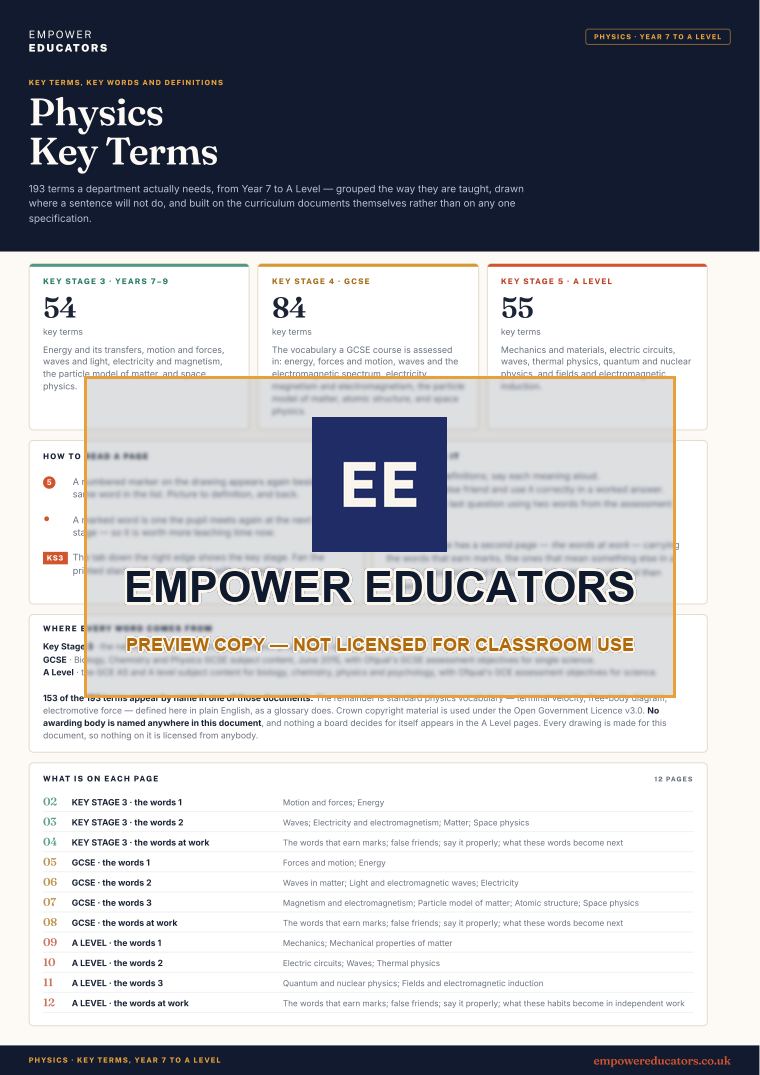
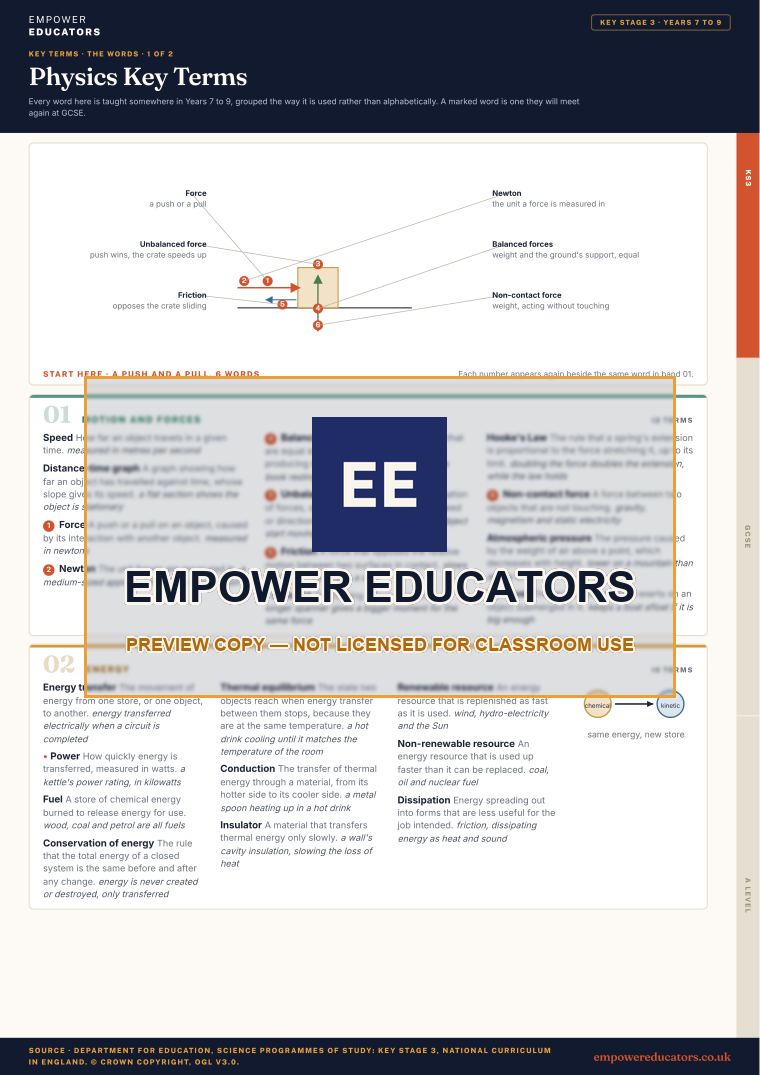
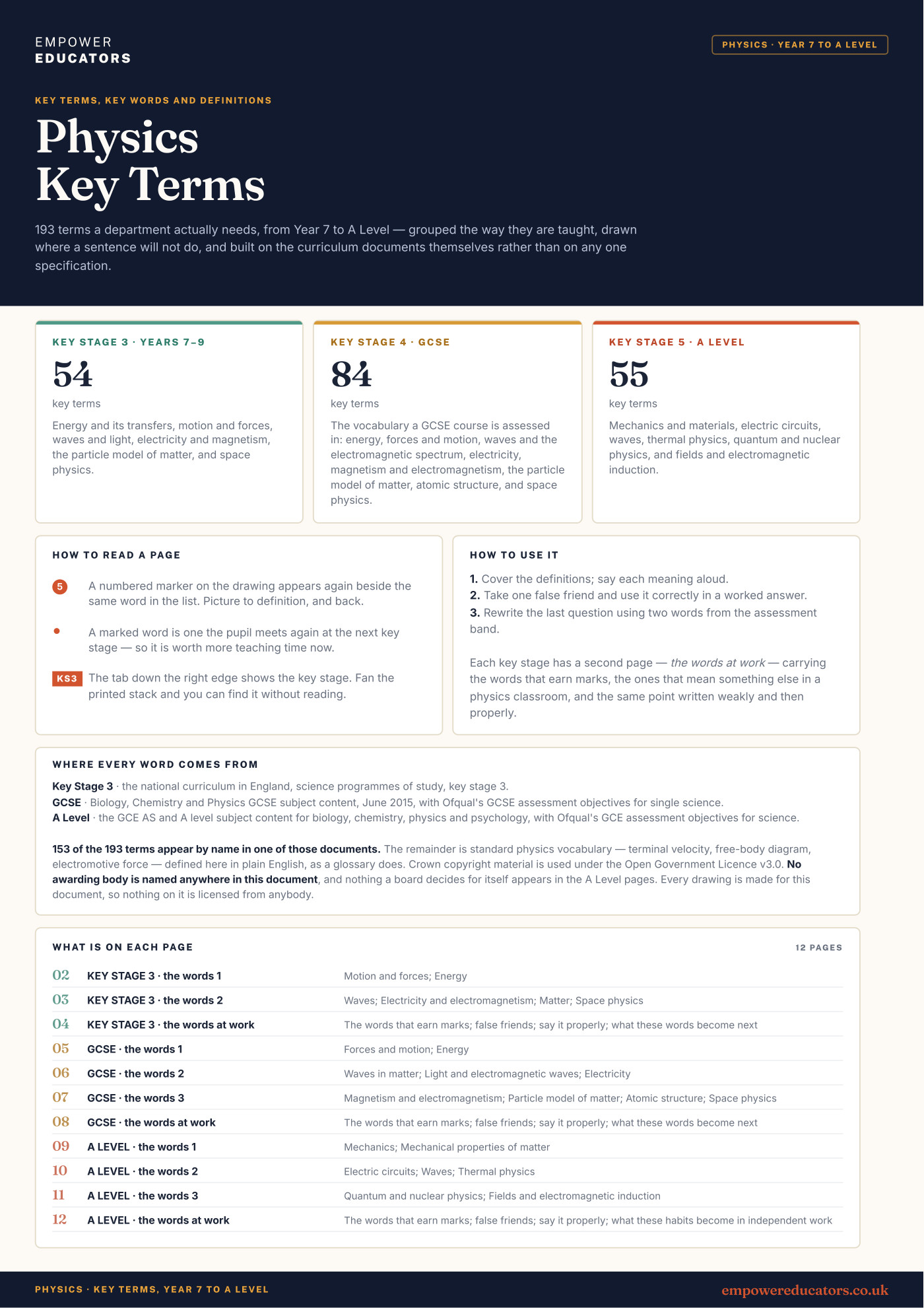
Every word a physics department teaches, Year 7 to A Level, in one A4 book. Each key stage gets its own pages: the terms grouped the way they are taught rather than alphabetically, a definition that fits on two lines, and a worked example beside almost every one. Each key stage opens on one large drawing instead of a list: a crate pushed against friction at Key Stage 3, a free body diagram with a resultant force at GCSE, a vector resolved into components alongside a satellite's orbit at A Level — three genuinely different drawings, because the curriculum teaches three genuinely different ideas of a force, not one picture redrawn three times. GCSE then follows the DfE's own physics content in order: forces and motion, energy, waves and the electromagnetic spectrum, electricity, magnetism and electromagnetism, the particle model of matter, atomic structure, and space physics; A Level adds mechanics, the mechanical properties of materials, electric circuits, thermal physics, quantum and nuclear physics, and fields and electromagnetic induction. Nineteen small diagrams are drawn where a sentence will not do, including a wave's amplitude and wavelength, alpha, beta and gamma penetrating different barriers, and a force-extension graph. Then a page on using the words: the ones the assessment itself is written in, the false friends that mean something else in a physics classroom, the same point written weakly and then properly, and what each word becomes at the next key stage.
Key Stage 3 follows the national curriculum in England, science programmes of study (September 2013); GCSE follows the DfE's Biology, Chemistry and Physics GCSE subject content (June 2015) and Ofqual's GCSE subject level conditions and requirements for single science; A Level follows the DfE's GCE AS and A level subject content for biology, chemistry, physics and psychology (April 2014), Appendix 3, and Ofqual's GCE subject level conditions for science, which also sets physics' own higher mathematical-content requirement, at least 40% of the assessment; 153 of 193 terms appear by name in one of those documents, the remainder being standard physics vocabulary defined here in plain English, as a glossary does; no awarding body is named, and the only named laws used are universal physics nomenclature — Newton's three laws, Hooke's, Ohm's, Faraday's and Lenz's laws, Fleming's left-hand rule — never anything a specification decides for itself · 12 pages, 11 sections ·For physics departments: printed one per pupil, kept in the front of an exercise book, or put on the wall by key stage