Physics · KS3 to A Level
Physics Key Terms
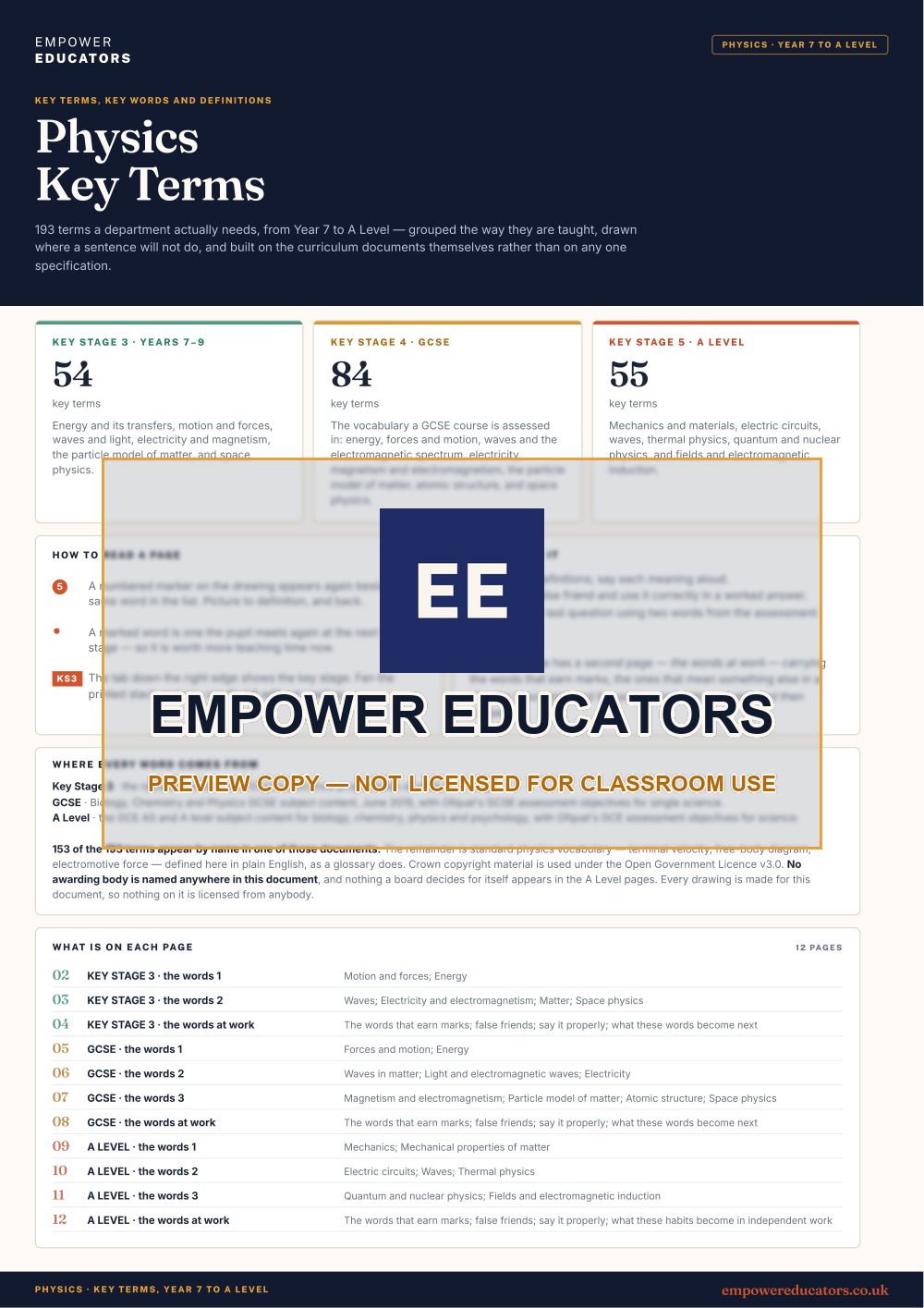
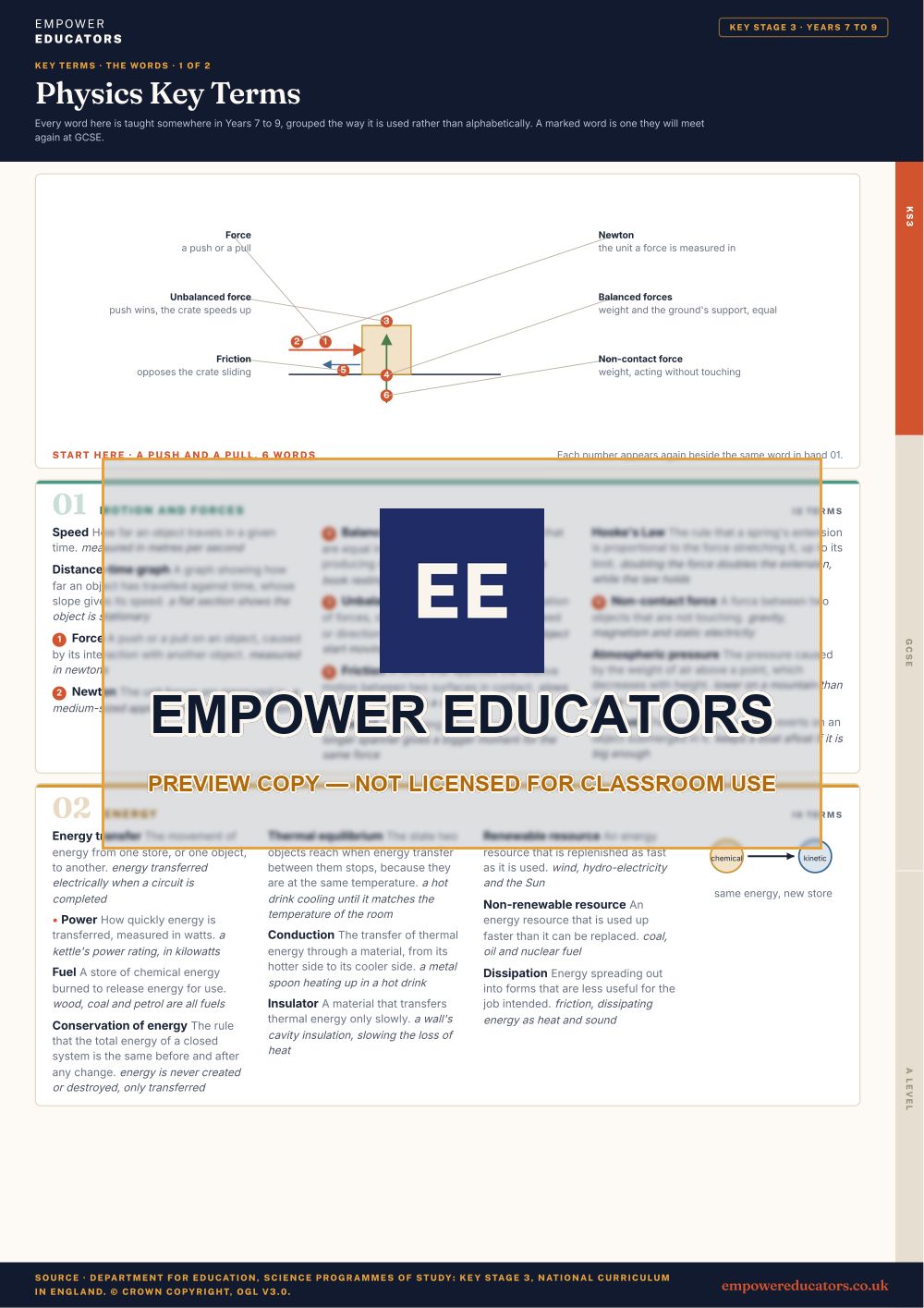
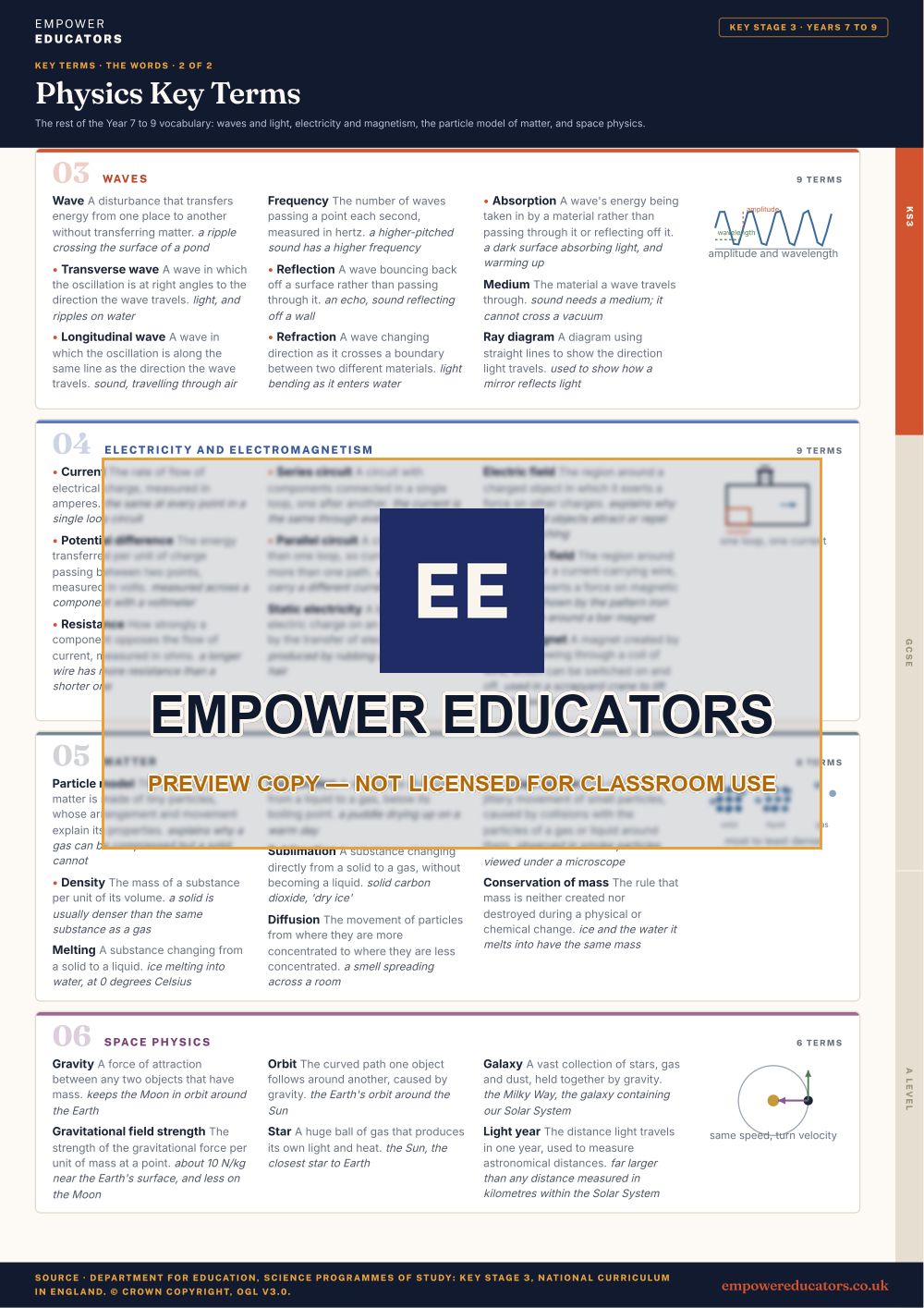
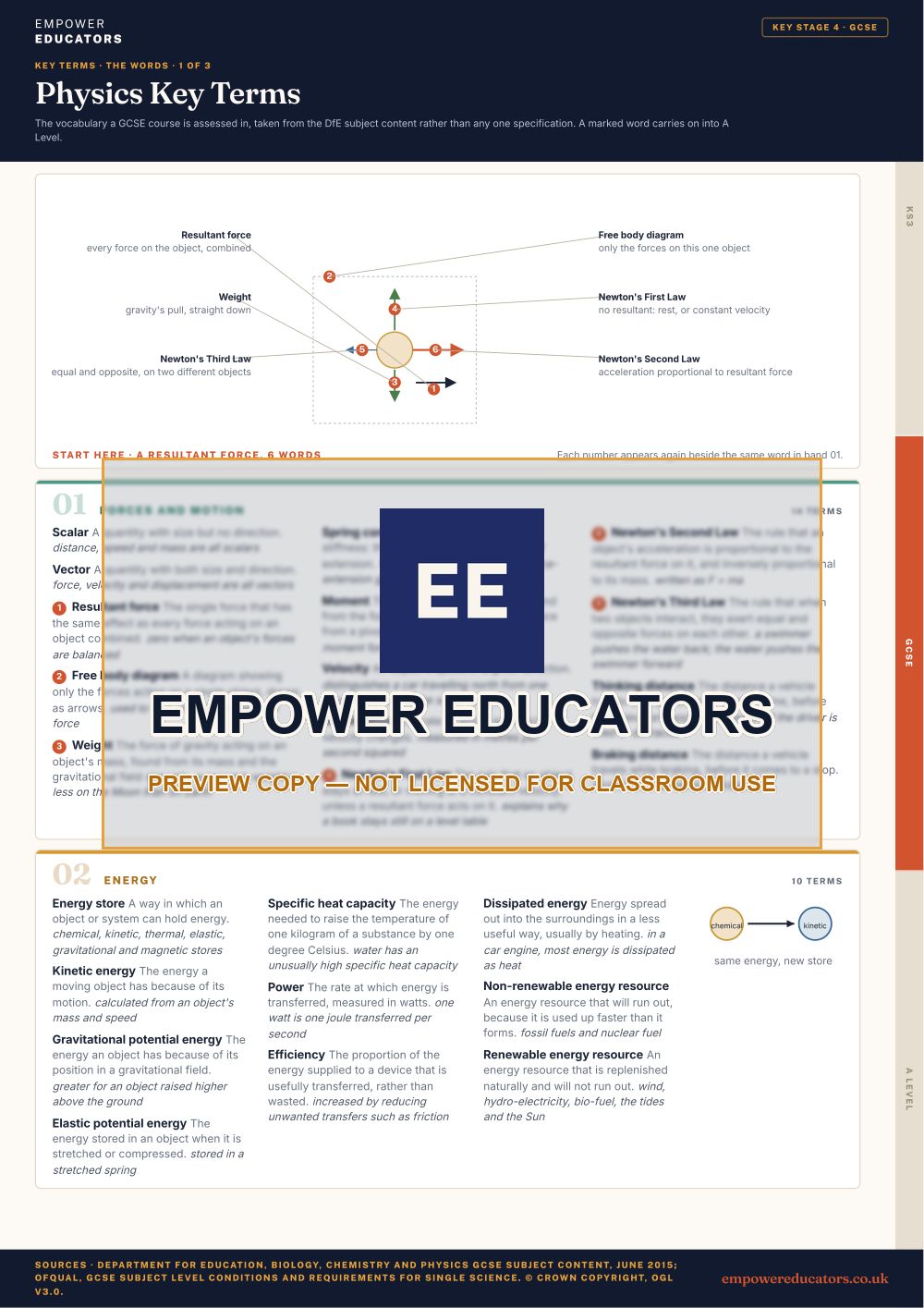
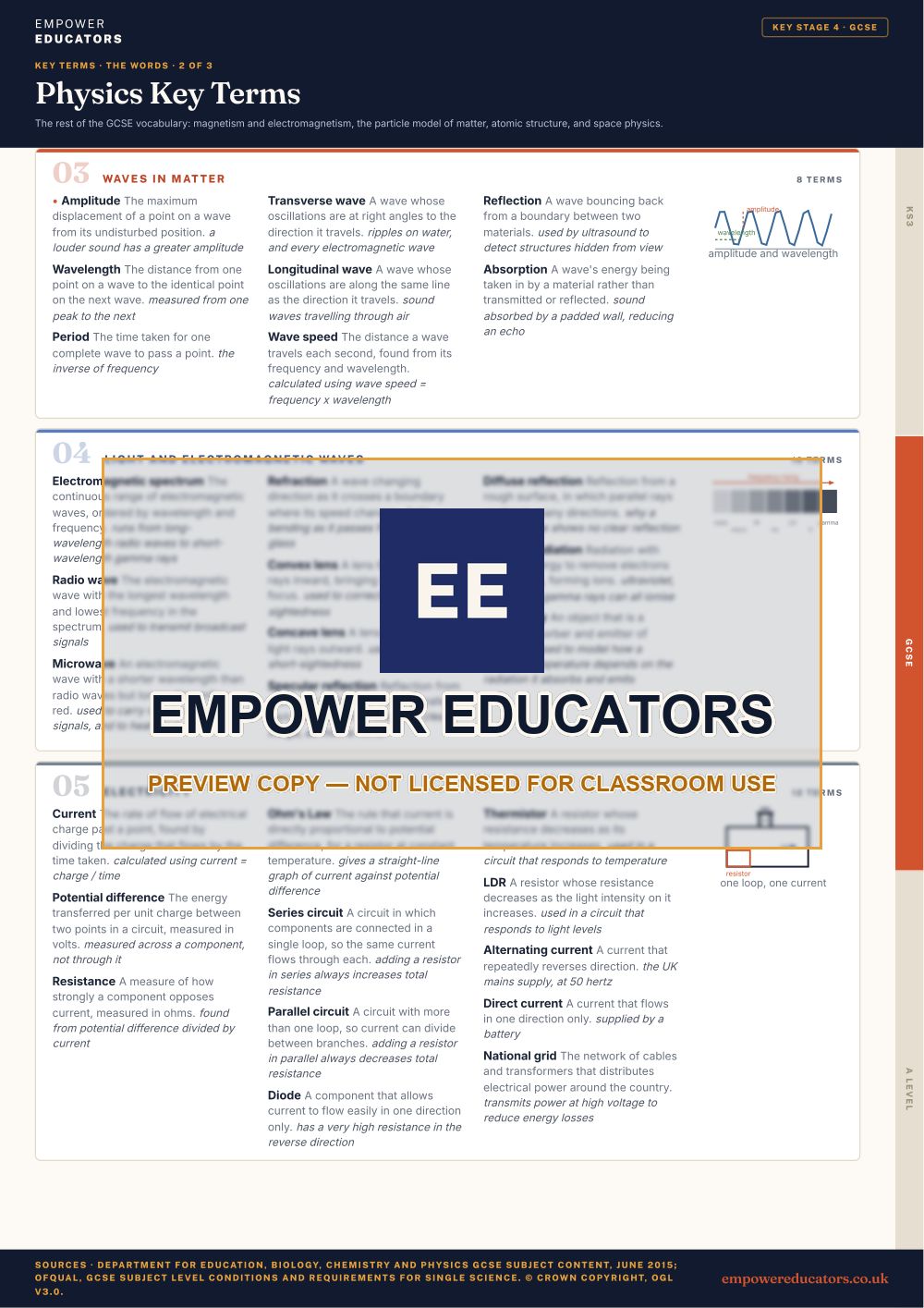
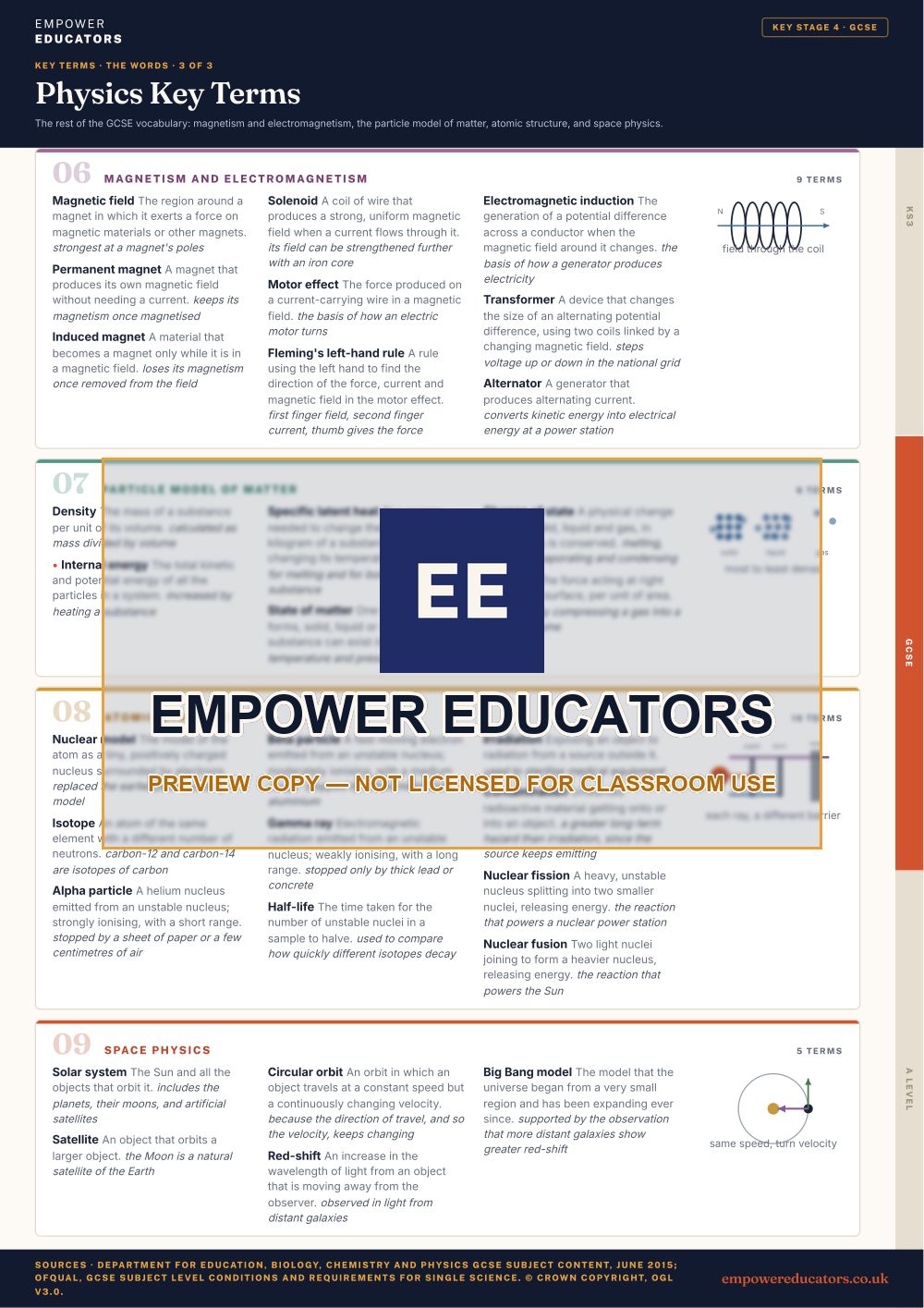
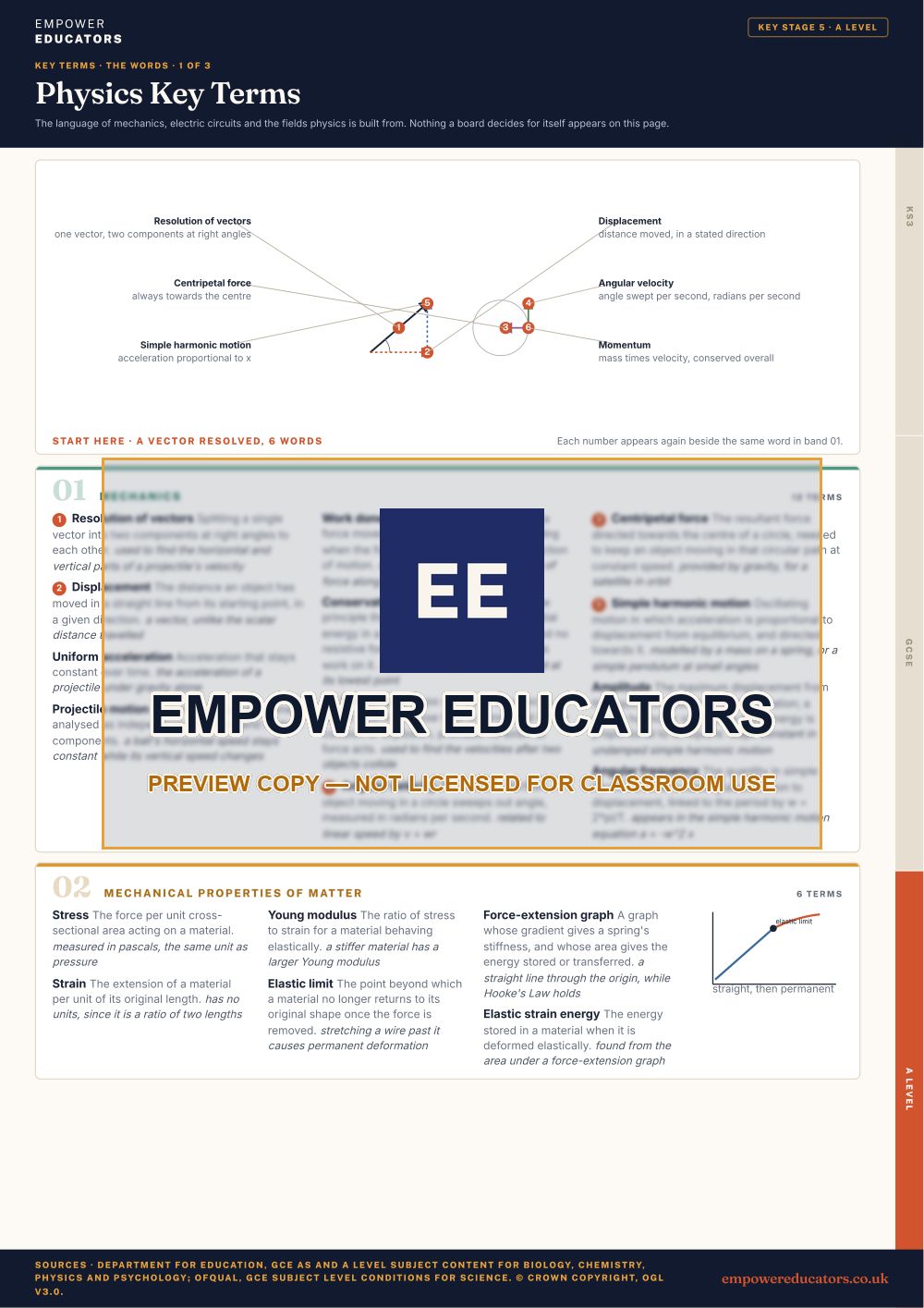
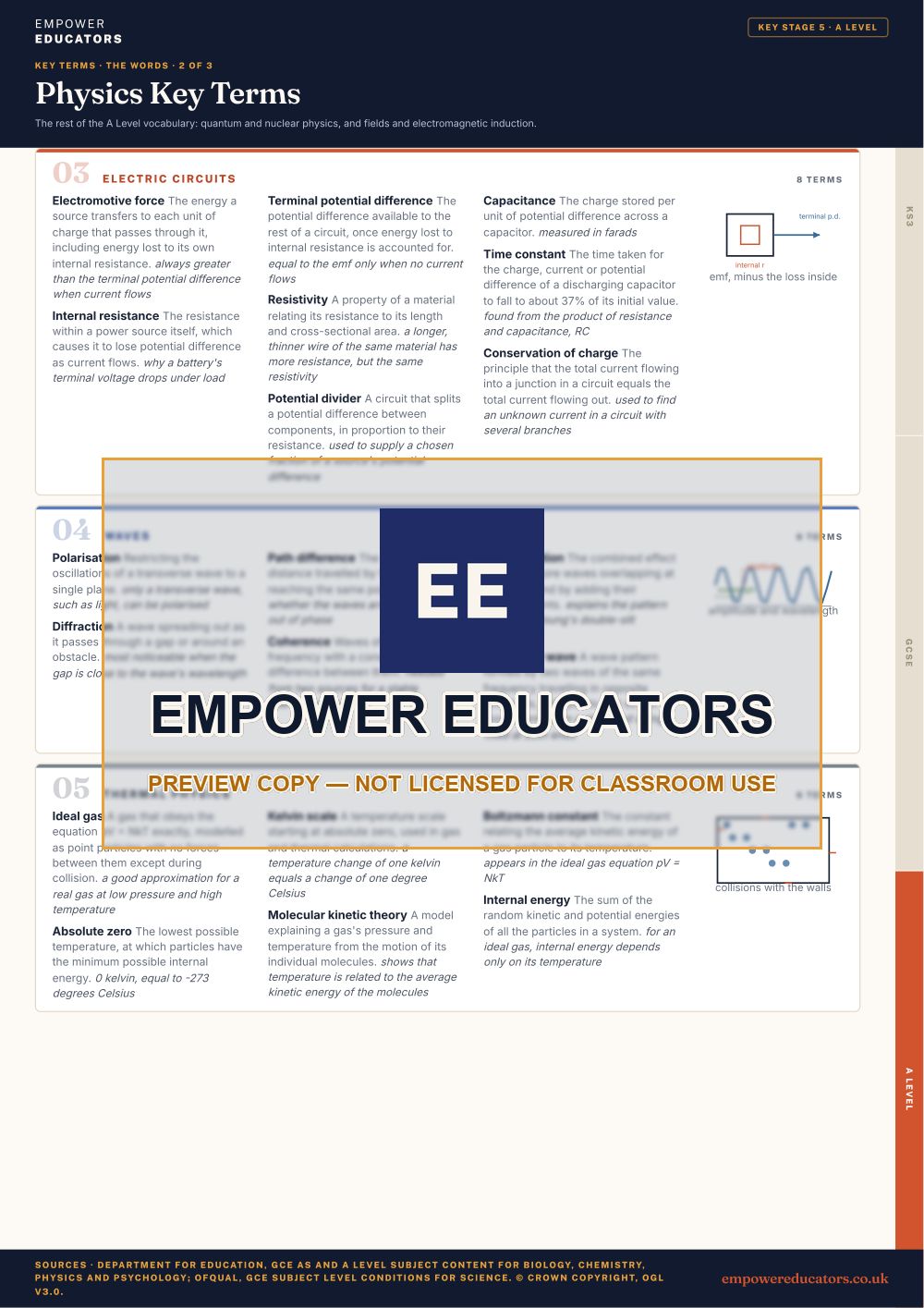
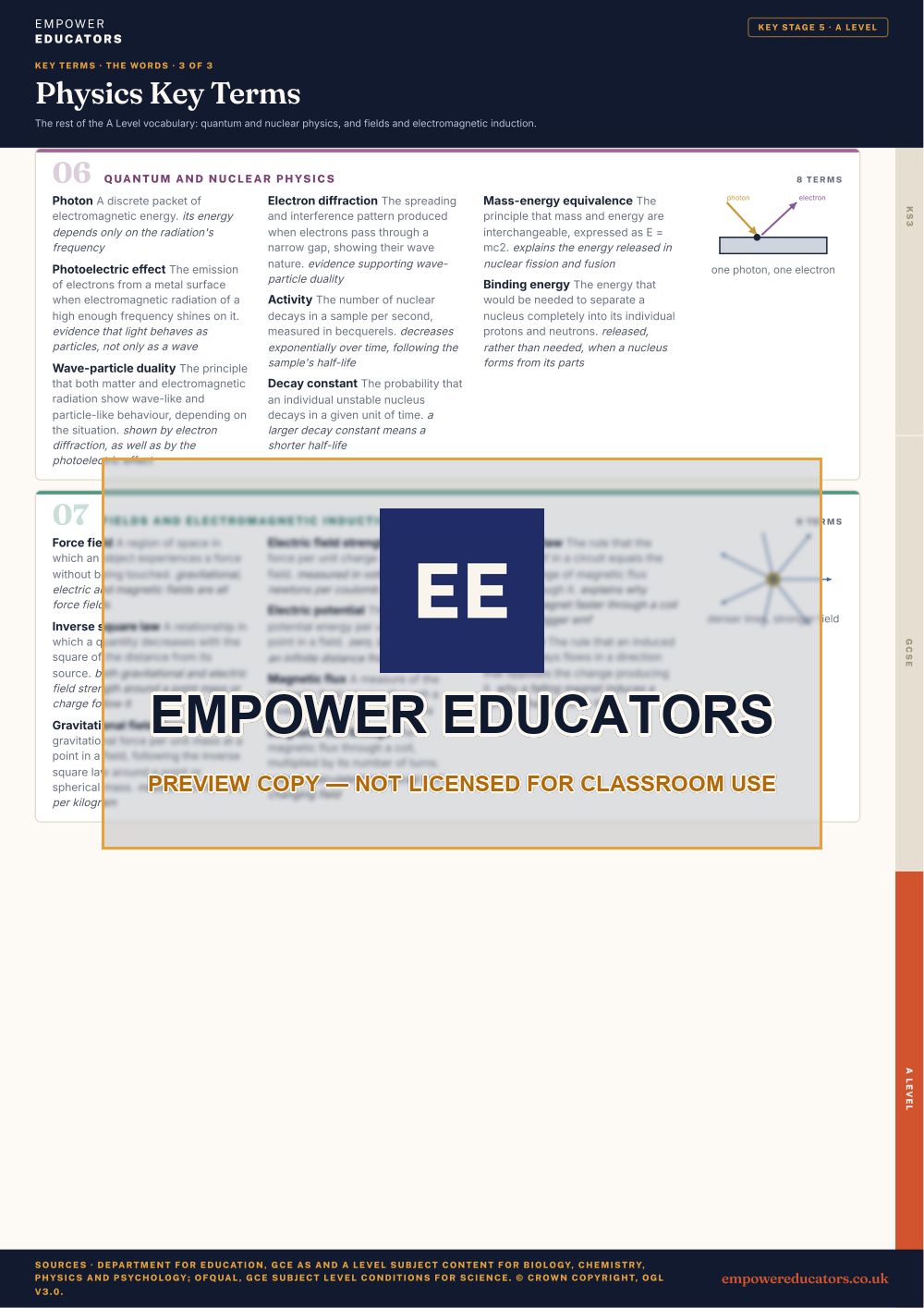
Every word a physics department teaches, Year 7 to A Level, in one A4 book. Each key stage gets its own pages: the terms grouped the way they are taught rather than alphabetically, a definition that fits on two lines, and a worked example beside almost every one. Each key stage opens on one large drawing instead of a list: a crate pushed against friction at Key Stage 3, a free body diagram with a resultant force at GCSE, a vector resolved into components alongside a satellite's orbit at A Level — three genuinely different drawings, because the curriculum teaches three genuinely different ideas of a force, not one picture redrawn three times. GCSE then follows the DfE's own physics content in order: forces and motion, energy, waves and the electromagnetic spectrum, electricity, magnetism and electromagnetism, the particle model of matter, atomic structure, and space physics; A Level adds mechanics, the mechanical properties of materials, electric circuits, thermal physics, quantum and nuclear physics, and fields and electromagnetic induction. Nineteen small diagrams are drawn where a sentence will not do, including a wave's amplitude and wavelength, alpha, beta and gamma penetrating different barriers, and a force-extension graph. Then a page on using the words: the ones the assessment itself is written in, the false friends that mean something else in a physics classroom, the same point written weakly and then properly, and what each word becomes at the next key stage.



Ready for the classroom
Get the clean copy
You have seen the whole layout of all 12 sheets, with part of each blurred in the preview. What you buy is the same set without the watermark or the blur, at full print resolution, ready to run off for every class in the department.
- Every sheet with no watermark, at print resolution
- 5 print-and-use templates
- Referenced to Key Stage 3 follows the national curriculum in England, science programmes of study (September 2013); GCSE follows the DfE's Biology, Chemistry and Physics GCSE subject content (June 2015) and Ofqual's GCSE subject level conditions and requirements for single science; A Level follows the DfE's GCE AS and A level subject content for biology, chemistry, physics and psychology (April 2014), Appendix 3, and Ofqual's GCE subject level conditions for science, which also sets physics' own higher mathematical-content requirement, at least 40% of the assessment; 153 of 193 terms appear by name in one of those documents, the remainder being standard physics vocabulary defined here in plain English, as a glossary does; no awarding body is named, and the only named laws used are universal physics nomenclature — Newton's three laws, Hooke's, Ohm's, Faraday's and Lenz's laws, Fleming's left-hand rule — never anything a specification decides for itself
- Instant PDF download, yours to keep and reproduce across the school that buys it — not for other schools