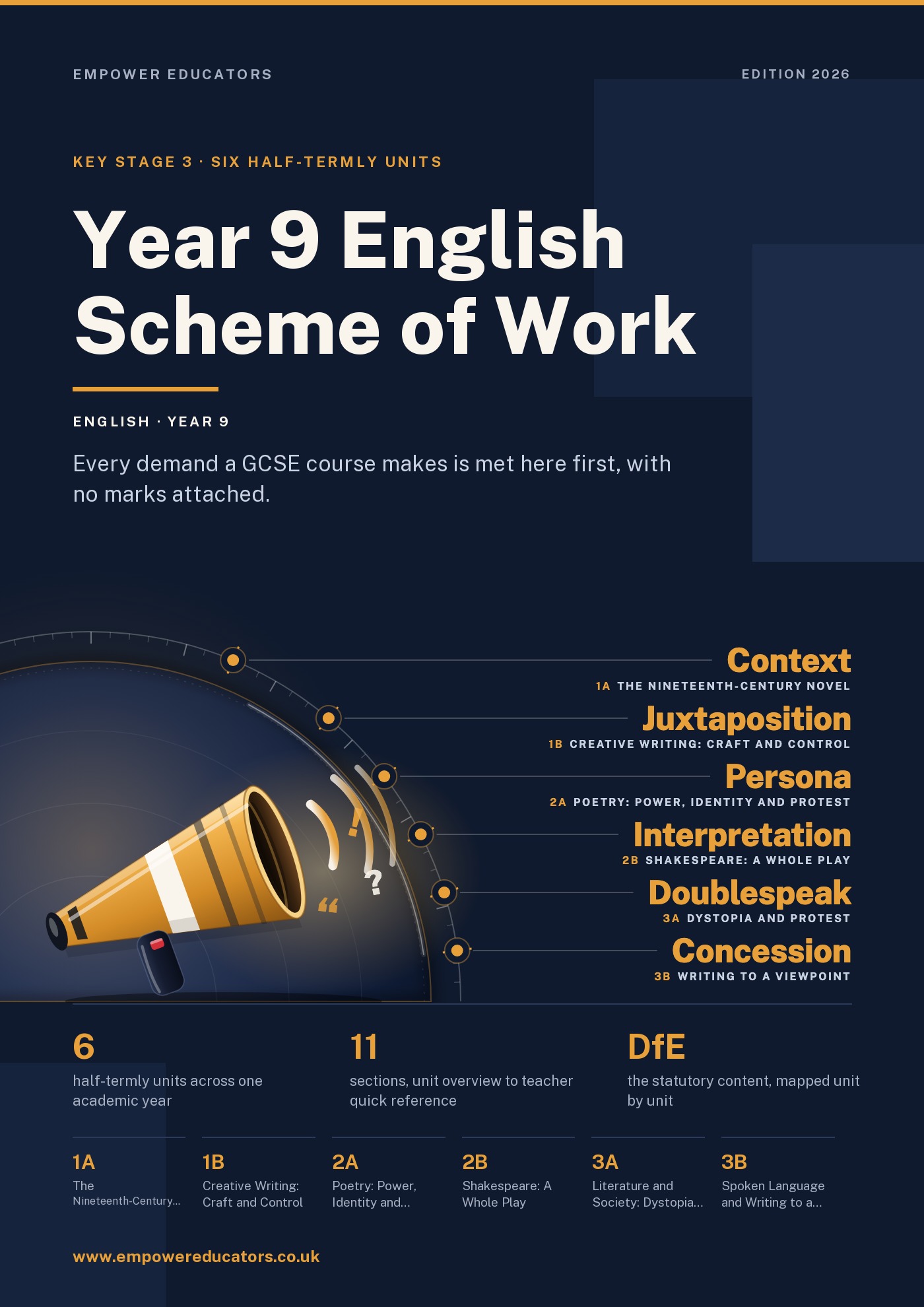
Six half-term units, in the order we teach them: a nineteenth-century novel, crafted creative writing, poetry of power and protest, a whole Shakespeare play, dystopia and protest, and a formal presentation with a viewpoint article. Below is what each unit asks of pupils, what they read and the grammar it carries, taken from our Year 9 English scheme of work.
Six half-termly units forming the bridge to GCSE. Every demand a GCSE course makes — a whole nineteenth-century novel, a whole Shakespeare play, comparison across periods, structured creative writing, viewpoint writing and a formal spoken assessment — is met here first, with no marks attached.
Year 9 means ages 13–14, or S2–S3 in Scotland.
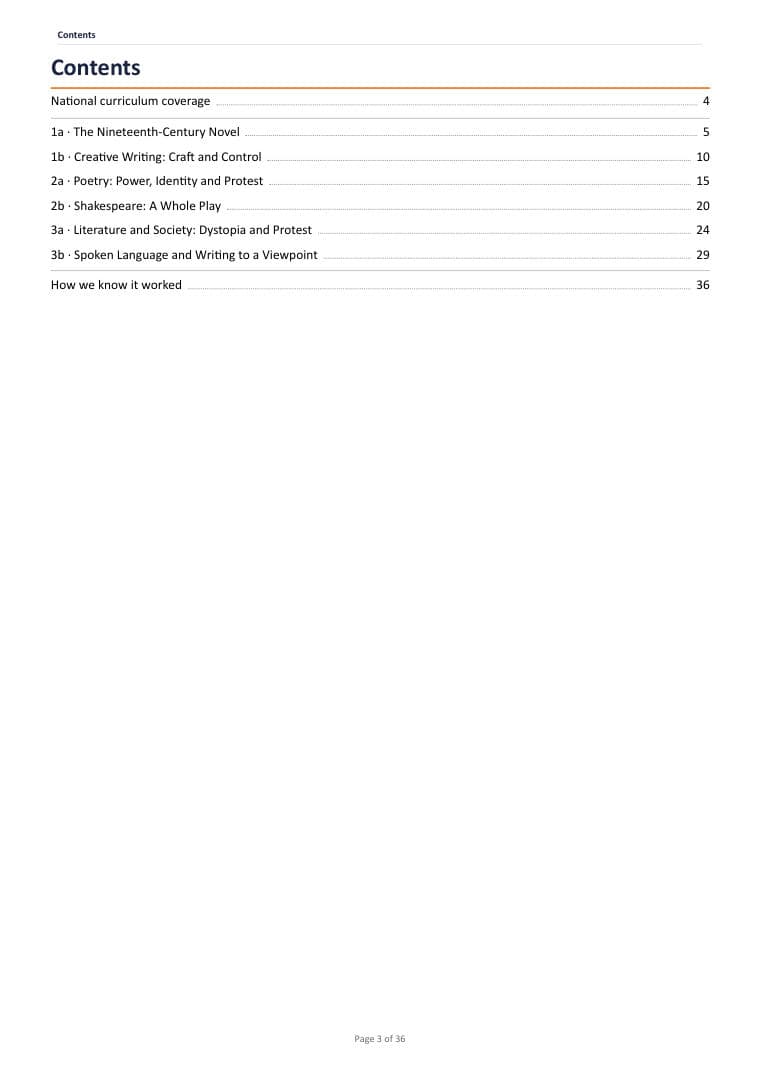
The year, unit by unit
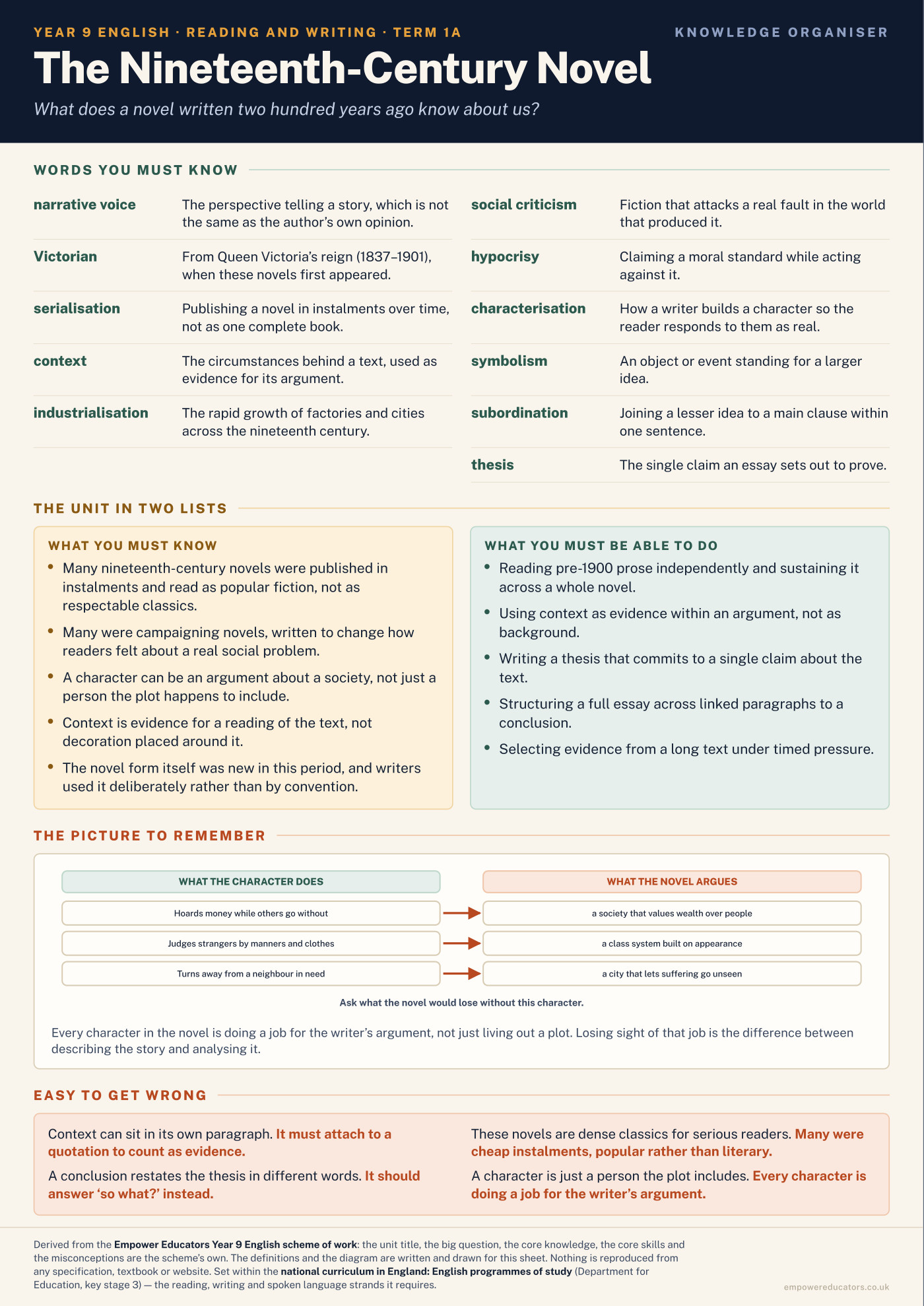
The Nineteenth-Century Novel
Unit 1a · Autumn 1 · approx. 7 weeks · September – October
What does a novel written two hundred years ago know about us?
Pupils produce
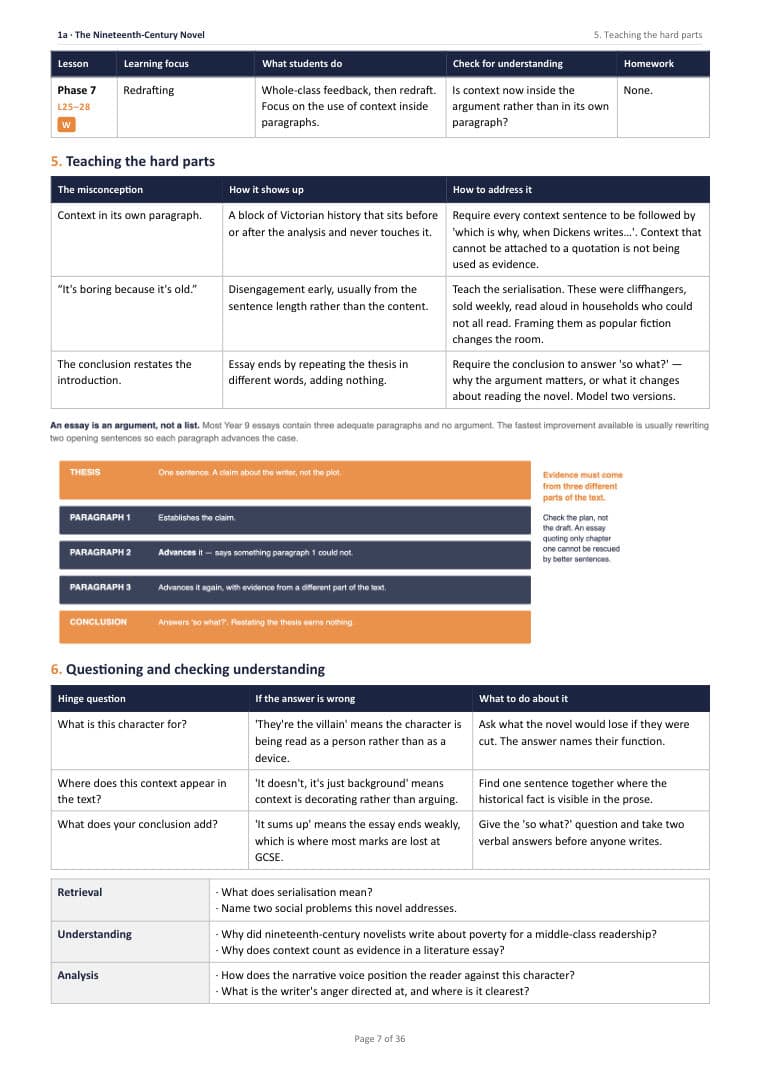
An essay on how the writer uses one character to criticise the society they lived in.
They read
One nineteenth-century novel or novella, all public domain and free to print: A Christmas Carol (Dickens, 1843), The Strange Case of Dr Jekyll and Mr Hyde (Stevenson, 1886), Great Expectations (Dickens, 1861), Jane Eyre (Brontë, 1847).
Grammar focus
Nineteenth-century syntax read fluently; using subordination to hold a complex claim in one sentence
Creative Writing: Craft and Control
Unit 1b · Autumn 2 · approx. 7 weeks · November – December
What separates writing that is correct from writing that is good?
Pupils produce
One piece of narrative or descriptive writing of about 700 words, crafted through three drafts.
They read
Short, complete models: opening pages of the Year 9 novel, published short stories, and the strongest pieces from previous cohorts.
Grammar focus
The deliberate fragment; the semicolon; paragraph length as a structural signal
Poetry: Power, Identity and Protest
Unit 2a · Spring 1 · approx. 6 weeks · January – February
Who gets to speak, and who decides?
Pupils produce
A comparative essay on how two poets from different periods write about power.
They read
A cluster on power and identity across periods. Public domain: Shelley's Ozymandias, Blake, Wordsworth, Barrett Browning. In copyright, so licence or buy: Carol Ann Duffy, John Agard, Imtiaz Dharker, Jackie Kay, Warsan Shire.
Grammar focus
Syntax as meaning — where a poet places the subject and why; inversion
Shakespeare: A Whole Play
Unit 2b · Spring 2 · approx. 6 weeks · February – April
Does a play mean what the writer intended, or what this production decides?
Pupils produce
An essay on how Shakespeare presents one theme across the whole play.
They read
One complete play, uncut or lightly cut: Romeo and Juliet or Macbeth. Public domain — print, cut and adapt freely.
Grammar focus
Shakespeare's syntax read at speed; quoting from verse with accurate line breaks
Literature and Society: Dystopia and Protest
Unit 3a · Summer 1 · approx. 6 weeks · April – May
What is a writer trying to stop from happening?
Pupils produce
An essay on how one writer uses an imagined society to argue about a real one.
They read
Nineteen Eighty-Four or Animal Farm (George Orwell). Orwell died in 1950, so both are public domain in the UK from 2021 — free to print here, though the position differs in other territories. Alternatives in copyright: The Hunger Games (Collins), Noughts & Crosses (Blackman), The Handmaid's Tale (Atwood, Year 10 and above).
Grammar focus
Euphemism and nominalisation as instruments of political control — the grammar of hiding, revisited from Year 8
Spoken Language and Writing to a Viewpoint
Unit 3b · Summer 2 · approx. 6 weeks · June – July
Can you argue well for something you do not believe?
Pupils produce
A formal presentation with questions taken, and a viewpoint article written to a brief.
They read
Real viewpoint journalism — columns and op-eds from outlets with different positions. Recorded presentations and speeches for delivery models.
Grammar focus
Concessive subordination — 'although', 'while it is true that' — and the sentence structures that carry a concession
The texts are suggestions, not requirements. The scheme works with a different novel or
anthology, because the skills sequence is what matters.
How it meets the key stage 3 programme of study
The scheme maps each requirement of the statutory programme of study for key stage 3 (Department for Education, 2013) to the unit that teaches it. Pupils
should be taught to…
develop an appreciation and love of reading, and read increasingly challenging material independently
1a whole nineteenth-century novel · 2a poetry across two centuries · 2b whole Shakespeare play · 3a modern novel · 3b viewpoint journalism
write accurately, fluently, effectively and at length for pleasure and information
1b 700-word crafted piece through three drafts · 3b viewpoint article to a brief · full essays in 1a, 2a, 2b and 3a
consolidate and build on their knowledge of grammar and vocabulary
Named grammar focus in every unit: Victorian syntax (1a) · fragments and semicolons (1b) · syntax as meaning (2a) · quoting verse (2b) · euphemism and nominalisation (3a) · concessive structures (3b)
This year meets every GCSE demand a year early and without marks attached, which is the whole design. The risk is the opposite of a gap: it is heavy. Two whole texts in the autumn and a full play in the spring is a lot of reading, and a department under time pressure will be tempted to cut Unit 1a to extracts. Do not — the whole-text reading is what Year 9 is for, and extracts can be taught at any point afterwards.
The Year 9 English resources
Two PDFs sit behind this page, and they are meant to be used together: the
scheme of work to plan the year, the knowledge organisers to put in front of pupils.
The statutory programme of study for key stage 3 English (DfE, 2013)· 36 pages, 11 sections ·For heads of English, subject leaders and every teacher who has to deliver it
This site works the same either way. Measurement — Google Analytics and Microsoft
Clarity — only runs if you say yes, and it is used to see which resources people
actually reach.Measurement only runs if you say yes.What is collected.