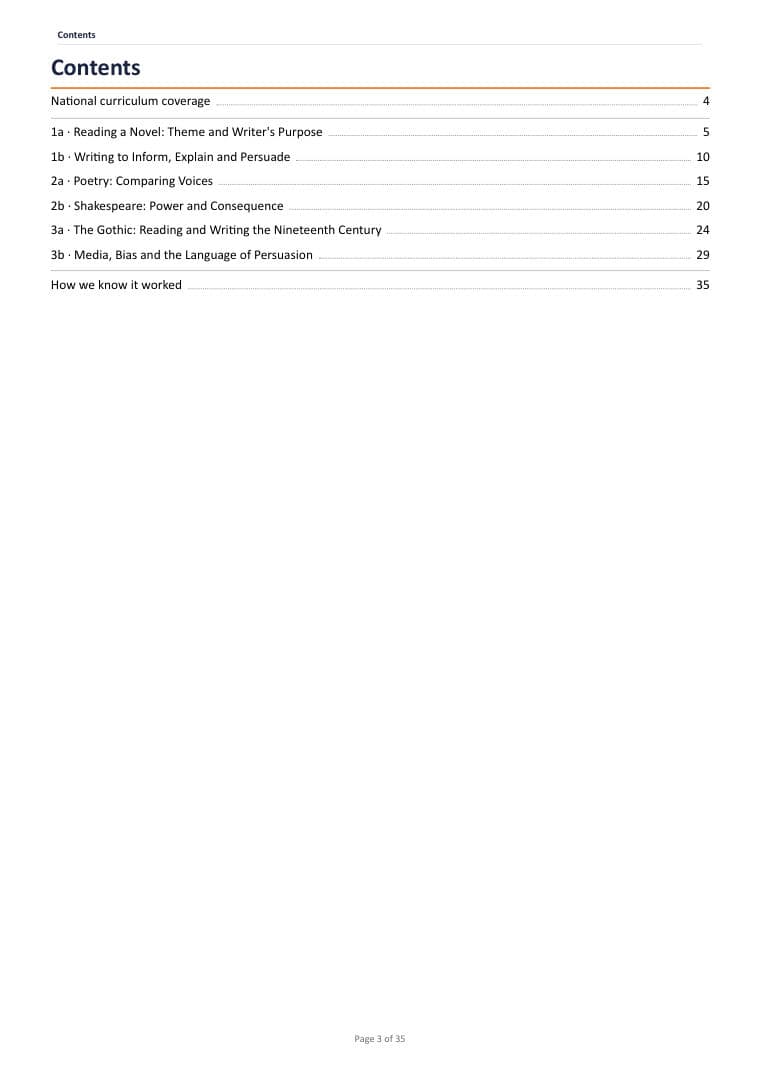
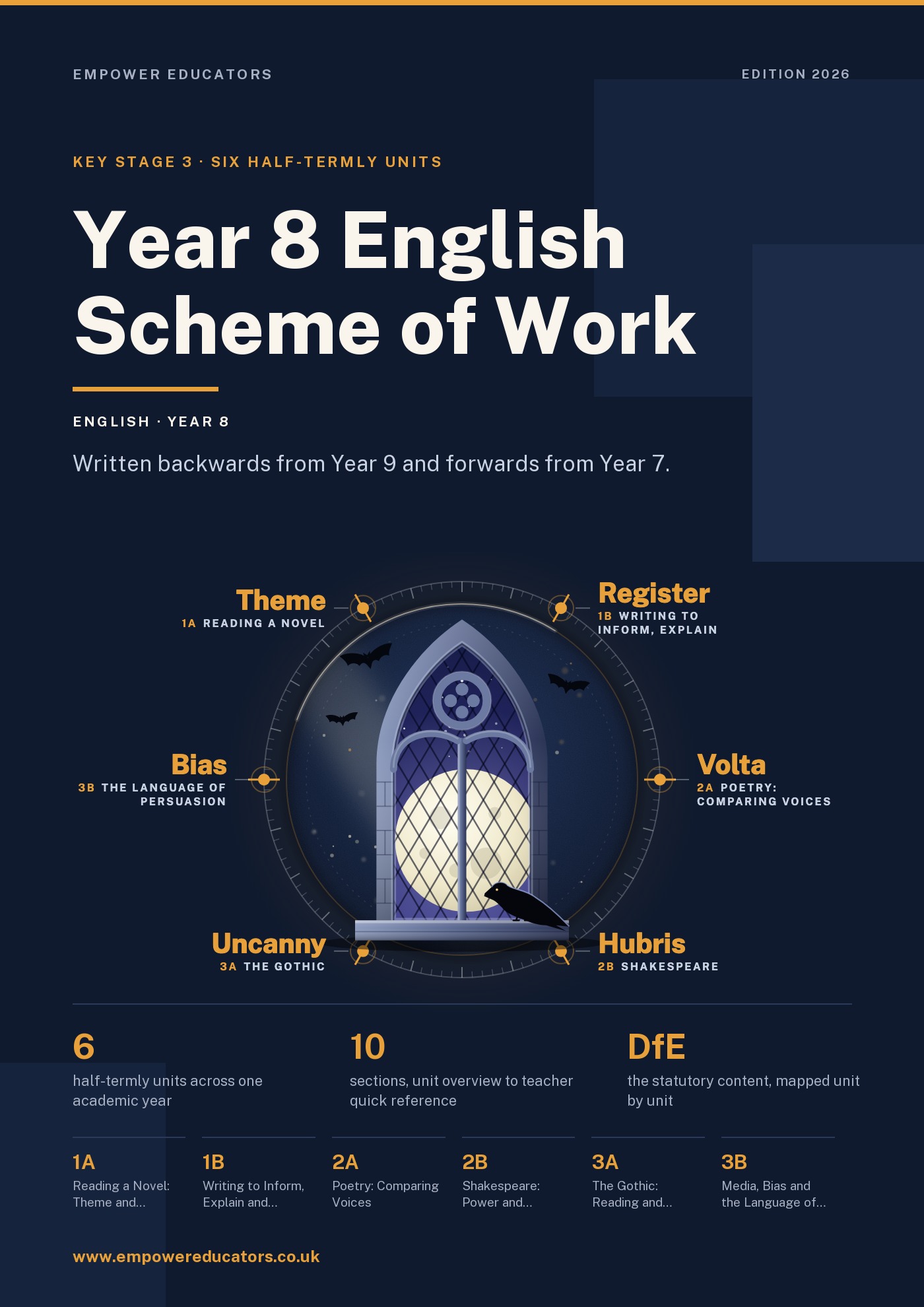
Six half-term units, in the order we teach them: a novel read for theme and a writer’s purpose, writing for different readers, comparing poets, a Shakespeare tragedy, the Gothic, and a unit on media and bias. Below is what each unit asks of pupils, what they read and the grammar it carries, taken from our Year 8 English scheme of work.
Six half-termly units written backwards from Year 9 and forwards from Year 7. The year adds the three things Year 9 assumes: comparison, control of register for a named audience, and sustained reading of pre-1900 prose.
Year 8 means ages 12–13, or S1–S2 in Scotland.
The year, unit by unit
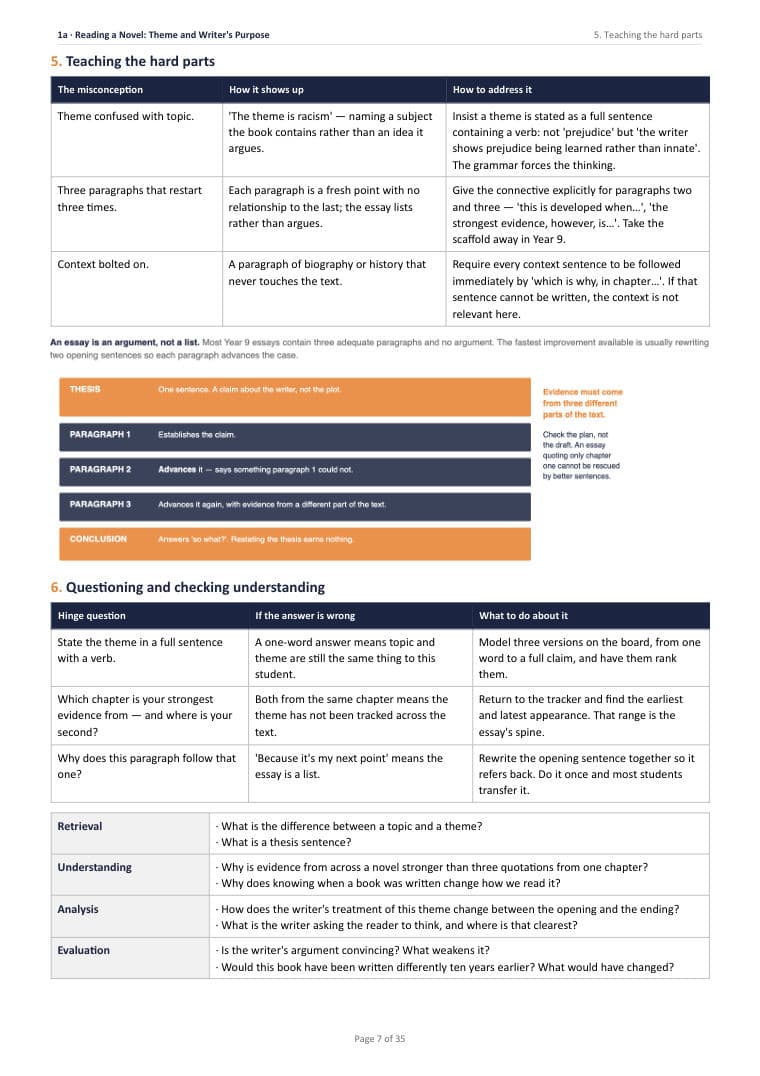
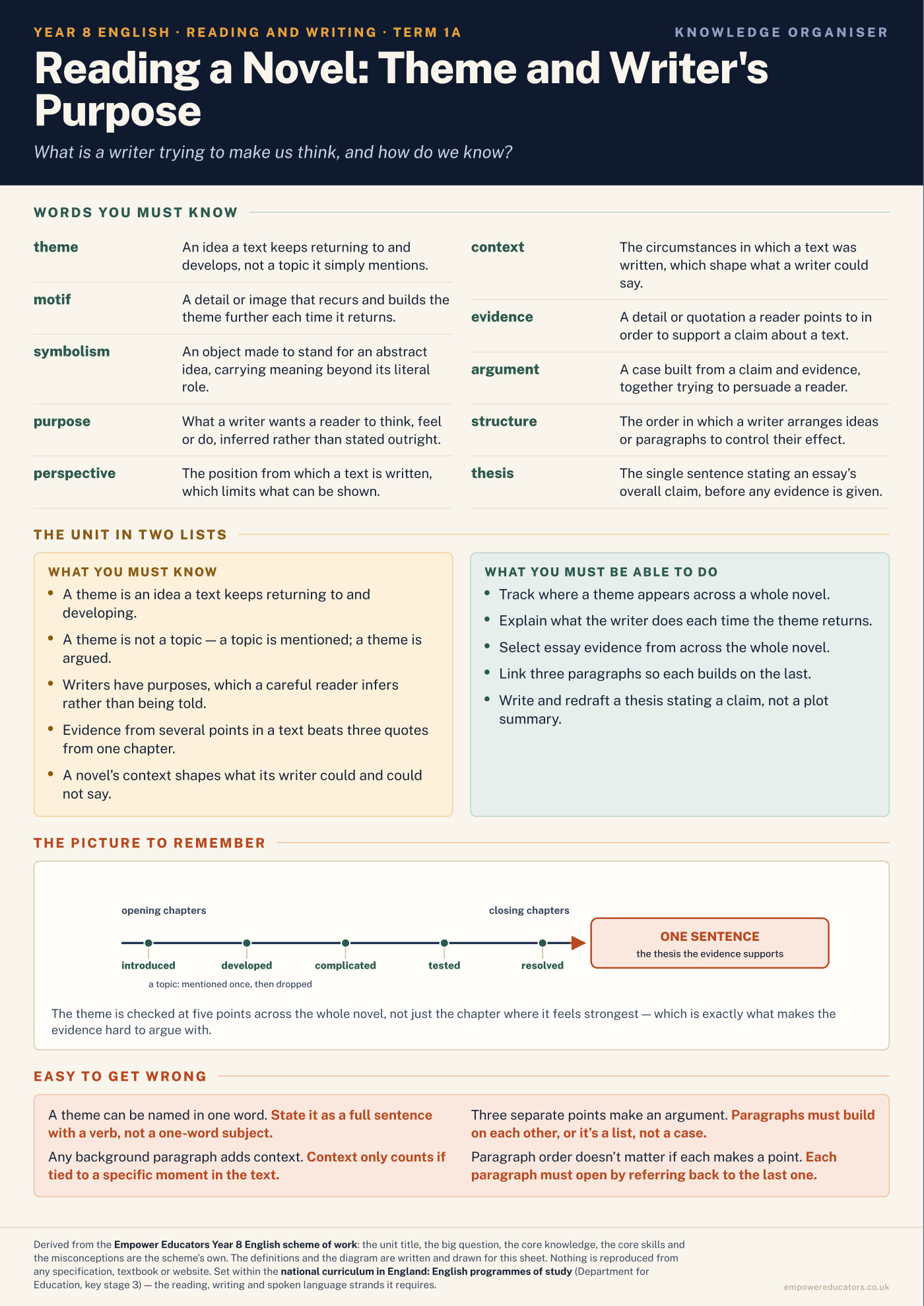
Reading a Novel: Theme and Writer's Purpose
Unit 1a · Autumn 1 · approx. 7 weeks · September – October
What is a writer trying to make us think, and how do we know?
Pupils produce
An essay of three paragraphs on how the writer explores one theme across the novel.
They read
One whole-class novel with a clear thematic spine. Strong Year 8 options: Noughts & Crosses (Malorie Blackman), A Monster Calls (Patrick Ness), The Curious Incident of the Dog in the Night-Time (Mark Haddon), Coram Boy (Jamila Gavin). All in copyright — buy a class set.
Grammar focus
Subordinate clauses to show relationship between ideas; connectives that argue rather than list
Writing to Inform, Explain and Persuade
Unit 1b · Autumn 2 · approx. 7 weeks · November – December
How does a writer change the way they sound for a different reader?
Pupils produce
Two pieces on the same subject for different audiences and purposes, with a written commentary.
They read
Real non-fiction models: a broadsheet article, a charity appeal, a set of instructions, a review, a formal letter. Use current, real examples — students spot invented ones immediately.
Grammar focus
Formality: passive and active voice; modal verbs; nominalisation and when it helps
Poetry: Comparing Voices
Unit 2a · Spring 1 · approx. 6 weeks · January – February
Two poets, one subject — why do they sound nothing like each other?
Pupils produce
A comparative response to two poems on a shared theme.
They read
A cluster of poems on one theme — conflict works well at Year 8. Public domain and free to print: Wilfred Owen, Rupert Brooke, Isaac Rosenberg, Tennyson. In copyright, so buy or licence: Carol Ann Duffy, Simon Armitage, Imtiaz Dharker, Jackie Kay.
Grammar focus
Comparative connectives that argue — 'whereas', 'by contrast', 'similarly' — used inside a sentence rather than to open one
Shakespeare: Power and Consequence
Unit 2b · Spring 2 · approx. 6 weeks · February – April
What makes a good person do a terrible thing?
Pupils produce
An essay paragraph on how Shakespeare presents a character's change, plus a performed soliloquy.
They read
Macbeth, cut to about 75 minutes of playing time — the shortest tragedy and the one Year 8 handles best. Romeo and Juliet works if the department prefers it. Public domain: print freely.
Grammar focus
Verse and prose as a grammatical choice; imperatives and questions in soliloquy
The Gothic: Reading and Writing the Nineteenth Century
Unit 3a · Summer 1 · approx. 6 weeks · April – May
Why does a two-hundred-year-old ghost story still work?
Pupils produce
A Gothic opening of about 400 words, plus an analysis of how one nineteenth-century writer builds fear.
They read
All public domain and free to print in full: Mary Shelley's Frankenstein (1818), Edgar Allan Poe's short stories, Bram Stoker's Dracula (1897), Elizabeth Gaskell's ghost stories, Charles Dickens's The Signalman (1866).
Grammar focus
The semicolon and the long sentence; subordination stacked deliberately, as nineteenth-century writers use it
Media, Bias and the Language of Persuasion
Unit 3b · Summer 2 · approx. 6 weeks · June – July
How do you know when you are being sold something?
Pupils produce
A comparative analysis of how two sources report the same event, and a piece of persuasive writing with a commentary.
They read
Two or more real reports of the same recent event, from outlets with different positions. Plus advertising, and one piece of sponsored content that does not announce itself.
Grammar focus
How grammar carries bias — passive voice to hide an actor, nominalisation to hide a cause
The texts are suggestions, not requirements. The scheme works with a different novel or
anthology, because the skills sequence is what matters.
How it meets the key stage 3 programme of study
The scheme maps each requirement of the statutory programme of study for key stage 3 (Department for Education, 2013) to the unit that teaches it. Pupils
should be taught to…
develop an appreciation and love of reading, and read increasingly challenging material independently
write accurately, fluently, effectively and at length for pleasure and information
1b two pieces for different audiences plus commentary · 3a Gothic opening · 3b persuasive writing plus commentary · essays in 1a, 2a and 2b
consolidate and build on their knowledge of grammar and vocabulary
Named grammar focus in every unit: subordination (1a) · formality, voice and modality (1b) · comparative connectives (2a) · verse and prose (2b) · semicolons and long sentences (3a) · the grammar of bias (3b)
speak confidently and effectively
2b performed soliloquy · 1b register aloud · 2a recital and argument · 3a reading for atmosphere · structured discussion in 1a and 3b
This year deliberately front-loads the pre-1900 reading that Year 9 and GCSE both assume, and it does so with public-domain texts in Unit 3a so the cost is nil. If 3a is dropped or shortened, students meet nineteenth-century prose for the first time in Year 9 alongside a whole novel, which is a much harder place to start. Check that before reordering.
The Year 8 English resources
Two PDFs sit behind this page, and they are meant to be used together: the
scheme of work to plan the year, the knowledge organisers to put in front of pupils.
The statutory programme of study for key stage 3 English (DfE, 2013)· 35 pages, 10 sections ·For heads of English, subject leaders and every teacher who has to deliver it
This site works the same either way. Measurement — Google Analytics and Microsoft
Clarity — only runs if you say yes, and it is used to see which resources people
actually reach.Measurement only runs if you say yes.What is collected.