English · KS3 to A Level · £4.99
English
Key Terms
Every word an English department teaches, Year 7 to A Level, in one A4 book — Language and Literature both. Each key stage gets its own pages: the terms grouped the way they are taught rather than alphabetically, a definition that fits on two lines, and a worked example beside almost every one. Each key stage opens on one large annotated passage instead of a drawing — a sentence marked up for grammar at Key Stage 3, an extract marked up for analysis at GCSE, a paragraph read for what it implies at A Level — and the numbers on it appear again beside the same words in the list. Then a page on using the words: the ones the assessment itself is written in, the false friends that mean something else in an English classroom, the same point written weakly and then properly, and what each word becomes at the next key stage.
£4.99The whole book, Year 7 to A Level, 16 pages
- A4 PDF
- every page shown, part-blurred
- instant download
One purchase covers the school that buys it. Print it, copy it, hand it round your department. Not for passing to other schools or uploading anywhere.
PDF download, ready straight after payment. Downloading it ends the 14-day right to cancel; a file that is faulty or not as described is always refunded. Refunds
Read before publication by the serving head of that department and by senior leaders, in school.
5.0 from 24+ reviews on Google
Schools that have bought from Empower Educators include Nottingham High School, Northampton High School GDST and Sutton Valence School.
Complete your English

Everything else this site has for English: English teaching resources
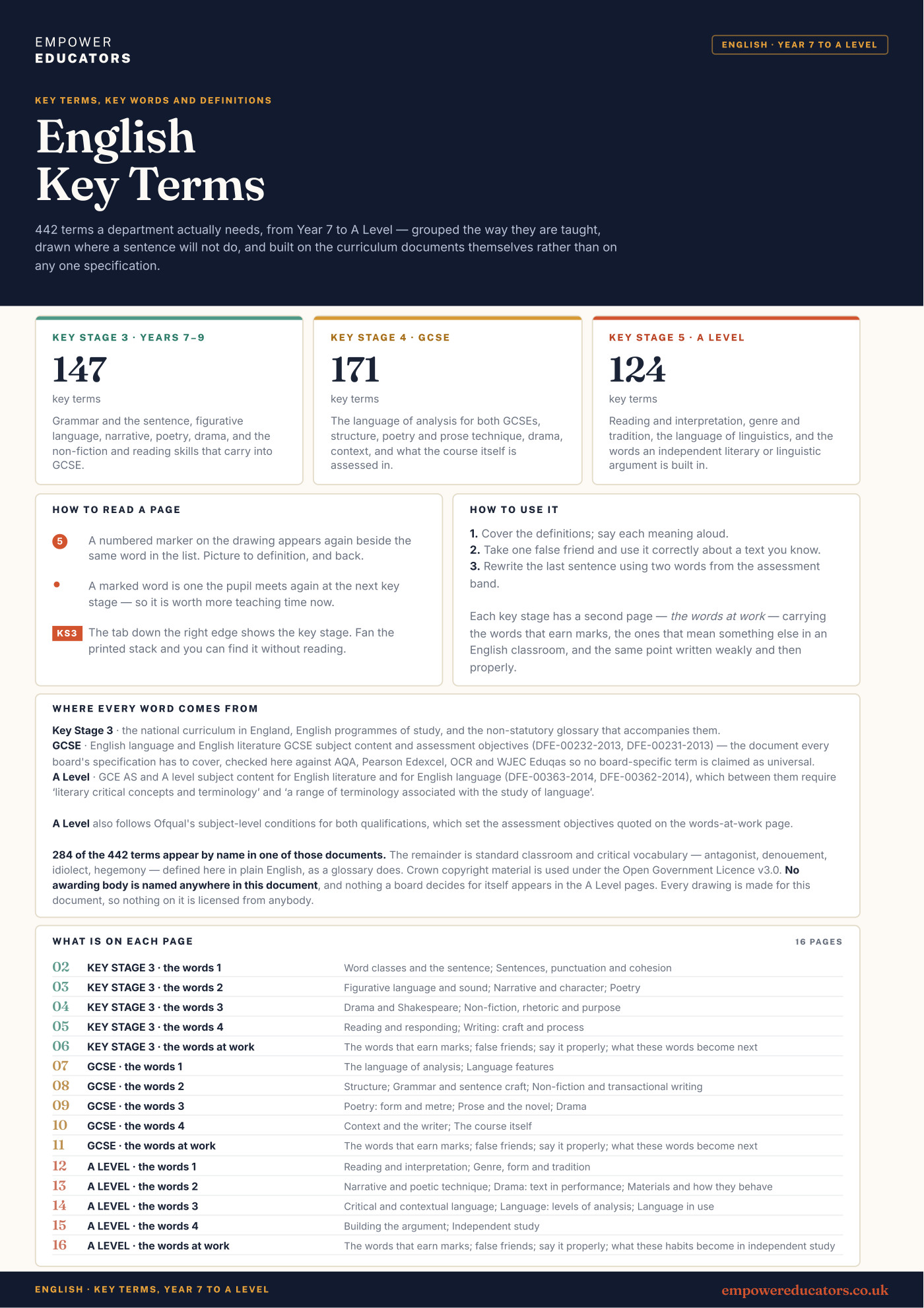
A pupil who knows a word is not yet using it. This book is built around that gap. The words for each key stage sit in the groups they are taught in, each with a short definition and a worked example, and a marked word is one the pupil meets again at the next key stage, so a department can see where its vocabulary carries forward and where it changes name. Instead of a drawing — English is a language subject, not a visual one — each key stage opens on one real sentence, extract or paragraph, annotated: the words sit on the language itself, numbered, so a pupil can go from the picture to the definition and back.
Every key stage closes on a page about using the words. The words the assessment is written in, quoted from the DfE where they are theirs. The false friends: register, context, form, tense, draft, canon, which a pupil already owns in another sense — each one contrasted with what it actually means, not just told it is wrong. The same point written weakly and then properly. And a table of what each habit is called at the next stage, so "spotting techniques" in Year 9 is already "analysing how writers use language and structure" by the time it is assessed at GCSE. Nothing a board decides for itself is in it, and no text is quoted beyond a handful of public-domain lines used exactly as examples are meant to be: every annotated passage was written for the book.
- Written to
- The DfE's national curriculum programmes of study for English at Key Stage 3 and its non-statutory glossary, the English Language and English Literature GCSE subject content (DFE-00232-2013, DFE-00231-2013), and the GCE AS and A level subject content for English Literature and English Language, with Ofqual's GCE subject level conditions; checked against AQA, Pearson Edexcel, OCR and WJEC Eduqas so no board-specific term is claimed as universal; most terms appear by name in one of those documents and the cover says how many, the rest are standard classroom and critical vocabulary; no awarding body is named, and nothing a board decides for itself appears in the A Level pages
- Intended for
- English departments: printed one per pupil, kept in the front of an exercise book, or put on the wall by key stage
- Extent
- 16 pages · 15 sections
Look inside
Real pages, straight from the PDF
Click any page to see it full size.
Contents
All 15 sections
Taken from the book’s own contents page, so the page numbers are the real ones.