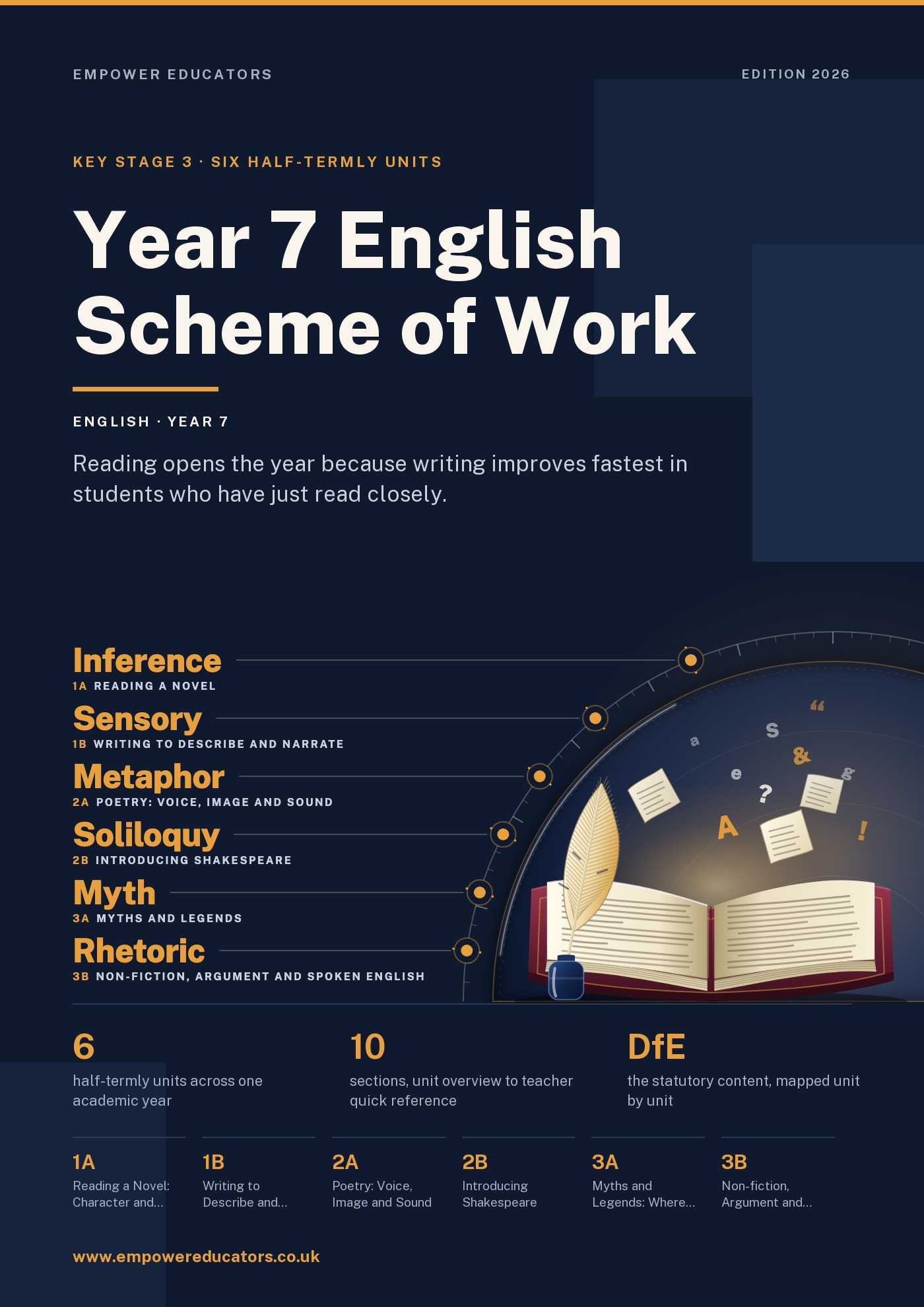
Six half-term units, in the order we teach them: a novel, descriptive and narrative
writing, poetry, an introduction to Shakespeare, myths and legends, and a researched
speech to finish. Below is what each unit asks of pupils, what they read and the
grammar it carries, taken from our Year 7 English scheme of work.
Reading opens the year because writing improves fastest in students who have just read closely, and spoken English closes it because it draws on everything the other five units build.
The speech in the last unit is assessed, which is how the scheme keeps spoken English from
being squeezed out when time runs short. Year 7 means ages 11–12, or P7–S1 in Scotland.
The year, unit by unit
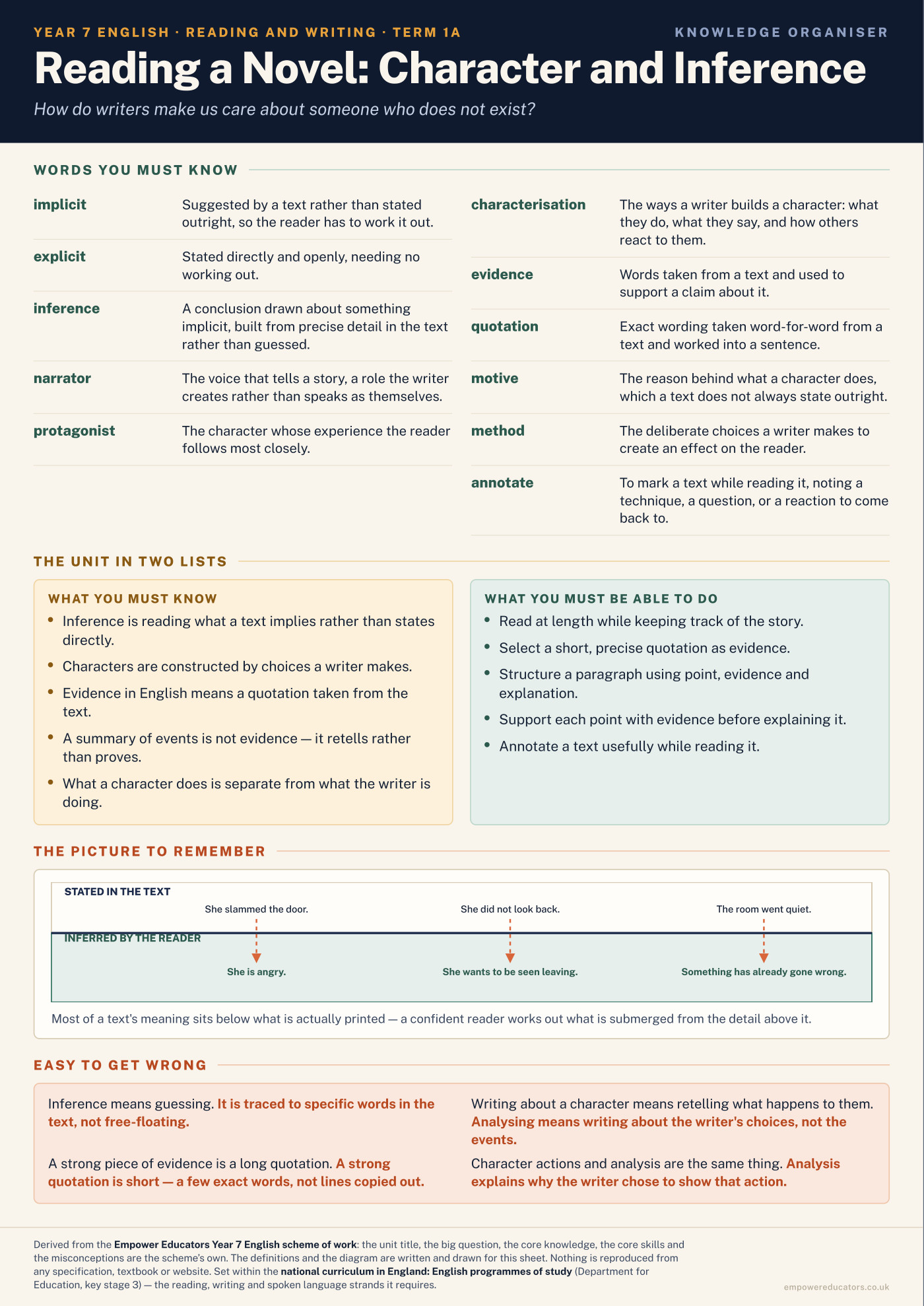
Reading a Novel: Character and Inference
Unit 1a · Autumn 1 · approx. 7 weeks · September – October
How do writers make us care about someone who does not exist?
Pupils produce
An analytical paragraph on how the writer presents one character, using evidence and inference.
They read
One whole-class novel, chosen by the department. Strong Year 7 options: Skellig (David Almond), Holes (Louis Sachar), Refugee Boy (Benjamin Zephaniah), The Boy at the Back of the Class (Onjali Q. Raúf). All in copyright — buy a class set.
Grammar focus
The sentence as a unit of meaning; subject and verb; using a colon to introduce a quotation
Writing to Describe and Narrate
Unit 1b · Autumn 2 · approx. 7 weeks · November – December
Why does one piece of writing put a picture in your head and another does not?
Pupils produce
A piece of descriptive or narrative writing, planned, drafted and redrafted, of roughly 500 words.
They read
Short extracts as models, from the Unit 1a novel and from public-domain writers — Dickens and Stevenson describe place better than almost anyone and cost nothing to print.
Grammar focus
Sentence variety: simple, compound and complex; the comma in a complex sentence; strong verbs in place of adverbs
Poetry: Voice, Image and Sound
Unit 2a · Spring 1 · approx. 6 weeks · January – February
Why say it in fourteen lines when you could say it in a paragraph?
Pupils produce
An analytical response to one unseen poem, plus one poem written and performed.
They read
A departmental anthology of six to eight poems. Public domain and free to print: Blake, Wordsworth, Christina Rossetti, Shakespeare's sonnets. Named modern poets to buy or licence: Benjamin Zephaniah, John Agard, Imtiaz Dharker, Grace Nichols.
Grammar focus
Word class and why it matters — a verb chosen as a metaphor does more work than an adjective
Introducing Shakespeare
Unit 2b · Spring 2 · approx. 6 weeks · February – April
Why is a four-hundred-year-old play still worth three hours of your life?
Pupils produce
A performed scene, and a paragraph explaining one character's motivation using the text.
They read
One play, cut to about 60 minutes of playing time. A Midsummer Night's Dream is the usual Year 7 choice and the best one: comic, physical, and the plot survives heavy cutting. The Tempest works if the department prefers it.
Grammar focus
Word order — why Shakespeare puts the verb where he does, and what that does to emphasis
Myths and Legends: Where Stories Come From
Unit 3a · Summer 1 · approx. 6 weeks · April – May
Why do people on opposite sides of the world tell the same stories?
Pupils produce
A retold myth written for a modern reader, with a short written comparison of two traditions.
They read
Greek myths, Norse myths and West African and Caribbean Anansi stories. All traditional and free to print in translation or retelling; use a named modern retelling and credit the reteller.
Grammar focus
Tense consistency in narrative; the past perfect for events before the story's present
Non-fiction, Argument and Spoken English
Unit 3b · Summer 2 · approx. 6 weeks · June – July
What makes someone change their mind?
Pupils produce
A speech, written and delivered, arguing a position the student has chosen and researched.
They read
Real speeches and articles. Public domain and free: Sojourner Truth, Emmeline Pankhurst, Churchill. Modern and in copyright, so link rather than reproduce: Malala Yousafzai's UN address, Greta Thunberg.
Grammar focus
The imperative and the inclusive pronoun; the rule of three; sentence length for emphasis in speech
The texts are suggestions, not requirements. The scheme works with a different novel or
anthology, because the skills sequence is what matters.
How it meets the key stage 3 programme of study
The scheme maps each requirement of the statutory programme of study for key stage 3 (Department for Education, 2013) to the unit that teaches it. Pupils
should be taught to…
develop an appreciation and love of reading, and read increasingly challenging material independently
1a whole novel · 2a poetry anthology · 2b Shakespeare · 3a myths from three traditions · weekly independent reading in every unit
write accurately, fluently, effectively and at length for pleasure and information
1b description and narrative (500 words) · 3a retelling for an audience · 3b speech writing · analytical paragraphs in 1a, 2a and 2b
consolidate and build on their knowledge of grammar and vocabulary
Named grammar focus in every unit: sentence boundaries (1a) · sentence variety (1b) · word class (2a) · word order (2b) · tense (3a) · rhetorical structures (3b)
speak confidently and effectively
2b performance · 3b assessed speech · structured discussion in 1a and 3a · weekly recitation in 2a
All four strands are covered every year, but the balance is deliberate rather than equal: this year is reading-heavy in the autumn and spoken-heavy in the summer, because reading stamina has to be built before it can be used and spoken assessment works better once a class knows each other.
The Year 7 English resources
Two PDFs sit behind this page, and they are meant to be used together: the
scheme of work to plan the year, the knowledge organisers to put in front of pupils.
The statutory programme of study for key stage 3 English (DfE, 2013)· 35 pages, 10 sections ·For heads of English, subject leaders and every teacher who has to deliver it
This site works the same either way. Measurement — Google Analytics and Microsoft
Clarity — only runs if you say yes, and it is used to see which resources people
actually reach.Measurement only runs if you say yes.What is collected.