Psychology · GCSE (Key Stage 4) · £5.99
Year 11 Psychology
Scheme of Work
GCSE Psychology Scheme of Work (SOW) — KS4 Year 11 PDF
Eighty-five pages completing the course: psychological problems, the brain and neuropsychology, two optional topics, and a closing unit that judges reliability, validity and ethics against the research plans students built in Year 10. Four purpose-drawn diagrams and a two-year coverage matrix. The clinical unit is written to be substituted — depression is the one condition all three specifications set, so the second half swaps without touching the other six weeks — and it carries a full page on what to tell your pastoral lead, and when.
£5.99The Year 11 scheme: 4 units, 85 pages
- A4 PDF
- first 8 pages free to read
- instant download
Teaching all of the GCSE course? Year 10 and Year 11 as one set: £9.99, saving £1.99.
One purchase covers the school that buys it. Print it, copy it, hand it round your department. Not for passing to other schools or uploading anywhere.
PDF download, ready straight after payment. Downloading it ends the 14-day right to cancel; a file that is faulty or not as described is always refunded. Refunds
Read before publication by serving senior leaders, in school.
5.0 from 24+ reviews on Google
Schools that have bought from Empower Educators include Nottingham High School, Northampton High School GDST and Sutton Valence School.
Complete your Psychology


Board-neutral, written for AQA, Pearson Edexcel and OCR. All GCSE schemes of work
Both years: GCSE Psychology scheme of work
Everything else this site has for Psychology: Psychology teaching resources
- 3aPsychological Problems: Classification, Explanation and What Helps
- 3bThe Brain and Neuropsychology: How a Gap Becomes a Behaviour
- 4aPerception, and Language, Thought and Communication
- 4bResearch Methods II, the Debates, and Final Preparation
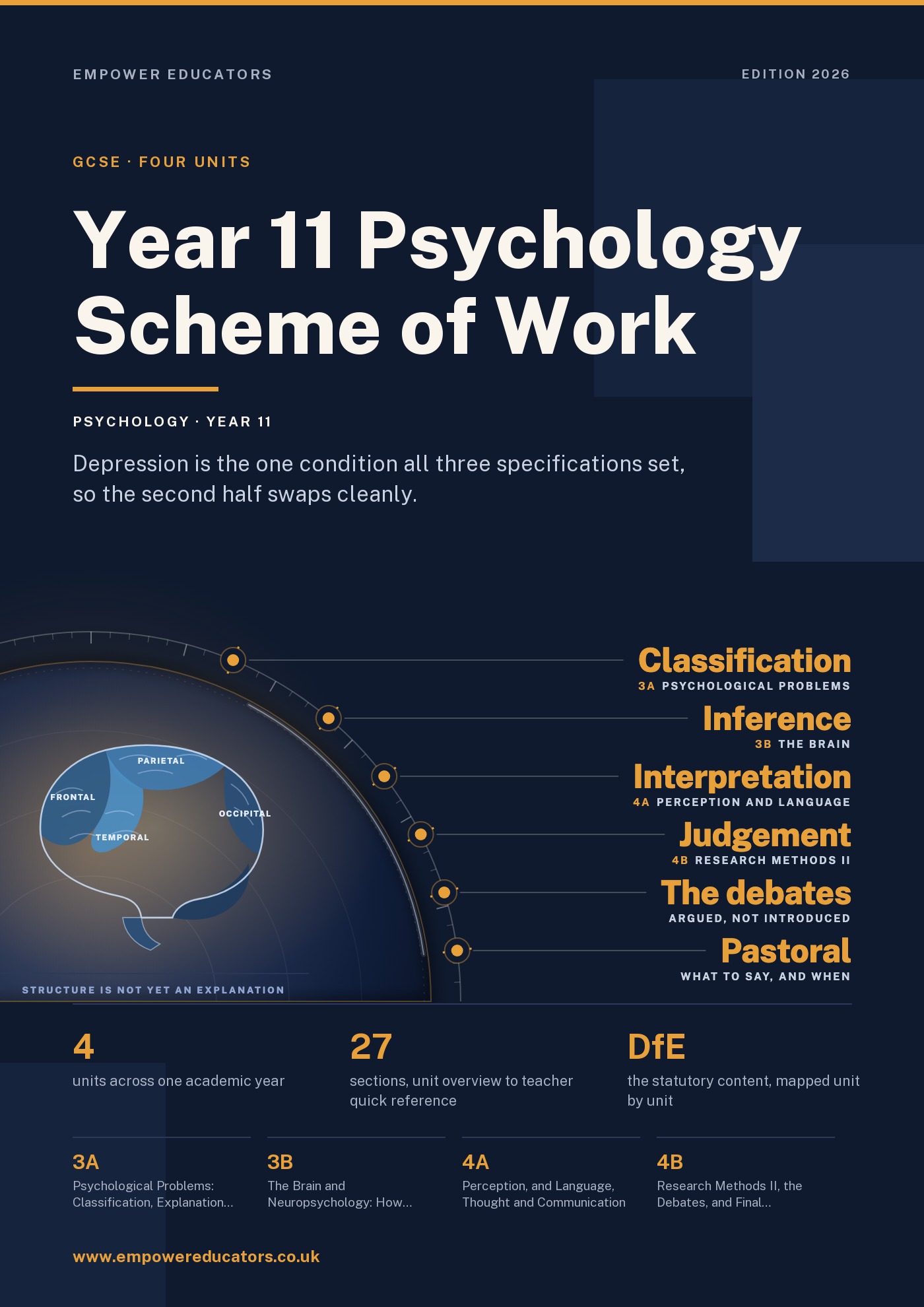
The second year completes the specification and ends in a programme rather than a revision list. Ten sections per unit, the same shape as Year 10, and every promise Year 10 makes about Year 11 is kept and cross-checked: the three research-methods requirements it deliberately held, the five mathematical requirements it placed here, and the debates it met but did not argue.
The clinical unit is the one a senior leader will read first. It teaches classification before either condition, so that characteristics are a set of dimensions rather than a list to self-measure against; it names no prevalence figure, because a number printed in a book is out of date before the cohort sits the paper, and teaches instead the four reasons a recorded figure moves and where to find the current one; and it is explicit about what to tell the pastoral lead, when to tell them, and what to do with a disclosure. A student who does not want to be in the room is told privately the week before and has an exit agreed in advance, so no permission has to be asked for in front of the class.
One point of currency that most material has not caught up with: the Department requires the two conditions to be characterised according to the International Classification of Disease and names no edition, and neither do AQA or Pearson Edexcel. OCR's specification is the exception: a footnote tells teachers to use the most recent version of ICD when starting a two-year course. ICD-11 came into effect in January 2022, replacing ICD-10, so the unit teaches the current classification: the characteristics and what classification is for, not a symptom count learned from an older list.
Research methods closes the course by being used rather than revised: students judge reliability, validity and ethics against the plans they wrote themselves in Year 10, which is why the unit opens by telling departments to keep them. The debates are then argued on four examples the course already owns, not introduced as a new topic in the last half-term.
- Written to
- GCSE subject content: psychology (DfE, DFE-00213-2015) and Ofqual’s GCSE subject level conditions for psychology
- Intended for
- heads of psychology, subject leaders and every teacher who has to deliver it
- Extent
- 85 pages · 27 sections
Look inside
Real pages, straight from the PDF
Click any page to see it full size.
Contents
All 27 sections
Taken from the book’s own contents page, so the page numbers are the real ones.