Psychology · GCSE · £6.99
GCSE Psychology
Questions
& Answers
One hundred questions, each answered three times (weakly, securely and well), with the marks each earns and a paragraph naming the one thing that separates them. Memory, development, psychological problems, social influence, the brain, research methods with its calculations and graphs, the further topics and the debates, each with a real mark scheme. Written against the Department for Education subject content and read against all three current specifications, so where the boards genuinely differ the page says so in each board's own words.
£6.99100 questions, each answered three times (weak, middling, strong), 112 pages
- A4 PDF
- first 14 pages free to read
- instant download
One purchase covers the school that buys it. Print it, copy it, hand it round your department. Not for passing to other schools or uploading anywhere.
PDF download, ready straight after payment. Downloading it ends the 14-day right to cancel; a file that is faulty or not as described is always refunded. Refunds
Read before publication by serving senior leaders, in school.
5.0 from 24+ reviews on Google
Schools that have bought from Empower Educators include Nottingham High School, Northampton High School GDST and Sutton Valence School.
Complete your Psychology


Everything else this site has for Psychology: Psychology teaching resources
Also teaching psychology lower down the school, or the exam itself? Psychology scheme of work · GCSE Psychology assessment objectives
- 1Memory
- 2Development
- 3Psychological problems
- 4Social influence
- 5The brain and neuropsychology
- 6Research methods
- 7Further topics
- 8Debates, diversity and putting it together
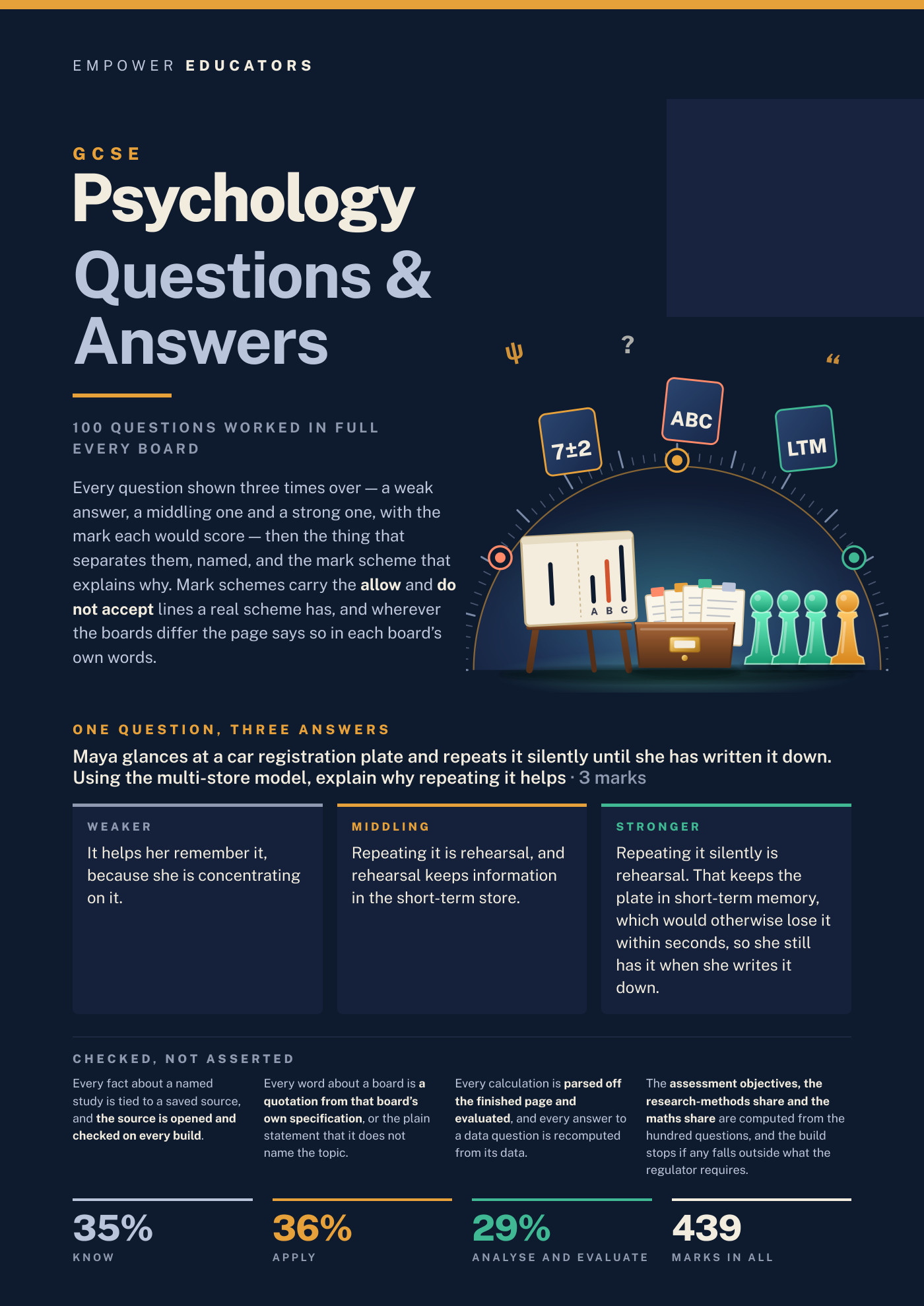
Not a bank of questions with the answers printed underneath. The three banded responses are the starting point, not the output: what follows each one is the discriminator, named out loud, then the questions you actually ask to move a student from the first answer to the last, then the mark scheme that shows what each line was worth.
GCSE Psychology is three courses that share a name. The Department for Education sets the shape and each board fills it differently. AQA and Pearson Edexcel examine depression and addiction; OCR examines depression and schizophrenia. Each board names its own studies. The topics beyond the core are fixed by AQA and OCR and chosen by Edexcel students, two from five. So the book opens with the differences set out in each board's own words, and any page whose content a board leaves out carries a note quoting the three specifications. The opening pages count how many of the hundred sit on each board's own specification.
Every fact about a named study is checked, not remembered. Each finding is tied to a saved source (a board's specification, an open textbook, a study's own abstract) and the build opens the source and fails if the words are not there. An independent read of the finished book still found places where a widely used open textbook gets a famous study wrong, such as the group size at which conformity in Asch's studies stops rising. The book follows the better evidence and says so.
The marks are weighted the way Ofqual weights them. The assessment objectives sit at 35, 35 and 30 per cent by marks, not by question count. Research methods take no less than a fifth of the marks, across all three objectives, and mathematical skills at least a tenth: sampling, percentages, ratios, scatter graphs, frequency tables, the normal distribution and standard form, every calculation recomputed from the built page. The build stops if any of these drifts.
- Written to
- The GCSE subject content for psychology published by the Department for Education, with Ofqual's conditions for the subject and all three current specifications read against it — AQA 8182 version 1.1, Pearson Edexcel 1PS0 Issue 1 and Cambridge OCR J203 version 2.0
- Intended for
- psychology teachers and heads of department. Used with a class, not a student revision guide
- Extent
- 112 pages · 13 sections
Sample questions
Sample GCSE Psychology questions and answers
Four questions from the book, printed exactly as they appear in it: the question, the answers it works through, and the mark each one scores. All of them are in the free preview.
Question 1·Memory·2 marks
State what is meant by encoding in memory.
Weaker0 marks
Remembering something.
Middling1 mark
Putting information into memory.
Stronger2 marks
Changing information into a form, or code, that memory can store.
What separates them
The first answer describes the whole of memory, not the step the question names. The second has the direction right — encoding is the way in — and stops there. What earns the second mark is the word changing: encoding is a conversion, not a doorway. A sound does not enter memory as a sound.
The full-mark answer2 marks
Encoding is the process of changing information that has come in through the senses into a form, or code, that memory can store.
Question 3·Memory·3 marks
Maya glances at a car registration plate and repeats it silently until she has written it down. Using the multi-store model, explain why repeating it helps.
Weaker0 marks
It helps her remember it, because she is concentrating on it.
Middling2 marks
Repeating it is rehearsal, and rehearsal keeps information in the short-term store.
Stronger3 marks
Repeating it silently is rehearsal. That keeps the plate in short-term memory, which would otherwise lose it within seconds, so she still has it when she writes it down.
What separates them
The first answer is not wrong about psychology; it is wrong about the question. Concentrating helps with anything, and the answer names no part of the model. The second names the process and the store, then stops at the label. What takes it to full marks is the link back to Maya: short-term memory loses information in seconds, and she needs it to last until she has written it down.
The full-mark answer3 marks
Repeating the plate silently is rehearsal. Rehearsal keeps the information in short-term memory, which would otherwise lose it within seconds, so Maya still has it when she writes it down.
Question 27·Psychological problems·4 marks
A student fails a test and thinks, ‘I am useless and I always will be.’ Explain how this kind of thinking could lead a person to become depressed.
Weaker1 mark
If you think bad things you feel bad, so you can get depressed.
Middling3 marks
She has a negative way of thinking about herself. She reads the failed test as proof that she is useless, and that makes her feel hopeless and depressed.
Stronger4 marks
Cognitive theories say that depression is triggered by negative thoughts, interpretations, self-evaluations and expectations . She reads one failed test as proof that she is useless and expects to fail again, which makes her feel hopeless. Because the way of thinking stays in place, she reads later events the same way, so the low mood continues.
What separates them
The stem supplies the thinking; the answer has to show the step from thought to mood. The weaker answer is the theory in a dozen words and earns the first mark. The middling answer shows the interpretation, which is the heart of it. What it lacks is the reason this becomes depression rather than a bad afternoon: the way of thinking persists, so it colours the next event and the next.
The full-mark answer4 marks
Cognitive theories say that depression is triggered by negative thoughts, interpretations, self-evaluations and expectations . The student does not simply fail a test; she interprets it through a habit of negative thinking, as proof that she is useless and always will be, and expects to fail again. That interpretation makes her feel hopeless. Because the way of thinking persists, she is likely to read later events the same way, so the low mood continues.
Question 49·The brain and neuropsychology·5 marks
In 1848 an iron rod passed through the front of a railway worker’s head. He survived, but people who knew him said he was no longer the same person. Explain what later work on the damage to his skull suggests about the frontal lobes, and one limitation of drawing conclusions from a single case.
Weaker1 mark
It shows that the frontal lobe controls personality. But it is only one person.
Middling4 marks
Later work found the damage was to the prefrontal cortex, which suggests the frontal lobes control personality and decision making. But it is a single case, so it cannot be generalised.
Stronger5 marks
Damasio and colleagues concluded that the damage involved both the left and the right prefrontal cortices , causing a defect in rational decision making and the processing of emotion , though later CT studies of his actual skull concluded that only the left frontal lobe was damaged . Either way the frontal lobes are implicated. But it is one case, and the nature, extent and duration of the changes have been difficult to establish .
What separates them
The weaker answer is a conclusion and a slogan. The middling answer has the finding, what it suggests and the limitation, but the limitation is stated rather than explained. The top answer earns the last mark by explaining it — not just that one case is one case, but that the change itself is hard to establish — and it notes that later studies disagree about where the damage was.
The full-mark answer5 marks
Damasio and colleagues concluded that the damage involved both the left and the right prefrontal cortices , causing a defect in rational decision making and the processing of emotion , but later CT studies of his actual skull concluded that only the left frontal lobe was damaged . Either way it was frontal, which fits his change of personality and suggests the frontal lobes help control decisions, emotion and behaviour. One limitation is that this is a single case: only a handful of sources describe what he was like before or after the accident , so the nature, extent and duration of the changes have been difficult to establish , and one person cannot show what is true of everyone.
Look inside
Real pages, straight from the PDF
Click any page to see it full size.
Contents
All 13 sections
Taken from the book’s own contents page, so the page numbers are the real ones.