Psychology · GCSE (Key Stage 4) · £5.99
Year 10 Psychology
Scheme of Work
GCSE Psychology Scheme of Work (SOW) — KS4 Year 10 PDF
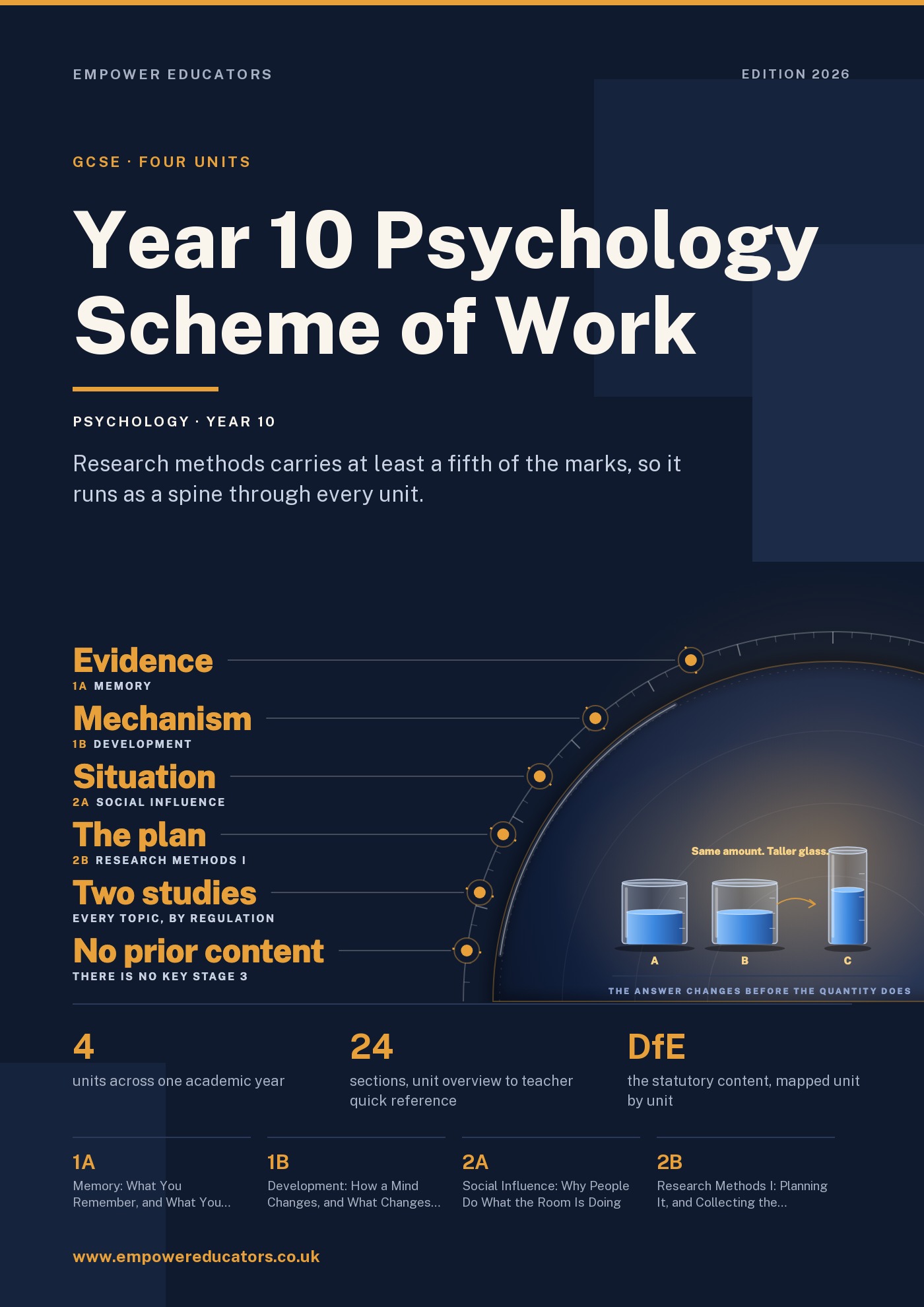
Sixty-eight pages, board-neutral by construction: the core is the Department’s own subject content, and every week is tagged for one of Ofqual’s three assessment objectives (identical on all three boards at 35%, 35% and 30%). Four half-termly units, four purpose-drawn diagrams and a coverage matrix that places every requirement across both years. The design decision is research methods: Ofqual requires it to carry at least a fifth of the marks and to be assessed across all three objectives, so it runs as a spine through every unit rather than waiting for a half-term of its own.
£5.99The Year 10 scheme: 4 units, 68 pages
- A4 PDF
- first 8 pages free to read
- instant download
Teaching all of the GCSE course? Year 10 and Year 11 as one set: £9.99, saving £1.99.
One purchase covers the school that buys it. Print it, copy it, hand it round your department. Not for passing to other schools or uploading anywhere.
PDF download, ready straight after payment. Downloading it ends the 14-day right to cancel; a file that is faulty or not as described is always refunded. Refunds
Read before publication by serving senior leaders, in school.
5.0 from 24+ reviews on Google
Schools that have bought from Empower Educators include Nottingham High School, Northampton High School GDST and Sutton Valence School.
Complete your Psychology


Board-neutral, written for AQA, Pearson Edexcel and OCR. All GCSE schemes of work
Both years: GCSE Psychology scheme of work
Everything else this site has for Psychology: Psychology teaching resources
- 1aMemory: What You Remember, and What You Rebuild
- 1bDevelopment: How a Mind Changes, and What Changes It
- 2aSocial Influence: Why People Do What the Room Is Doing
- 2bResearch Methods I: Planning It, and Collecting the Evidence
Ten sections per unit, in the same order every time, so a teacher who learns the shape once knows all four. One row per week rather than one per lesson, because a week is what a department plans in and the row then survives a school teaching three periods a fortnight as easily as one teaching five.
There is no key stage 3 psychology, and this scheme does not invent one. Psychology is not a national curriculum subject, so a Year 10 class arrives with no prior content at all — and the first lesson is built on that honest floor. It teaches what a theory is and what a study is for, because every week after it depends on the difference.
The sequence is argued for. Memory opens the year because it is the only topic in the subject a class can test on itself in twenty minutes and get a result that contradicts what it expected, which is where the idea that a theory is a claim that can be wrong gets installed rather than asserted. Development follows, because schema is already taught and comparing explanations of one child is the easier version of the move social influence then demands. Social influence is third, because its study variations put an independent variable into the class's hands before anybody names one. Research methods is last, which is the whole argument: by the time the vocabulary arrives, every term in it attaches to a study the class has already argued about.
Every requirement is traced to the document that sets it, and the three specifications are compared rather than averaged — which two optional topics each fixes, which two psychological problems, and how differently the three time their papers. Includes a diagnostic inside every unit, exemplar answers in three bands with the reason each one sits where it does, the research-methods spine across both years, and the named studies table with a column for what each study cannot show.
- Written to
- GCSE subject content: psychology (DfE, DFE-00213-2015) and Ofqual’s GCSE subject level conditions for psychology
- Intended for
- heads of psychology, subject leaders and every teacher who has to deliver it
- Extent
- 68 pages · 24 sections
Look inside
Real pages, straight from the PDF
Click any page to see it full size.
Contents
All 24 sections
Taken from the book’s own contents page, so the page numbers are the real ones.