Drama · GCSE (Key Stage 4) · £5.99
Year 11 Drama
Scheme of Work
GCSE Drama Scheme of Work (SOW) — KS4 Year 11 PDF
Sixty-three pages completing the course. Five units rather than six, because the examination series is the summer term and two components must be moderated before it. A scheme that plans six half-terms of Year 11 teaching is planning a year that does not exist. The devised cycle runs nine weeks and finishes in November; the text-based performance finishes in February, so the written paper gets the spring it needs. Twenty-four phases, five purpose-drawn diagrams and thirteen back-matter tables, including a readiness tracker whose descriptors describe what a student does rather than what level they are at.
£5.99The Year 11 scheme: 5 units, 63 pages
- A4 PDF
- first 8 pages free to read
- instant download
Teaching all of the GCSE course? Year 10 and Year 11 as one set: £9.99, saving £1.99.
One purchase covers the school that buys it. Print it, copy it, hand it round your department. Not for passing to other schools or uploading anywhere.
PDF download, ready straight after payment. Downloading it ends the 14-day right to cancel; a file that is faulty or not as described is always refunded. Refunds
Read before publication by serving senior leaders, in school.
5.0 from 24+ reviews on Google
Schools that have bought from Empower Educators include Nottingham High School, Northampton High School GDST and Sutton Valence School.
Complete your Drama

Board-neutral, written for AQA. All GCSE schemes of work
The whole course: GCSE Drama scheme of work
Everything else this site has for Drama: Drama teaching resources
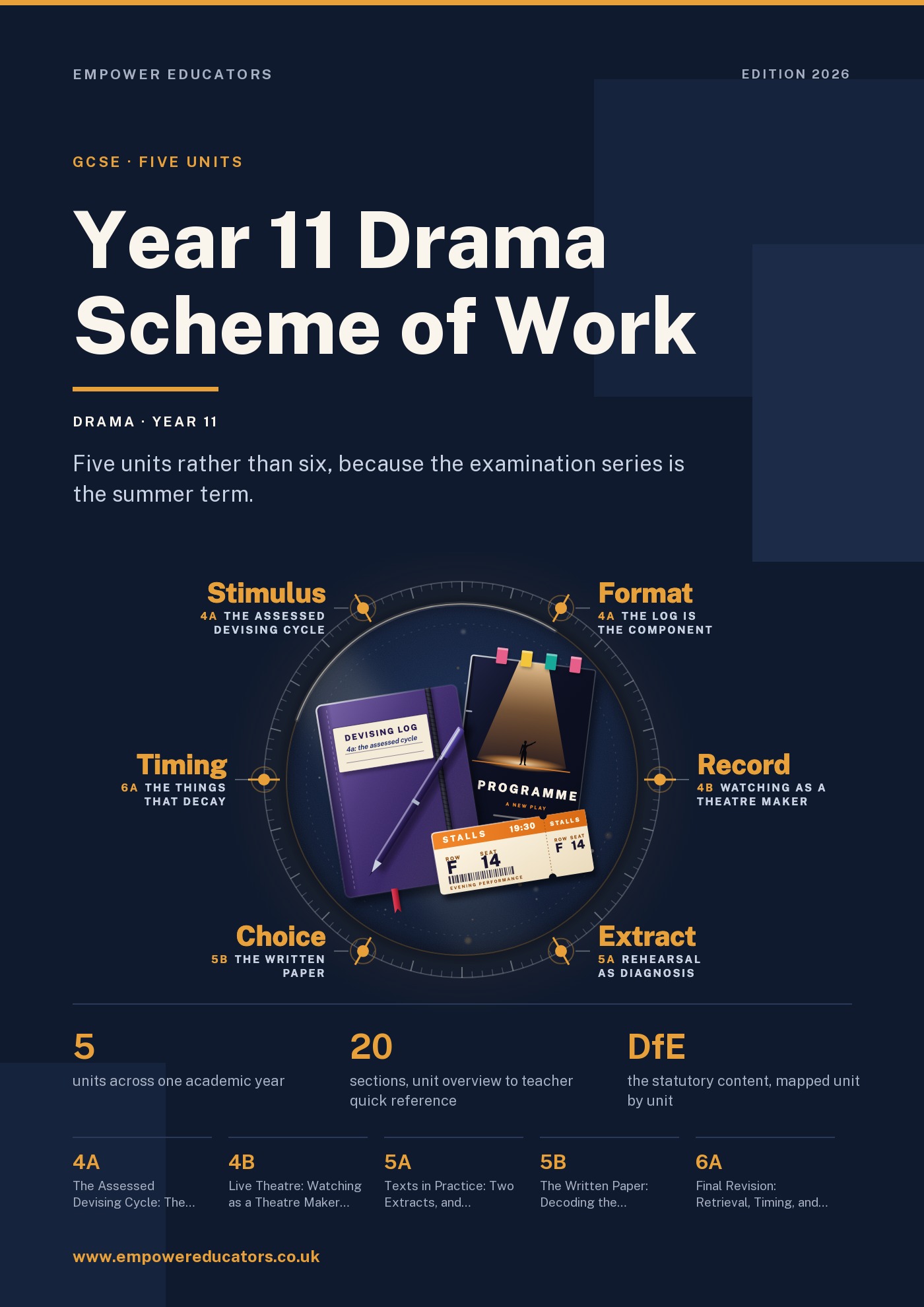
- 4aThe Assessed Devising Cycle: The Log Is the Component
- 4bLive Theatre: Watching as a Theatre Maker Rather Than as an Audience
- 5aTexts in Practice: Two Extracts, and Rehearsal as Diagnosis
- 5bThe Written Paper: Decoding the Question, and Writing About Theatre Not in the Room
- 6aFinal Revision: Retrieval, Timing, and the Things That Decay
The companion to Year 10 and built on the same statutory floor. Between the two books every statement in the Department’s subject content is taught, and a build check resolves each one against the document before either can be produced.
Year 11 is shaped by two facts most schemes ignore. The written paper is the largest single component and the only place AO3 is examined, which means a strong performer cannot compensate for it. And two thirds of the qualification is already recorded and submitted by April, so revision competes badly with subjects that feel more urgent. That is why unit 6a opens by saying the number out loud.
The two performance components are scheduled to finish early enough that the spring is available for the paper. Departments that run the text-based performance into March are revising for a written examination in the fortnight before it.
Includes the live theatre analysis framework, the text framework in three colours, a four-band comparison of written answers from weak to exceptional, the GCSE readiness tracker, a two-year progression map across seventeen strands, and a seven-point checklist ordered by what it costs when it slips.
- Written to
- GCSE subject content: drama (DfE, DFE-00039-2015) and Ofqual’s assessment objectives
- Intended for
- heads of drama, subject leaders and every teacher who has to deliver it
- Extent
- 63 pages · 20 sections
The sequence
What this scheme of work covers, unit by unit
The 5 units of the Year 11 Drama Scheme of Work, in teaching order, with the term each one runs in and the question it is built to answer.
4a
The Assessed Devising Cycle: The Log Is the Component
Autumn 1 and part of Autumn 2 · 6 phases · approx. 9 weeks · September – November
Can a stranger reconstruct what you decided, and why?
4b
Live Theatre: Watching as a Theatre Maker Rather Than as an Audience
Autumn 2 · 4 phases · approx. 5 weeks · November – December
What did they decide, and what did it do to me?
5a
Texts in Practice: Two Extracts, and Rehearsal as Diagnosis
Spring 1 · 5 phases · approx. 6 weeks · January – February
What does this text need that our first instinct did not give it?
5b
The Written Paper: Decoding the Question, and Writing About Theatre That Is Not in the Room
Spring 2 · 5 phases · approx. 6 weeks · February – April
How do you write about a choice nobody can see you make?
6a
Final Revision: Retrieval, Timing, and the Things That Decay
Summer 1 · 4 phases · approx. 4 weeks · April – May, to the examination
What have you forgotten that you cannot rebuild in the room?
Look inside
Real pages, straight from the PDF
Click any page to see it full size.
Contents
All 20 sections
Taken from the book’s own contents page, so the page numbers are the real ones.