147·Business · GCSE (Key Stage 4)
Year 10 Business
Scheme of Work
GCSE Business Scheme of Work (SOW) — KS4 Year 10 PDF
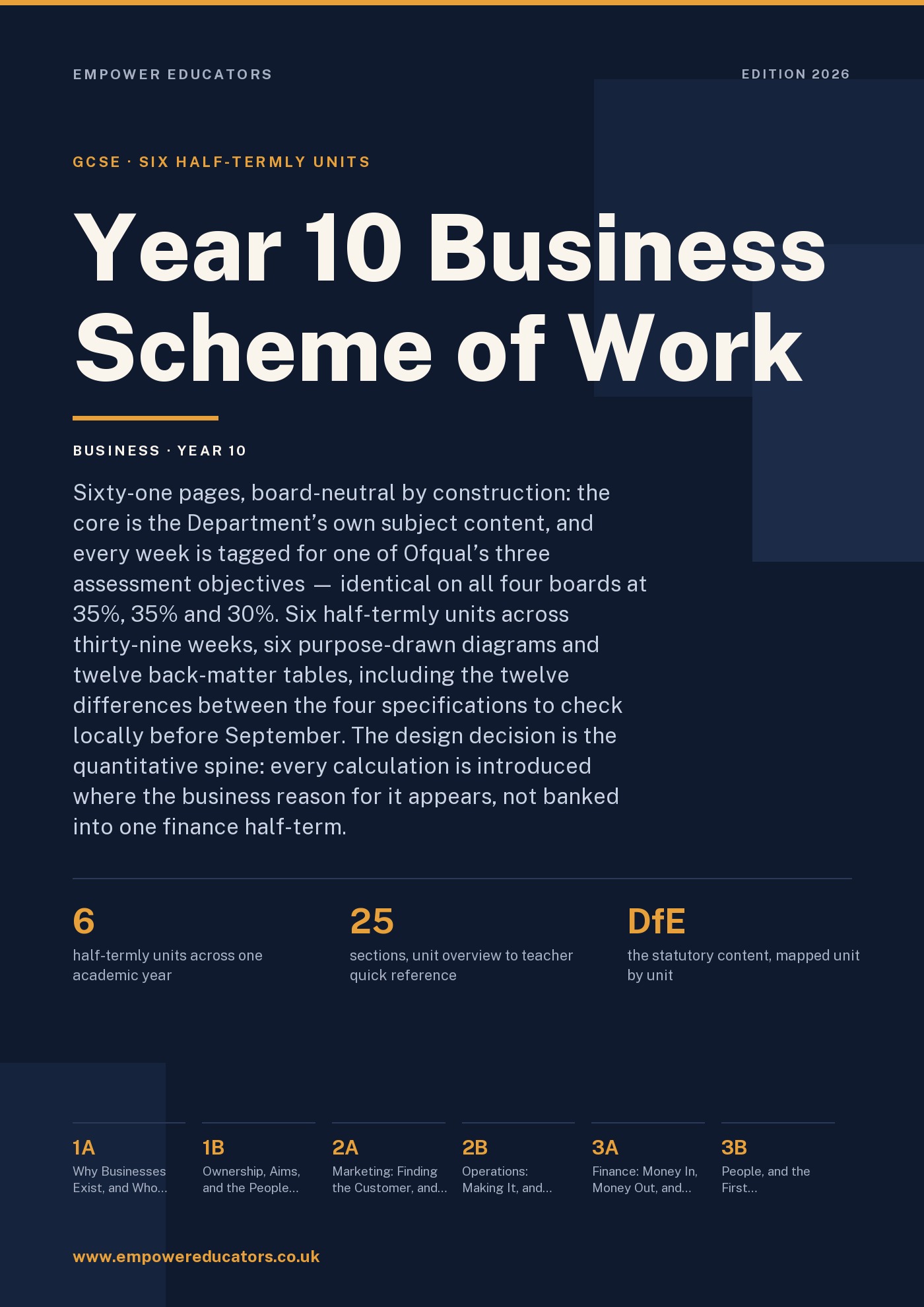
Sixty-one pages, board-neutral by construction: the core is the Department’s own subject content, and every week is tagged for one of Ofqual’s three assessment objectives — identical on all four boards at 35%, 35% and 30%. Six half-termly units across thirty-nine weeks, six purpose-drawn diagrams and twelve back-matter tables, including the twelve differences between the four specifications to check locally before September. The design decision is the quantitative spine: every calculation is introduced where the business reason for it appears, not banked into one finance half-term.
Board-neutral — for AQA, Pearson Edexcel, OCR and Eduqas. All GCSE schemes of work
Both years: GCSE Business scheme of work
Everything else this site has for Business: Business teaching resources
- 1aWhy Businesses Exist, and Who Starts Them
- 1bOwnership, Aims, and the People With a Stake
- 2aMarketing: Finding the Customer, and the Four Decisions
- 2bOperations: Making It, and Making It Well
- 3aFinance: Money In, Money Out, and Why the Difference Is Not Cash
- 3bPeople, and the First Whole-Business Decision
One purchase covers the school that buys it. Print it, copy it, hand it round your department. Not for passing to other schools or uploading anywhere.
Ten sections per unit, in the same order every time, so a teacher who learns the shape once knows all six. One row per week rather than one per lesson, because a week is what a department plans in and the row then survives a school teaching three periods a fortnight as easily as one teaching five.
Board-neutral is a construction rather than a disclaimer, and in this subject the differences are larger than they look. AQA states that students will not be expected to draw break-even charts or use the break-even formula, and will not be expected to construct an entire cash flow forecast. Eduqas requires the opposite on both, and is the only board that uses contribution. AQA alone examines the income statement and the statement of financial position; Edexcel alone sets interest as a calculation, plus the design mix and market mapping. Every one of those is named on the page where it arises, marked as a board extension, and listed again at the back against the board that requires it — rather than averaging four specifications into a fifth that nobody sets.
The sequence is argued for. Enterprise opens the year because it is where the idea that costs come before revenue can be established; ownership follows, because every later decision belongs to somebody and is judged against an objective; marketing generates the revenue and operations decides the costs, so finance is where the two meet; and the year ends on one staffing decision with four consequences. Each unit names the misconceptions it will meet before it teaches, with the number, timeline or counter-example that actually shifts them.
Includes a diagnostic inside every unit, exemplar answers in three bands with the reason each one sits where it does, the quantitative spine across both years, the four interdependence chains walked in both directions, and the equations page — every formula a student needs, with the board extensions marked, because no board supplies them in the examination.
- Written to
- GCSE subject content: business (DfE, DFE-00203-2015) and Ofqual’s assessment objectives
- Intended for
- heads of business, subject leaders and every teacher who has to deliver it
- Extent
- 61 pages · 25 sections
—·The sequence
What this scheme of work covers, unit by unit
The 6 units of the Year 10 Business Scheme of Work, in teaching order, with the term each one runs in and the question it is built to answer.
1a
Why Businesses Exist, and Who Starts Them
Year 10 · Autumn 1 · 7 weeks · September – October
Why would anyone start a business when most of the risk lands on them?
1b
Ownership, Aims, and the People With a Stake
Year 10 · Autumn 2 · 7 weeks · November – December
If the business fails, who actually pays?
2a
Marketing: Finding the Customer, and the Four Decisions
Year 10 · Spring 1 · 6 weeks · January – February
Why do two businesses selling the same thing charge different prices?
2b
Operations: Making It, and Making It Well
Year 10 · Spring 2 · 6 weeks · February – April
When a business cuts a cost, who feels it first?
3a
Finance: Money In, Money Out, and Why the Difference Is Not Cash
Year 10 · Summer 1 · 6 weeks · April – May
Why do profitable businesses run out of money?
3b
People, and the First Whole-Business Decision
Year 10 · Summer 2 · 7 weeks · June – July
What actually makes someone work harder — and what does it cost?
—·Look inside
Real pages, straight from the PDF
Click any page to see it full size.
—·Contents
All 25 sections
Taken from the booklet’s own contents page, so the page numbers are the real ones.