Business · GCSE · £6.99
GCSE Business
Questions
& Answers
A business book that contradicts itself on page fifty is worse than one with no figures at all, because the reader has no way to tell which page is wrong. Every figure about either of the two running businesses here is computed from one another rather than typed, and the arithmetic on every page is parsed off the finished book and evaluated on each build. Seventy-five per cent of the marks are set in a named company, and every calculation is step marked, each step saying what it still earns when the figure coming into it is wrong.
£6.99100 questions, each answered three times (weak, middling, strong), 115 pages
- A4 PDF
- first 14 pages free to read
- instant download
One purchase covers the school that buys it. Print it, copy it, hand it round your department. Not for passing to other schools or uploading anywhere.
PDF download, ready straight after payment. Downloading it ends the 14-day right to cancel; a file that is faulty or not as described is always refunded. Refunds
Read before publication by serving senior leaders, in school.
5.0 from 24+ reviews on Google
Schools that have bought from Empower Educators include Nottingham High School, Northampton High School GDST and Sutton Valence School.
Complete your Business


Everything else this site has for Business: Business teaching resources
Also teaching business lower down the school, or the exam itself? Business scheme of work · GCSE Business assessment objectives
- 1Business activity
- 2Influences on business
- 3Operations
- 4Finance
- 5Marketing
- 6People
- 7Answering the paper
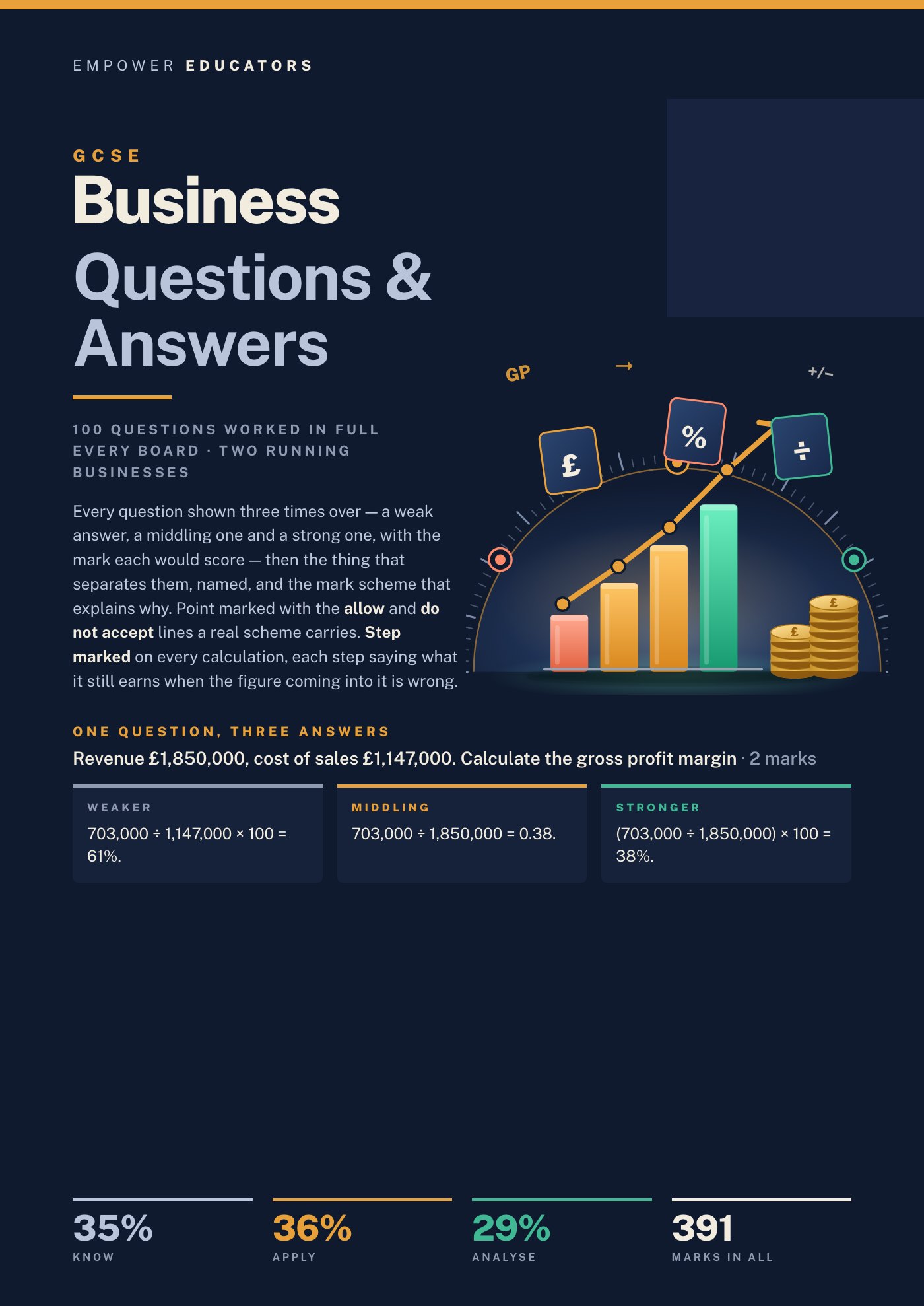
Not a bank of questions with the answers printed underneath. The three banded responses are the starting point, not the output: what follows each one is the discriminator, named out loud, then the questions you actually ask to move a student from the first answer to the last, then the mark scheme that shows what each line was worth.
Business is a subject where the marks are lost to arithmetic and to context, so the book is built against both. Two companies run through it: a bicycle shop owned by two partners, and a private limited company making kitchen furniture to order. Every derived figure about them is computed from their inputs when the book is built rather than typed on a page. Revenue, contribution, break-even, both margins, the average rate of return and a six-month cash-flow forecast all fall out of the same data, which is why the number on page nine is the number on page fifty-two.
That machinery earns its place. In an early draft the two views of one company’s year (its profit and loss on one side, its break-even data on the other) implied profits of £222,000 and £844,000. Every figure matched the table it came from, so every check passed. A checker that validates figures against their own table cannot find a contradiction between two tables, and the book now asserts that the two reconcile on every build.
Every calculation the subject content names is worked at least once, and every one is step marked, with each step saying what it still earns when the figure coming into it is wrong. One rule governs them all and it is stated plainly: error carried forward rescues a wrong number and never a wrong method. A candidate who divides by the wrong figure at step two keeps the marks for steps one and three; a candidate who divides fixed costs by price instead of contribution keeps none, because everything after it answers a different question.
75% of the marks are set in one of the two named companies, with a floor enforced on every build, because an answer that is correct about business in general fills the knowledge row of a mark scheme and leaves the application rows empty. That is what caps a fluent answer at four out of nine. The last ten pages are about exactly that student. The assessment objectives are computed from the hundred questions each time the book is built, and the build stops if they fall outside what the regulator sets. No board is named anywhere.
- Written to
- The GCSE subject content for business published by the Department for Education — including the calculations it names in full — and the assessment objectives set by Ofqual at 35% knowledge, 35% application and 30% analysis and evaluation
- Intended for
- business teachers and heads of department. Used with a class, not a student revision guide
- Extent
- 115 pages · 7 sections
Sample questions
Sample GCSE Business questions and answers
One question from the book, printed exactly as they appear in it: the question, the answers it works through, and the mark each one scores. All of them are in the free preview.
Question 6·Business activity·2 marks
Define limited liability.
Weaker1 mark
It means the owners are not liable for the business’s debts.
Middling2 marks
Limited liability means the owners’ losses are limited to the amount they have invested in the business. If the company fails, their personal assets cannot be taken to pay its debts.
Stronger2 marks
The owners’ losses are limited to what they have invested. It follows from the company being a separate legal person: the debts belong to the company rather than to the shareholders, which is why they can lose their investment and not their house.
What separates them
The first answer overstates it: owners are liable, up to the amount invested, and a shareholder who loses their whole stake has been liable for all of it. The second is accurate and earns both marks. The third adds where it comes from — separate legal identity — which is what makes the concept explicable rather than a rule to remember.
The full-mark answer2 marks
Limited liability means the owners’ losses are limited to the amount they have invested in the business. Because the company is a separate legal person, its debts belong to it rather than to the shareholders, so their personal assets cannot be taken to pay them.
Look inside
Real pages, straight from the PDF
Click any page to see it full size.
Contents
All 7 sections
Taken from the book’s own contents page, so the page numbers are the real ones.