Art & Design · GCSE (Key Stage 4) · £5.99
Year 10
Art & Design
Scheme of Work
GCSE Art & Design Scheme of Work (SOW) — KS4 Year 10 PDF
Sixty-five pages, board-neutral, built on the DfE subject content and Ofqual’s four assessment objectives rather than any one exam board’s specification. Photography opens (untouched at key stage 3), then print, surface and form rebuild what Years 7–9 only started into registered multi-layer print, a constructed surface and casting, each unit closing with a running record of what was tried, not just what was finished.
£5.99The Year 10 scheme: 6 half-termly units, 65 pages
- A4 PDF
- first 8 pages free to read
- instant download
Teaching all of the GCSE course? Year 10 and Year 11 as one set: £9.99, saving £1.99.
One purchase covers the school that buys it. Print it, copy it, hand it round your department. Not for passing to other schools or uploading anywhere.
PDF download, ready straight after payment. Downloading it ends the 14-day right to cancel; a file that is faulty or not as described is always refunded. Refunds
Read before publication by serving senior leaders, in school.
5.0 from 24+ reviews on Google
Schools that have bought from Empower Educators include Nottingham High School, Northampton High School GDST and Sutton Valence School.
Complete your Art & Design

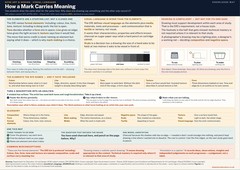
Board-neutral, written for AQA, OCR and Pearson Edexcel. All GCSE schemes of work
Both years: GCSE Art & Design scheme of work
Everything else this site has for Art & Design: Art & Design teaching resources
- 1aRecording: Observation Held Over Time
- 1bThe Photographic Image
- 2aPrint: Layer, Register, Edition
- 2bSurface and Stitch: Building in Layers
- 3aForm: Casting, Constructing, Repeating
- 3bFirst Sustained Project: From Question to Outcome
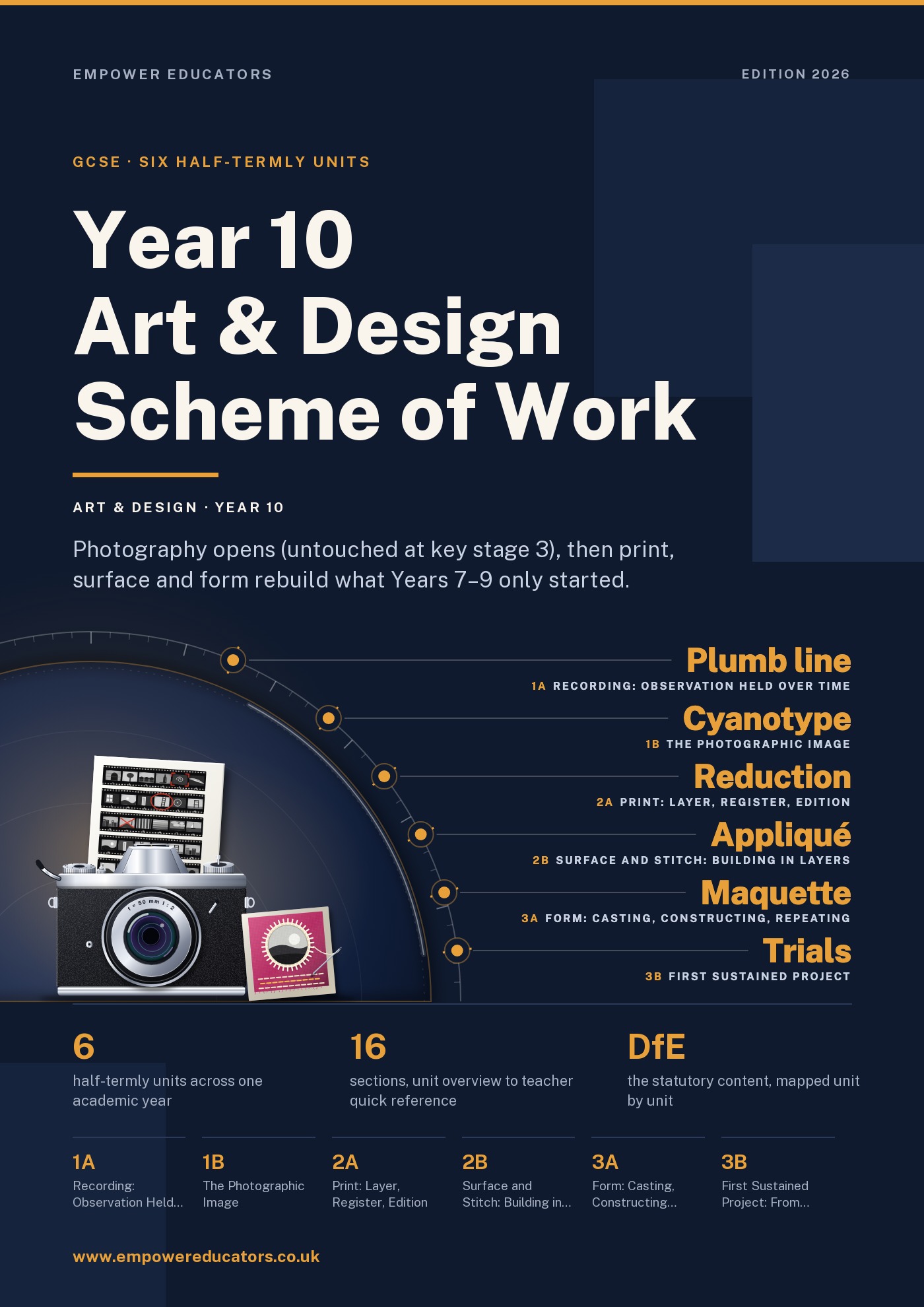
Ten sections per unit, in the same order every time. Lessons are one row per week rather than one per hour, because Key Stage 4 art is timetabled in doubles more often than singles.
At Key Stage 4 the working is the work. Three of the four assessment objectives are about investigation, refinement and recording, so every unit requires a visible trail of stage photographs, proofs, maquettes, layer logs and rejected trials, and treats it as the assessed product rather than preparation for it.
Art and design sits outside the statutory national curriculum at Key Stage 4, so this book is built on the two documents that actually bind every board in England, checked against the source PDFs rather than assumed. A back-matter section names exactly what varies by specification and what a department must confirm locally before teaching the externally set assignment in Year 11.
- Written to
- The GCSE subject content for art and design (DfE, 2015) and the four assessment objectives set by Ofqual (Ofqual/15/5643)
- Intended for
- heads of art, subject leaders and every teacher who has to deliver it
- Extent
- 65 pages · 16 sections
The sequence
What this scheme of work covers, unit by unit
The 6 units of the Year 10 Art & Design Scheme of Work, in teaching order, with the term each one runs in and the question it is built to answer, what students make, the artists they meet and the vocabulary they learn.
1a
Recording: Observation Held Over Time
Autumn 1 · approx. 7 weeks · September – October
What does a drawing gain in eight hours that it cannot gain in one?
- End outcome
- One A2 sustained study from direct observation, plus the four staged photographs that prove how it was built.
- Core skills
- Comparative measurement — checking one interval against another with a plumb line · Building a full tonal range from one grade of graphite · Working wet media over a measured underdrawing · Photographing work in progress as evidence
- Key artists
- Euan Uglow, Vija Celmins, Lynette Yiadom-Boakye
- Key vocabulary
- sustained study, comparative measurement, plumb line, interval, negative shape, tonal range, ground, resolution, focal hierarchy, picture plane
1b
The Photographic Image
Autumn 2 · approx. 7 weeks · November – December
When does a photograph stop being a record of something and start being a decision about it?
- End outcome
- A sequenced series of eight to twelve photographs with a stated theme, plus one cyanotype or other alternative-process print.
- Core skills
- Setting exposure deliberately on manual or on a priority mode · Composing through a viewfinder rather than cropping afterwards · Editing a large take down to a sequence · Coating, exposing and washing a cyanotype
- Key artists
- Vivian Maier, Hiroshi Sugimoto, Khadija Saye
- Key vocabulary
- aperture, f-number (f-stop), shutter speed, ISO, depth of field, exposure, contact sheet, the take, edit, sequence, alternative process, cyanotype, tintype
2a
Print: Layer, Register, Edition
Spring 1 · approx. 6 weeks · January – February
Why would an artist choose to make the same image more than once?
- End outcome
- A three-colour reduction linocut in a numbered edition of five, plus a typographic overprint.
- Core skills
- Cutting for the reduction sequence · Registering by jig so every impression lands identically · Rolling an even, thin layer of ink · Proofing, correcting and then editioning · Setting and locking up type, or its stencil equivalent
- Key artists
- Angie Lewin, Alan Kitching, Paula Scher
- Key vocabulary
- relief, reduction, registration, jig, proof, edition, impression, overprint, brayer, burnish, artist's proof, colophon
2b
Surface and Stitch: Building in Layers
Spring 2 · approx. 6 weeks · February – March
What can a built surface carry that a flat image cannot?
- End outcome
- An A2 mixed-media piece on a prepared ground, using transfer, collage, paint and stitch, with the layer order recorded as it was made.
- Core skills
- Preparing a ground that will take wet and dry media · Gel-medium photographic transfer, laid down one week and rubbed back the next · Cutting and tearing for effect · Straight, running and whip stitch through paper and fabric · Sanding and lifting back through layers
- Key artists
- Romare Bearden, Njideka Akunyili Crosby, Faith Ringgold
- Key vocabulary
- ground, substrate, transfer, toner, burnish, appliqué, collage, photomontage, register, opacity, translucency, subtractive
3a
Form: Casting, Constructing, Repeating
Summer 1 · approx. 7 weeks · April – May
Can the space around an object be the subject instead of the object?
- End outcome
- A resolved 3D piece by one of three routes, plus maquettes of the other two and a set of drawings from three viewpoints.
- Core skills
- Making and casting from a simple one-part press mould · Building and skinning an armature · Looped and twisted wire construction · Designing a repeatable module and joining at volume · Drawing a 3D form from three fixed viewpoints
- Key artists
- Rachel Whiteread, Ruth Asawa, El Anatsui
- Key vocabulary
- armature, maquette, void, negative space, positive form, press mould, one-part mould, release agent, undercut, module, in the round, plinth, patina
3b
First Sustained Project: From Question to Outcome
Summer 2 · approx. 7 weeks · June – July
You have five ways of making. What do you actually want to say, and which one will say it?
- End outcome
- A complete portfolio section: a stated question, first-hand source material, experiments in at least two material areas, a development sequence, one resolved outcome and a written evaluation.
- Core skills
- Narrowing a question by testing it · Gathering first-hand sources · Selecting a material area for a reason · Running the full cycle to a deadline without being told what to do next
- Key artists
- Lubaina Himid, Cornelia Parker, Do Ho Suh — plus at least two the student finds and defends themselves
- Key vocabulary
- intention, investigation, first-hand and second-hand source, development, refinement, realisation, personal response, contextual link, rationale
Look inside
Real pages, straight from the PDF
Click any page to see it full size.
Contents
All 16 sections
Taken from the book’s own contents page, so the page numbers are the real ones.