English Language · GCSE · £6.99
GCSE English Language
Questions
& Answers
Feature-spotting is what caps an English answer: the device named, the effect assumed. Each of these hundred pages separates the two, then supplies the questions that move a student from one to the other. Twelve passages are written for the book and reprinted on every question that uses them, so no page depends on an anthology a department already has to own. Fifty-two questions read those passages, and forty-eight write, up to the full forty-mark task.
£6.99100 questions, each answered three times (weak, middling, strong), 110 pages
- A4 PDF
- first 14 pages free to read
- instant download
One purchase covers the school that buys it. Print it, copy it, hand it round your department. Not for passing to other schools or uploading anywhere.
PDF download, ready straight after payment. Downloading it ends the 14-day right to cancel; a file that is faulty or not as described is always refunded. Refunds
Read before publication by the serving head of that department and by senior leaders, in school.
5.0 from 24+ reviews on Google
Schools that have bought from Empower Educators include Nottingham High School, Northampton High School GDST and Sutton Valence School.
Complete your English Language
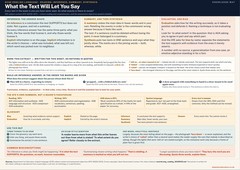
Everything else this site has for English Language: English Language teaching resources
Also teaching english language lower down the school, or the exam itself? English Language scheme of work · GCSE English Language assessment objectives
- 1Finding and interpreting information
- 2Analysing language
- 3Analysing structure
- 4Comparing writers' perspectives
- 5Evaluating a text critically
- 6Descriptive writing
- 7Narrative writing
- 8Writing to argue or persuade
- 9Writing to explain, inform and advise
- 10Sentence craft and technical accuracy
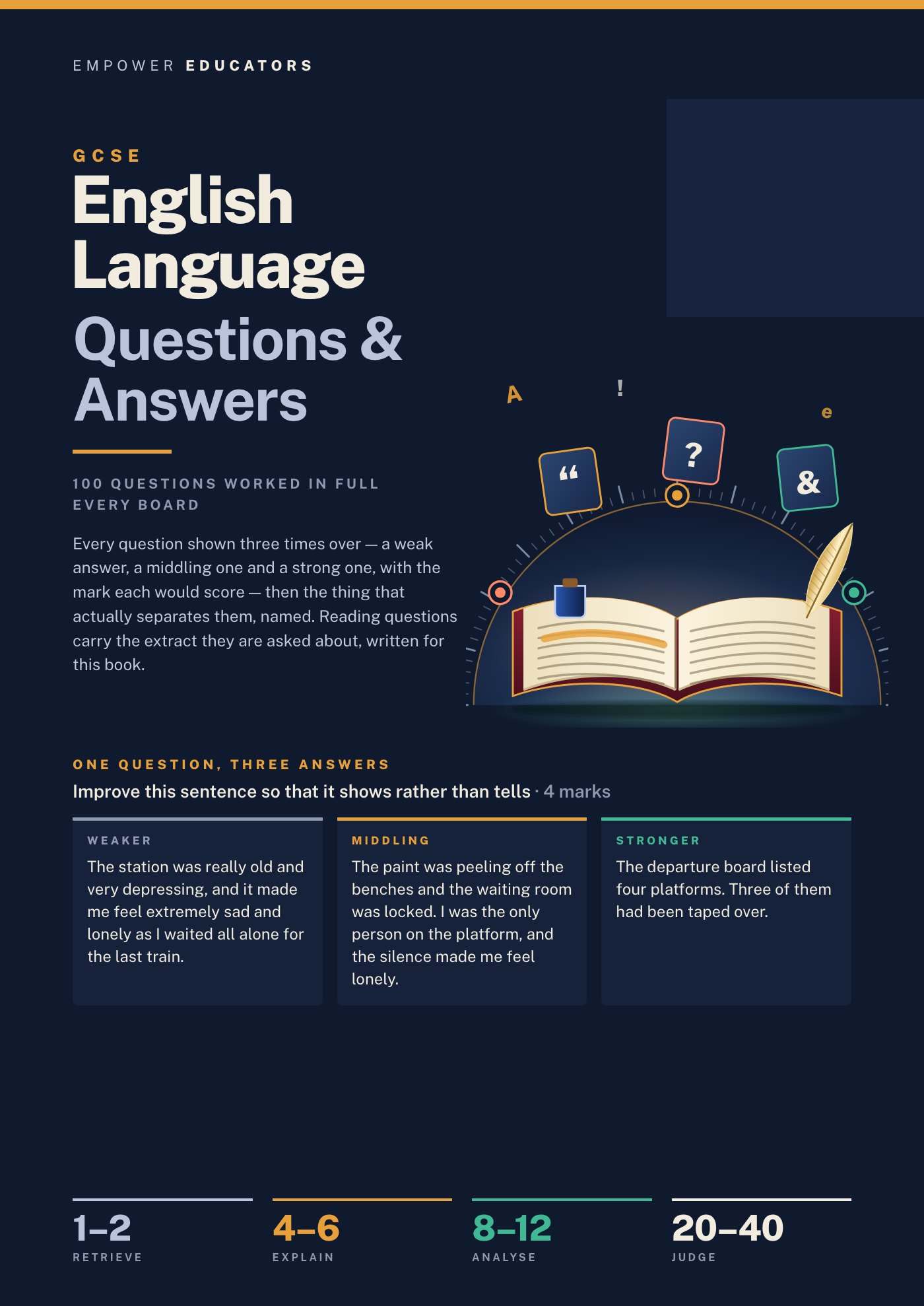
Not a bank of questions with the answers printed underneath. The three banded responses are the starting point, not the output: what follows each one is the discriminator, named out loud, and then the questions you actually ask to move a student from the first answer to the last. That prompt sequence is the part no mark scheme contains.
Every question, every answer and every passage here is written for this book. None is copied from a past paper, a mark scheme or an examiner report, and no candidate’s script appears anywhere in it. What the questions do carry is the wording, the command word, the mark tariff and the structure the assessment objectives require, which is why they work whichever board a department has chosen.
The twelve passages are the reason nothing else is needed to teach from it. Nine single extracts and three paired sets, each reprinted in full on every question that uses it, so a class never holds one text in their heads while reading another and no page depends on an anthology. Fifty-two questions read those passages; the other forty-eight are the writing half, where the composition tasks are shaped like the ones a paper sets and the craft questions ask why a technique works before asking anyone to use it.
- Written to
- The GCSE subject content for English language (DfE) and the assessment objectives set by Ofqual, which are worded identically across AQA, Edexcel, OCR and Eduqas
- Intended for
- English teachers and heads of department. Used with a class, not a student revision guide
- Extent
- 110 pages · 10 sections
Sample questions
Sample GCSE English Language questions and answers
Eight questions from the book, printed exactly as they appear in it: the question, the answers it works through, and the mark each one scores. All of them are in the free preview.
Question 1·Finding and interpreting information·1 mark
I had said it was two hours. It had been closer to five, and for most of the last one the road had no signs on it at all, which I did not mention when I finally called.
The cottage was where the letter said it would be. I want to be clear that I was not frightened. I checked the back seat before I got out, because that is a sensible thing to do. I left the headlights on because the porch had no bulb in it. I stood for a moment with my hand on the car door because my leg had gone to sleep on the drive.
There was a note taped to the door. It was not addressed to me.
Identify one piece of evidence that the narrator is uneasy.
WeakerWould score 0 of 1
The narrator is uneasy because it is dark and they are on their own in a strange place.
MiddlingWould score 1 of 1
The narrator checks the back seat of the car before getting out.
StrongerWould score 1 of 1
‘I checked the back seat before I got out.’
What separates them
One mark, and the difference is what counts as evidence. The weaker answer states the situation and quotes nothing, so there is nothing for the examiner to award. The middling answer points at the right moment but paraphrases it. The strongest quotes — and on this command word a quotation is safest, because a paraphrase can always be argued with and the words on the page cannot.
The full-mark answer1 mark
‘I checked the back seat before I got out.’
Question 2·Finding and interpreting information·4 marks
I had said it was two hours. It had been closer to five, and for most of the last one the road had no signs on it at all, which I did not mention when I finally called.
The cottage was where the letter said it would be. I want to be clear that I was not frightened. I checked the back seat before I got out, because that is a sensible thing to do. I left the headlights on because the porch had no bulb in it. I stood for a moment with my hand on the car door because my leg had gone to sleep on the drive.
There was a note taped to the door. It was not addressed to me.
List four things you learn about the narrator from the opening of the extract.
WeakerWould score 1 of 4
The narrator is scared and lonely, and they have driven a long way to a spooky old cottage where something bad is going to happen to them.
MiddlingWould score 3 of 4
The narrator drove for about five hours. They had told someone it would be two. They checked the back seat of the car. There was a note on the door.
StrongerWould score 4 of 4
The narrator drove for around five hours. They had told someone the journey was two. They checked the back seat before getting out. Their leg had gone to sleep on the drive.
What separates them
Four marks, four separate facts, and no development wanted at all. The weaker answer gives one idea stretched over three clauses and then guesses at what happens next, which cannot be in a list of what you learn. The middling answer is nearly right and gives away its fourth mark: the note is a fact about the door, not about the narrator. Read the noun in the question — every item has to be about that noun.
The full-mark answer4 marks · 1 + 1 + 1 + 1
The narrator drove for around five hours. They had told someone the journey would take two. They checked the back seat of the car before getting out. Their leg had gone to sleep during the drive.
Question 3·Finding and interpreting information·4 marks
Bell arrived first and took the chair by the window, which had been Docherty’s chair for eleven years. Docherty came in, saw it, and sat down opposite without a word, and the two of them looked at the table.
Mrs Aldis brought the tea in. She put Docherty’s down in front of him, and Bell’s a little to the left, where he had to reach for it.
‘How’s the shoulder,’ Bell said. It was not really a question.
‘Fine,’ said Docherty.
Mrs Aldis stood in the doorway a moment longer than she needed to, then went back into the kitchen and closed the door, which she did not usually do.
Explain what the extract suggests about the relationship between the two men.
WeakerWould score 1 of 4
The two men do not like each other very much and there is a bad atmosphere between them in the room.
MiddlingWould score 2 of 4
Bell takes Docherty’s chair, which suggests he is trying to take over. Docherty does not say anything about it, which suggests he does not want a row. They are not friendly.
StrongerWould score 4 of 4
The chair does the work. It has been Docherty’s for eleven years, so Bell taking it is not a mistake but a claim — and Docherty answering it by sitting opposite rather than objecting suggests a rivalry that is old enough to have rules. Bell’s question about the shoulder is asked with no question mark, so it is not concern but a reminder of an injury he already knows about.
What separates them
Atmosphere asserted with nothing behind it is the weakest of the three. The middling answer uses the chair and reads it correctly, and then stops at they are not friendly. What lifts the strongest is that it notices the length of the history — eleven years, and a response so practised that neither man needs to speak — and then finds a second piece of evidence in the punctuation. An implication question is asking what the detail proves, not how the room feels.
The full-mark answer4 marks · 2 + 2
The chair carries the meaning. It had been Docherty’s for eleven years, so Bell taking it is a deliberate claim rather than an accident, and Docherty replying by sitting opposite in silence suggests a rivalry old enough to have settled into a routine. Bell’s ‘How’s the shoulder’ is written without a question mark, so it functions as a reminder of an injury he already knows about rather than as an enquiry.
Question 4·Finding and interpreting information·6 marks
Bell arrived first and took the chair by the window, which had been Docherty’s chair for eleven years. Docherty came in, saw it, and sat down opposite without a word, and the two of them looked at the table.
Mrs Aldis brought the tea in. She put Docherty’s down in front of him, and Bell’s a little to the left, where he had to reach for it.
‘How’s the shoulder,’ Bell said. It was not really a question.
‘Fine,’ said Docherty.
Mrs Aldis stood in the doorway a moment longer than she needed to, then went back into the kitchen and closed the door, which she did not usually do.
Explain what is implied, rather than stated, about Mrs Aldis.
WeakerWould score 1 of 6
Mrs Aldis is the one who makes the tea, so she probably works there and looks after the two men when they come in.
MiddlingWould score 3 of 6
Mrs Aldis puts Docherty’s tea in front of him but makes Bell reach for his, which suggests she prefers Docherty. She also waits in the doorway, which suggests she is interested in what is going on.
StrongerWould score 6 of 6
Two details place her, and neither is stated. Serving Docherty properly and leaving Bell’s where he has to reach is a judgement delivered in the one form available to her — she cannot say anything, so she says it with a cup. And the closed door is the stronger implication, because the writer tells us it is not what she usually does: she has decided she does not want to hear this, which means she already knows what it is about.
What separates them
The middling answer reads both details correctly and calls the second one interested, which is the weakest available reading. The strongest notices what the writer went out of the way to tell us: she did not usually close the door. A detail marked as unusual is never decoration — it is there because the change is the point. Ask of any implication question: what has the writer told me is different from normal, and why would they bother?
The full-mark answer6 marks · 3 + 3
Two details place her, and the writer states neither. Serving Docherty’s tea properly while leaving Bell’s where he has to reach for it is a judgement delivered in the only form available to her: she cannot say anything in front of them, so she says it with a cup. The closed door is the stronger implication, because the writer specifies that it is not what she usually does. She has decided she does not want to hear the conversation, which means she already knows what it will be about.
Question 5·Finding and interpreting information·8 marks
We came down into the valley at four o’clock, and I confess my first feeling was disappointment. I had been promised grandeur. What I found was a town the colour of the rock it had been cut from, sitting in the bend of a river the colour of tea, and above it a sky that had been grey since Tuesday. My companion pronounced it charming. I said nothing, and thought about the hotel.
You come out of the station and the heat hits you first, then the noise, and then — a second later, once your eyes have adjusted — the colour. Everything here has been painted at least twice. The bus that brought me in from the airport was pink. I had read about the cathedral for a year and I did not look at it for two days, because there was too much going on at eye level.
Summarise the differences between the two places described.
WeakerWould score 2 of 8
The first place is grey and boring but the second one is hot and colourful and much more exciting to be in.
MiddlingWould score 5 of 8
Text P describes a grey town by a brown river under a sky that has been grey for days. Text Q describes somewhere hot and noisy where everything has been painted at least twice. The first is dull and the second is lively.
StrongerWould score 8 of 8
The first place withholds and the second overwhelms. Text P gives a town the colour of its own rock, a river the colour of tea and a sky grey since Tuesday — three descriptions that all decline to offer a colour, which is why the writer feels short-changed. Text Q delivers its impressions in order and faster than they can be taken in, heat then noise then colour, until the writer cannot look at the cathedral for two days because eye level is already full.
What separates them
A summary that has not decided what it is about looks exactly like the middle answer: each text described in turn, a comparison added at the end. The strongest finds one difference and runs both texts through it: how much each place gives the visitor. A summary question is not asking for a shorter version of both texts, but for what the difference between them is.
The full-mark answer8 marks · 4 + 4
The first place withholds where the second overwhelms. Text P offers a town the colour of the rock it was cut from, a river the colour of tea and a sky grey since Tuesday — three descriptions that each decline to name a colour of their own, which is why the writer feels short-changed after being promised grandeur. Text Q by contrast delivers its impressions in sequence and faster than they can be absorbed, heat and then noise and then colour, until the writer cannot look at the cathedral for two days because eye level is already full.
Question 8·Finding and interpreting information·4 marks
I had said it was two hours. It had been closer to five, and for most of the last one the road had no signs on it at all, which I did not mention when I finally called.
The cottage was where the letter said it would be. I want to be clear that I was not frightened. I checked the back seat before I got out, because that is a sensible thing to do. I left the headlights on because the porch had no bulb in it. I stood for a moment with my hand on the car door because my leg had gone to sleep on the drive.
There was a note taped to the door. It was not addressed to me.
Select and quote the evidence that the journey has taken longer than expected.
WeakerWould score 0 of 4
The journey took much longer than the narrator thought it was going to, because the roads were bad and there were no signs anywhere.
MiddlingWould score 2 of 4
‘I had said it was two hours. It had been closer to five.’ This shows the journey took longer than expected because five is more than two.
StrongerWould score 4 of 4
‘I had said it was two hours. It had been closer to five’ gives the gap directly. ‘For most of the last one the road had no signs on it at all’ explains where the extra time went, and ‘when I finally called’ shows the delay was long enough for someone to be waiting to hear from them.
What separates them
Select and quote is two instructions, and a paraphrase obeys neither. The middling answer quotes correctly and then explains that five is more than two, spending its second sentence on arithmetic. The strongest gives three quotations that do different jobs: the gap, the cause, and the consequence. On a select-and-quote question the marks are for the choosing, so choose quotations that are not all making the same point.
The full-mark answer4 marks · 1 + 1 + 2
‘I had said it was two hours. It had been closer to five’ states the gap directly. ‘For most of the last one the road had no signs on it at all’ accounts for where the additional time went. And ‘when I finally called’ shows the delay was long enough that somebody had been waiting to hear from them.
Question 37·Comparing writers’ perspectives·8 marks
Compare how the two writers present the same place.
WeakerWould score 2 of 8
The first writer presents the city in a descriptive way with lots of imagery, whereas the second writer presents it in a much more realistic and everyday way.
MiddlingWould score 4 of 8
The letter writer describes the city visually, using the image of a brown haze and comparing the noise to a kettle on the hob. The columnist does not describe how the city looks at all, and instead writes about what it is like to be in it, such as being told to keep moving.
StrongerWould score 8 of 8
One text gives the city an appearance and the other gives it a behaviour. The letter writer can see it, so he paints it: below him, under haze, lit in places, and made safe by a domestic simile — a kettle on the hob. The columnist never describes the city at all, because she is inside it and there is no vantage point. Her only measure of the place is time: quieter at four, eleven years. The difference is not style but access, and each writer describes exactly as much of the city as their position allows.
What separates them
Visual description against lived experience is a real comparison, properly evidenced, and it earns the middle band. The strongest asks why one writer has images and the other has none, and finds the reason inside the texts: one is looking at the city from outside it and the other is standing in it. A comparison that explains the difference beats one that only demonstrates it.
The full-mark answer8 marks
One text gives the city an appearance and the other gives it a behaviour. The letter writer can see it, so he paints it: below him, under a haze, lit in places, made safe by a domestic simile — a kettle on the hob. The columnist never describes the city at all, because she is inside it and has no vantage point; her only measure of the place is time, quieter at four and eleven years long. The difference is not one of style but of access.
Question 73·Writing to argue or persuade·4 marks
Did you know that 74% of young people say that they feel stressed about school? This shocking statistic proves that something urgently needs to change in our education system before it is too late.
Improve this opening so it does not begin with a statistic.
WeakerWould score 1 of 4
Stress is a huge problem for young people today. Studies have shown that a very large proportion of students feel under pressure, and this is something that urgently needs to be addressed by everybody.
MiddlingWould score 2 of 4
Every day, thousands of students walk into school already exhausted. The pressure they are under has been building for years, and it is time that somebody in authority finally started to take the problem seriously.
StrongerWould score 4 of 4
There is a boy in Year 9 who has stopped putting his hand up. He knows the answers. He has just stopped.
What separates them
The weak rewrite removes the number and keeps the shape, so the opening is now a vague claim instead of a precise one — which is worse. The middling one reaches for scale, and thousands of students is a statistic wearing a coat. The strongest goes the other way entirely and opens on one person doing one thing. A reader cannot picture 74 per cent. They can picture a boy who has stopped putting his hand up, and the statistic can follow in paragraph three, where it now has something to be about.
The full-mark answer4 marks
There is a boy in Year 9 who has stopped putting his hand up. He knows the answers. He has just stopped.
Twelve more GCSE English Language questions, with answers, free
Look inside
Real pages, straight from the PDF
Click any page to see it full size.
Contents
All 10 sections
Taken from the book’s own contents page, so the page numbers are the real ones.