476·Chemistry · GCSE
What Reacts, and
Which Way the
Electrons Go
GCSE Chemistry Knowledge Mat — Chemical changes (PDF)
Why a dilute strong acid is not the same as a concentrated weak one — and how you know what appears at each electrode. Acids, alkalis and pH drawn against hydrogen-ion concentration; the reactivity series in full, with carbon and hydrogen placed in it; electrolysis of melts and solutions; four gas tests and the observation that earns the mark; balancing an equation the way that always works, state symbols included. Ten terms to define, a model answer on strong versus concentrated, and the misconceptions that cost marks.
Everything else this site has for Science: Science teaching resources
One purchase covers the school that buys it. Print it, copy it, hand it round your department. Not for passing to other schools or uploading anywhere.
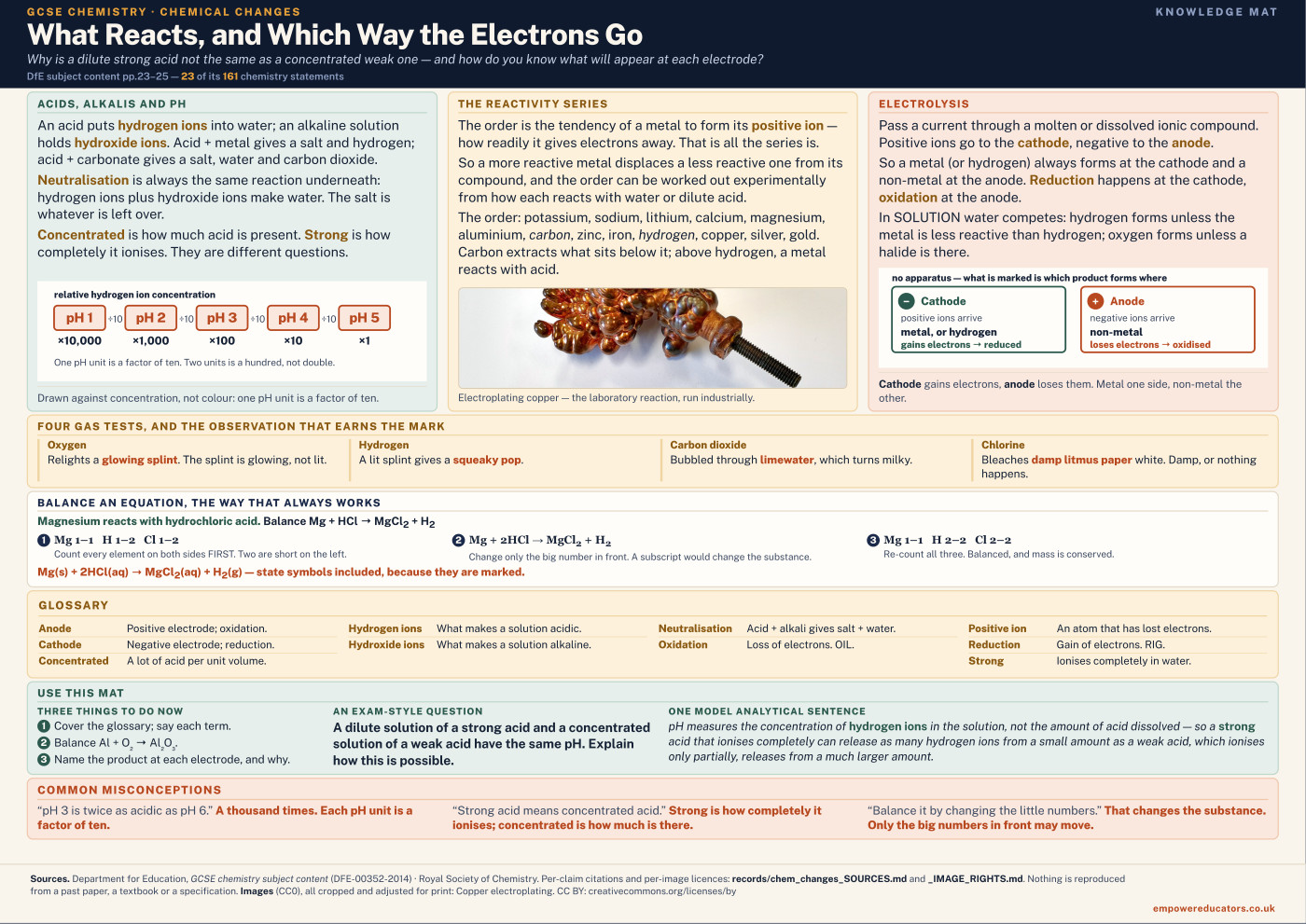
One landscape A4 page on one topic, led by the figures and photographs rather than the headings. It carries acids and pH against concentration, the full reactivity series, electrolysis of melts and solutions, four gas tests and a worked equation balance with state symbols — then the vocabulary, a worked exam-style answer and the misconceptions that cost marks.
Every photograph on the sheet is a real archival or scientific image, not an illustration and not AI-generated; every diagram is drawn in code for the sheet. Each image was checked against its own licence template rather than a label, and the running foot names every creator, states that the images have been cropped and adjusted for print, and links the licence — so the sheet can be photocopied for a class and stay compliant. Every claim is sourced to the DfE subject content, and nothing is reproduced from a past paper, a textbook or a specification.
Sold by subject: all four chemistry sheets for one price. A knowledge organiser stores a unit and is revised from afterwards; this is meant to be on the table while the work is happening.
- Written to The DfE GCSE subject content for chemistry (DFE-00352-2014). Every photograph is a sourced archival or scientific image, licensed for reuse and credited on the sheet; every diagram is drawn in code for the sheet
- Intended for chemistry teachers — on the desk during the lesson, not a student revision guide
- Extent 1 page · 8 sections
—·Look inside
Real pages, straight from the PDF
Click any page to see it full size.
—·Contents
All 8 sections
Taken from the booklet’s own contents page, so the page numbers are the real ones.