Drama · GCSE · WJEC Eduqas · £4.99
WJEC Eduqas GCSE Drama
Assessment Objectives
WJEC Eduqas GCSE Drama (England). The written paper is 40% of the GCSE, devising is 40% and performing from a text is 20%. The specification states no total mark, so the book sets the three 60-mark components side by side as 180 raw marks and says that sum is its own. The rules around the evidence decide whether any marks can be awarded, so it sets out the word limit, the contrast rule for the Component 2 text, the minimum performance times, the live performance statement and the places where Eduqas's own documents disagree.
This is the WJEC Eduqas book. Teaching a different board? AQA · OCR · Pearson Edexcel
£4.99The WJEC Eduqas GCSE Drama exam board playbook, 53 pages
- A4 PDF
- first 8 pages free to read
- WJEC Eduqas
- instant download
One purchase covers the school that buys it. Print it, copy it, hand it round your department. Not for passing to other schools or uploading anywhere.
PDF download, ready straight after payment. Downloading it ends the 14-day right to cancel; a file that is faulty or not as described is always refunded. Refunds
Read before publication by serving senior leaders, in school.
5.0 from 25+ reviews on Google
Schools that have bought from Empower Educators include Nottingham High School, Northampton High School GDST and Sutton Valence School.
Complete your Drama

Everything else this site has for Drama: Drama teaching resources
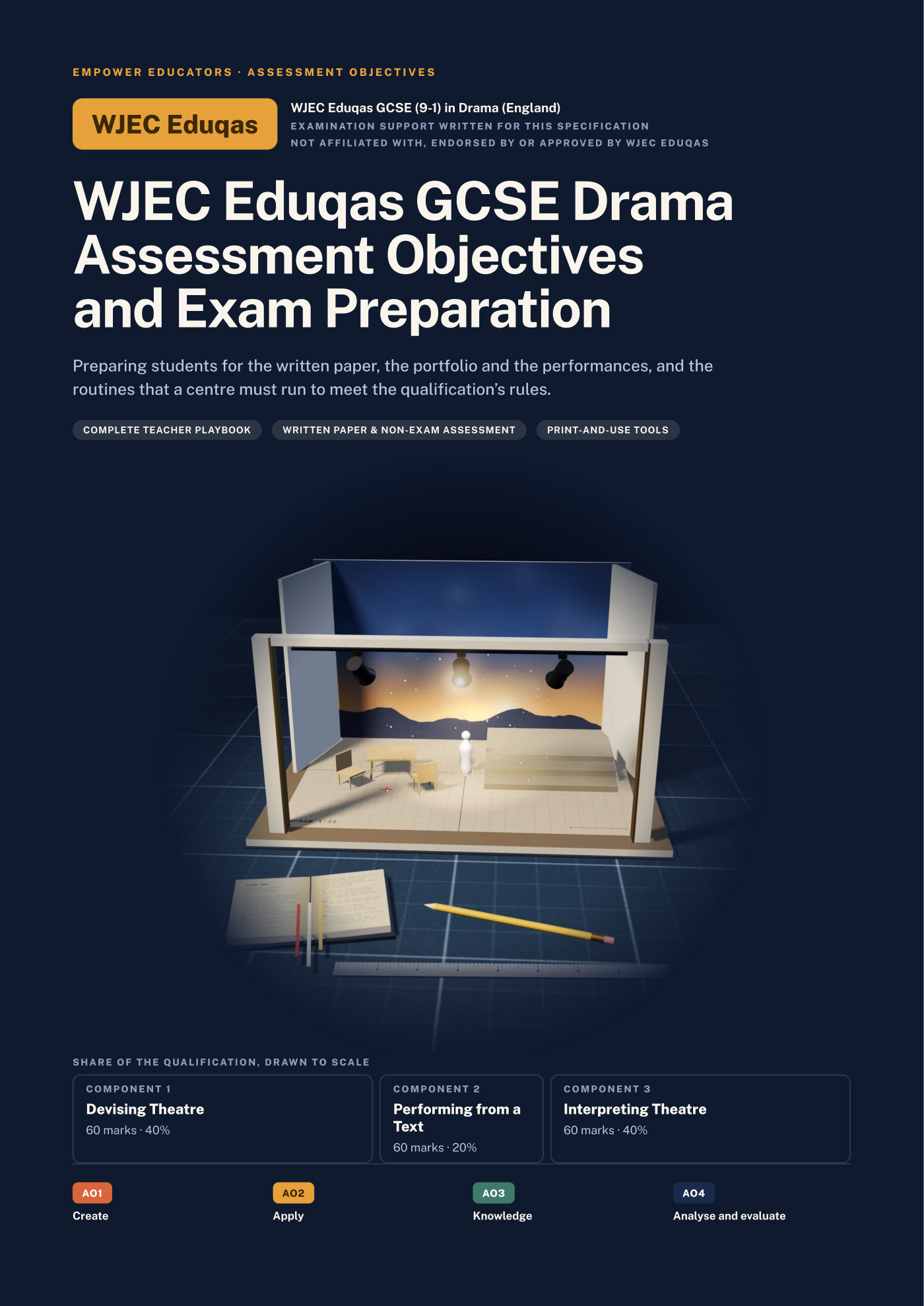
Three components, and who marks each one Component 1 is 40% of the GCSE, Component 2 is 20% and the written paper is 40%.
- AO1 Create and Develop
- AO2 Apply Skills
- AO3 Knowledge and Understanding
- AO4 Analyse and Evaluate
A working manual for a GCSE drama department teaching WJEC Eduqas GCSE Drama in England, written to the specification and checked against it before release.
Ofqual sets the four objectives and the 20/30/30/20 split, so those are identical on every board. What Eduqas chose is how the marks are shared. Component 1, devising theatre, is marked by your own teachers and moderated: a portfolio of 30 marks, a performance or design realisation of 15 and an evaluation of 15. Component 2, performing from a text, is marked by a visiting examiner and is all AO2. Component 3, interpreting theatre, is the written paper: 1 hour 30 minutes, with 45 marks on a set text and 15 on a live production. The specification states no total, so Part One draws all 180 raw marks to scale and labels the total as the book's own sum.
An early page routes by reader: a classroom teacher, someone new to the department, a head of department, a line manager or SLT member and an exams officer each get a named place to start. The book follows the order in which a department meets the qualification. Part Two takes the paper and its mark scheme section by section, with what Eduqas's examiners' reports for 2024 to 2026 said about it. Part Three covers the two non-exam components: the portfolio and its word limit, the contrast rule for the Component 2 text, the minimum performance times and what a short performance costs, the live performance statement, moderation, and what to do when something goes wrong. Part Four gives the department its own checks and tools. Where Eduqas's documents disagree with each other, the book prints both sides and says which it follows, with the sources.
The book rests on the Summer 2023, 2024 and 2025 papers and mark schemes that Eduqas publishes. The Summer 2026 papers and mark schemes are on Eduqas's centre portal, so the book says plainly that it has not seen them.
- Written to
- WJEC Eduqas GCSE in Drama specification, Version 10 (September 2026), with the weightings reconciled against it, DfE's GCSE subject content for Drama (DFE-00039-2015), Ofqual's GCSE subject-level conditions and requirements for Drama (Ofqual/17/6198), and Eduqas's own Component 3 question papers and mark schemes for Summer 2023, 2024 and 2025, its Component 1 stimulus materials, guidance, FAQs, sample and exemplar assessment materials, newsletters, processes and forms, and its examiners' reports to Summer 2026, quoted word for word
- Intended for
- teachers, heads of department and SLT — not a student revision guide
- Extent
- 53 pages · 31 sections
Look inside
Real pages, straight from the PDF
Click any page to see it full size.
Contents
All 31 sections
Taken from the book’s own contents page, so the page numbers are the real ones.