Art & Design
Arts education is getting its money back. What reaches the art room?
A National Centre is due to open this term and the EBacc is on its way out. Neither of them changes what is in a Year 9 sketchbook.
Written in response to the Department for Education’s announcement on creative education, and to the 2026 entry figures published on results day. Read on 17 August 2026.
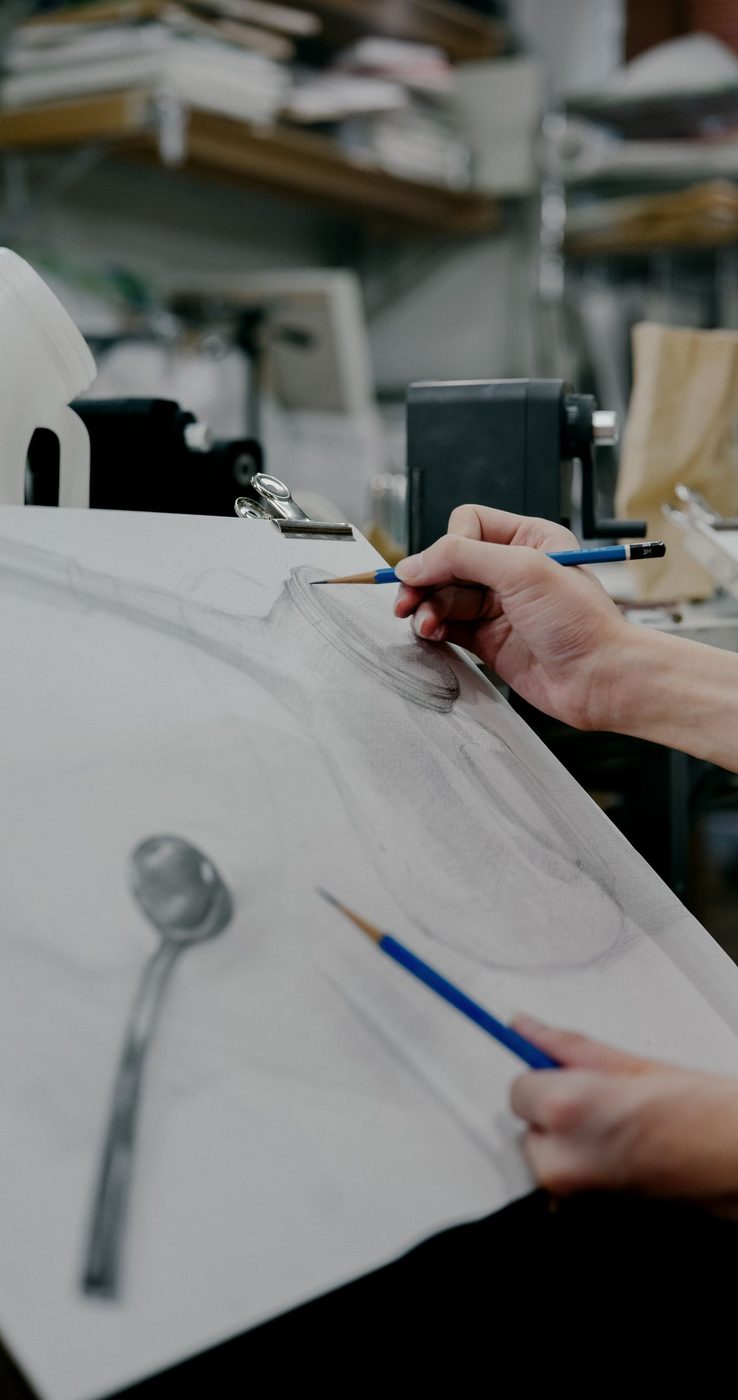
Four objectives, equally weighted. Three of them describe a process.
- AO1 Develop Ideas developed through investigations. Process
- AO2 Refine Ideas refined by experimenting with media. Process
- AO3 Record Observations recorded as work progresses. Process
- AO4 Present A personal and meaningful response. Product
A department that assesses mostly outcomes has quietly reduced the subject to a quarter of itself.
A National Centre for Arts and Music Education is due to begin operating this September, on a three-year contract worth £13 million and running to August 2029. It will run online training for teachers, broker partnerships between schools and cultural organisations, and from September 2027 take on the funding of the music hubs from Arts Council England. An Enrichment Framework is being built alongside it. DfE procurement notice, 6 February 2026; DfE announcement, 18 March 2025
And the Curriculum and Assessment Review has recommended removing the EBacc performance measure, which since 2010 has shaped which subjects a Year 9 could realistically pick. The government aims to publish the revised national curriculum by spring 2027, for first teaching in September 2028.
For anyone who has led an art department through the last decade, this is the first genuinely good week in a long time. But be precise about what has happened: the ceiling has been raised, and nothing has yet been said about the floor.
The figures arrived in the same fortnight
Four days before this was written, A Level results were published. Arts entries fell again, to 90,985. That is 10.0% of all A Level entries, the smallest share on record, and the share has fallen 34% since 2010. Art and design, by far the most-entered arts subject, slipped to its own record low of 4.7% of entries. GCSE figures follow this week. Campaign for the Arts analysis of JCQ data, 13 August 2026
So the money and the decline are arriving together, and the money is arriving slowly. The curriculum lands in classrooms in September 2028. The hubs handover has already moved back a year. A Year 9 choosing options this autumn will have finished their GCSE before any of it reaches them.
Access is not the same as quality
The levers in the announcement are all access levers. They change how many pupils can get through the door of an art room. That matters enormously, and it is not the same problem as what happens once they are inside it.
What the funding can do
- Put an artist in the hall.
- Fund the trip to the gallery.
- Stop the option block squeezing art out.
- Make the subject easier to choose.
What it cannot do
- Sequence three years of knowledge.
- Demonstrate a technique at pupils’ scale.
- Decide who chooses what, and when.
- Make two teachers mark the same portfolio the same.
None of the right-hand column can be bought, brokered or framed. All of it is departmental, and all of it is free. It is also the difference between a pupil who chooses art and a pupil who does well at it.
Three of the four objectives describe a process
The four assessment objectives are set by Ofqual and carry 25% each, identically across AQA, Edexcel, OCR and Eduqas. Three of them describe what a pupil did: develop, refine, record. Only the fourth describes what they produced. AO3 is explicit about when: observations recorded as work progresses. Annotation written in May about work made in November is not recording, whatever else it is.
Which is why the sketchbook is not a presentation object. It is the only place three quarters of the marks can actually be seen. That makes how pupils are taught to use it a mark-bearing decision.
- Weak A full-page copy of a photograph, neatly mounted, with the artist’s name underneath. One source, reproduced. It evidences care, and care is not an assessment objective.
- Developing The copy, plus a small colour study beside it and a sentence saying which the pupil prefers. A comparison has appeared. But preference is not analysis, and nothing follows from it.
- Strong Three quick media tests, one circled, a note on why, and a thumbnail showing where it goes next. Selection with a reason, and a forward move. Two objectives visible on one spread.
- Exceptional The above, plus one test crossed through: “too even, loses the edge I wanted”. The next page is already acting on it. The rejected test is the evidence of judgement. The thinking continues across the turn.
None of these four takes longer than the others. The difference is what the pupil believes the book is for, and a department tells them that every week, mostly without meaning to.
Where departments drift
Four drifts, and not one of them is caused by weak teaching. Each is a reasonable decision that stopped being examined, held in place by a sentence nobody in the room would think to question.
- 01
The copy that never becomes a response
A pupil finds an image, reproduces it well, and stops. The page is skilful and the thinking is absent. Nobody intervenes, because the work looks good.
“It’s a really strong drawing. Leave it.”
- 02
The sketchbook as decoration
Pages get tidied, backgrounds painted, edges neatened. Time that should buy experiments buys presentation. The book stops being a record and becomes an object.
“Make sure it looks nice for the moderator.”
- 03
Independence assumed, never taught
Pupils are told to be independent in Year 10 having chosen nothing for three years. Independence is treated as a personality trait some of them turn out to have.
“The strong ones just get on with it.”
- 04
A standard nobody agreed
Two teachers mark the same portfolio a grade apart and neither knows. It surfaces at moderation, in June, when nothing can be done about it.
“That’s about a five, I’d say.”
What the four have in common is that each substitutes something visible for something assessed. A tidy page for a tested idea. A finished drawing for a developed one. A confident pupil for a taught one. A number for an agreed standard.
Whole-school teaching strategies or assessment practices are likely to be too generic to capture the forms of knowledge that pupils build through the art and design curriculum.
Ofsted, Research review series: art and design, February 2023
That is Ofsted telling art departments that the school’s standard marking policy is probably not fit for this subject. It is the most useful sentence a head of art can have in their pocket when a whole-school system arrives wanting a percentage every half term. It works far better than arguing that art is different. Show what the four objectives measure, and ask which of them a percentage captures.
The thing no announcement can fund quickly
There were 1,040 fewer art and design teachers in secondary schools between 2010 and 2020, a fall of around 8%. Around two thirds of primary trainees reported not feeling confident about teaching arts subjects. Those two facts meet in the same place: a Year 7 cohort arriving with a wider spread of prior experience than any scheme of work assumes. Ofsted, Research review series: art and design, 2023
Departments answer that in one of two ways. Some lower the entry point, which quietly removes two years of curriculum from the top end. Others teach the basics explicitly and fast, then move on. They start from the assumption that nothing has been taught, instead of the assumption that everything has. The second is more work in September and considerably less work in Year 11.
What the wall is teaching
Every art department is judged, informally and constantly, by what is on its walls. Parents see it at open evening and colleagues see it on the way to the hall. Pupils see it every day, and they learn from it what the subject values. Which makes the display the most under-used teaching tool in the building.
A wall of resolved, beautiful outcomes teaches pupils that art is the production of beautiful outcomes. Three of the four things they are assessed on are nowhere on it. That is not a display decision. It is a curriculum statement, and it costs exactly the same as the other kind.
So take the good news, and then walk your own corridor. Put one failed experiment next to the outcome it produced, and label it honestly. It takes a morning, and it needs no funding settlement. It tells every pupil who walks past what this department actually believes the subject is for.