New · Free · AQA GCSE Chemistry
Chemistry Paper 1: a free revision guide, built from AQA’s own papers
Written for AQA GCSE Chemistry (8462), Paper 1. Every topic on two pages, exam questions answered and marked in red pen, the equations, moles and graph skills the paper really tests, and a practice paper with answers. Print it as a class set and use it from tomorrow.
Thank you. Your download is ready.
Download the PDF — 4.0MB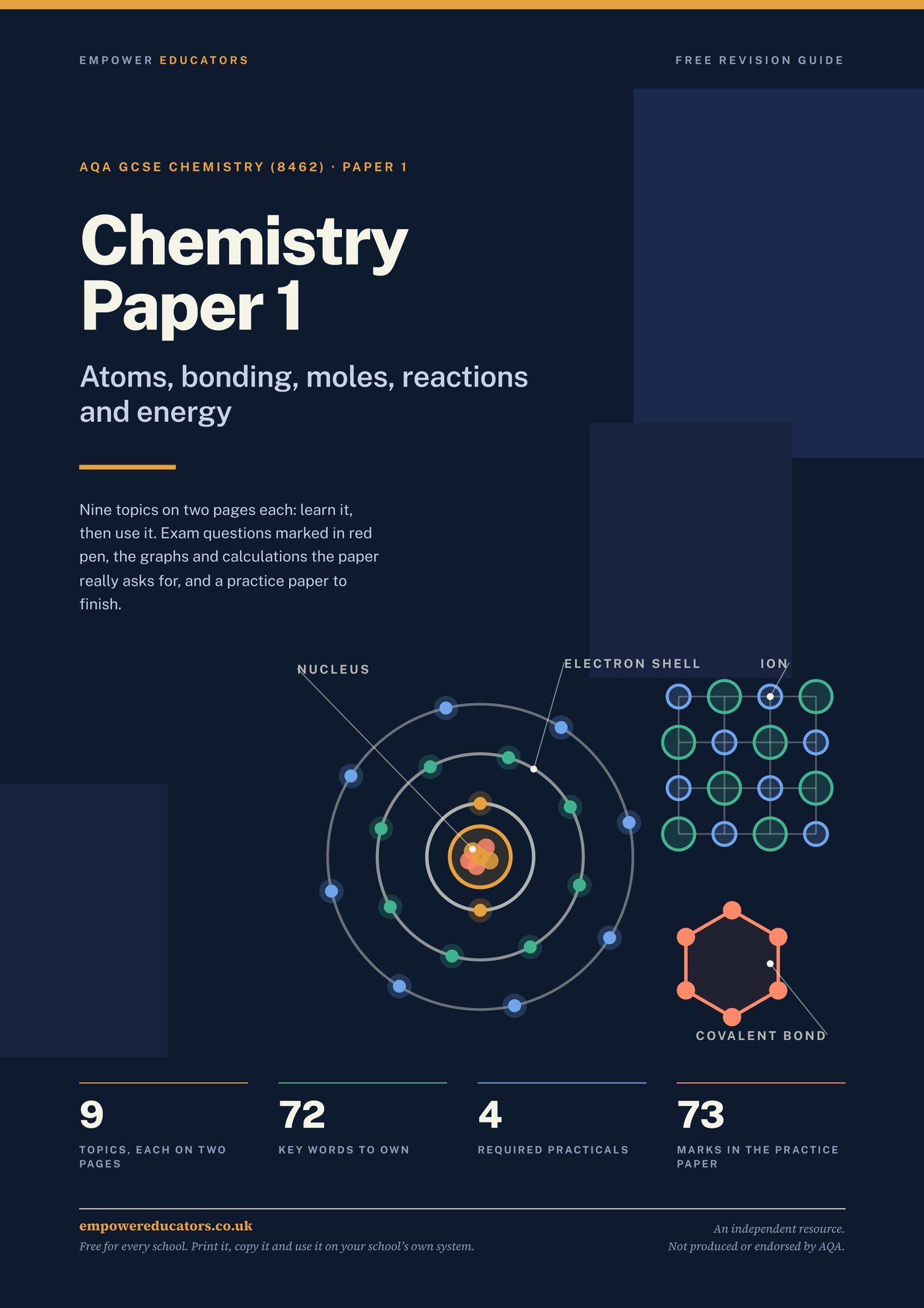
Look inside before you download
The first eight pages, free to read here with no watermark. Click a page to read it larger.
A guide that asks pupils to do something
1
Learn it
Every topic opens with sixty seconds of the topic, then the facts to know. Each fact has a circle to colour: know it, shaky, missed. The key words sit beside them with a box to tick, and a Spot it question on a sticky note tests one idea.
2
Use it
Then the page turns to a diagram or table, an exam question answered and marked in red pen (a few lose marks, so pupils see why), the ways the topic could be asked, and a blank box. Cover both pages and write the answer from memory.
3
Test it
Pages for ions, formulae and equations, the maths, moles and titrations, graphs and data, and the four required practicals. Two six-mark answers, marked, and a page of what AQA’s examiners saw students get wrong. Then a practice paper with its answers, and a tracker.
Every Paper 1 topic, and the skills
- Atoms and isotopes
- The periodic table
- Ionic and metallic bonding
- Covalent bonding and giant structures
- Mass and moles
- Reactivity of metals
- Acids, bases and salts
- Electrolysis
- Energy changes
That is topics 1 to 5 of the specification: atomic structure and the periodic table; bonding, structure and the properties of matter; quantitative chemistry; chemical changes; and energy changes. Paper 2 is not in this guide.
Built from AQA’s own documents
- The facts follow AQA’s GCSE Chemistry specification (8462).
- The exam advice comes from AQA’s own Paper 1 papers, mark schemes and examiners’ reports (November 2021, June 2022 and June 2023), and its command words list.
- No AQA question or mark scheme is copied. Every question in the guide was written for it.
- It is an independent resource, not produced or endorsed by AQA.
This is the first edition, and a serving science teacher has not read it through yet. If you teach GCSE Chemistry and spot anything that should change, tell us at info@empowereducators.co.uk and we will fix it.
Why it is free
We write exam board books for heads of department, and we sell them. This guide is one we give away. It shows how we work: the content follows the exam board’s own list, the exam advice comes from its own papers, and nothing is there to pad the page count.
If it helps your pupils, the rest of the Chemistry shelf is below. If it does not, you have lost nothing.
For the teacher printing it
Print it double-sided. Black and white works, though the cover is navy and the red pen shows as grey. Use it as a class set, or put it on your school’s own system. The contents page has a four-week plan, and the tracker at the back lets a pupil see what they have revisited.
Please do not pass it to other schools or put it on public websites.
Questions teachers ask
- Is it really free?
- Yes. We ask for a name and an email address, and one question: would you like to hear about new resources? Yes or no, you get the guide either way.
- Which course does it cover?
- AQA GCSE Chemistry (8462), Paper 1: topics 1 to 5. Paper 2 (the rate and extent of chemical change, organic chemistry, chemical analysis, the atmosphere and using resources) is not in it.
- Is it for Combined Science?
- AQA Combined Science: Trilogy (8464) shares much of this content, but its papers are different. Items marked Chemistry only in the guide are not in Trilogy, so check your own specification.
- Is it for Foundation or Higher tier?
- Both. Content for Higher tier only is marked HT, so Foundation pupils can skip it.
- Is it written by AQA?
- No. It is independent and is not produced or endorsed by AQA.
The rest of the Chemistry shelf
-
 The Science playbook The science department’s playbook, with Chemistry inside it.
 -
 Schemes of work Year 10 to Year 11, unit by unit and in teaching order.
 -
 Exam board playbooks The science department’s books, one for each board.
 -
 GCSE questions and answers Exam-style questions, each answered weak, middling and strong.
 -
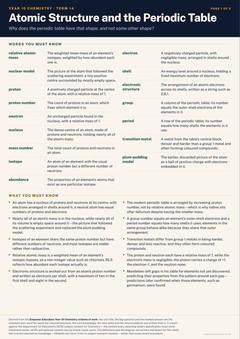 Knowledge organisers Year 10 to Year 11. One A4 sheet a unit.
 -
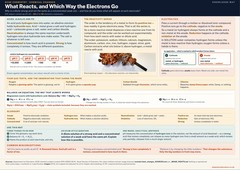 GCSE knowledge mats One landscape sheet a topic.
 -
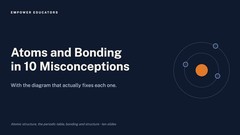 GCSE PowerPoints Atoms and bonding, with diagrams you can edit.
 -
 A Level revision guide The core ideas beside a figure, worked examples and the misconceptions that cost marks.