
Chemistry · KS3 to A Level £4.99
Chemistry Key Terms
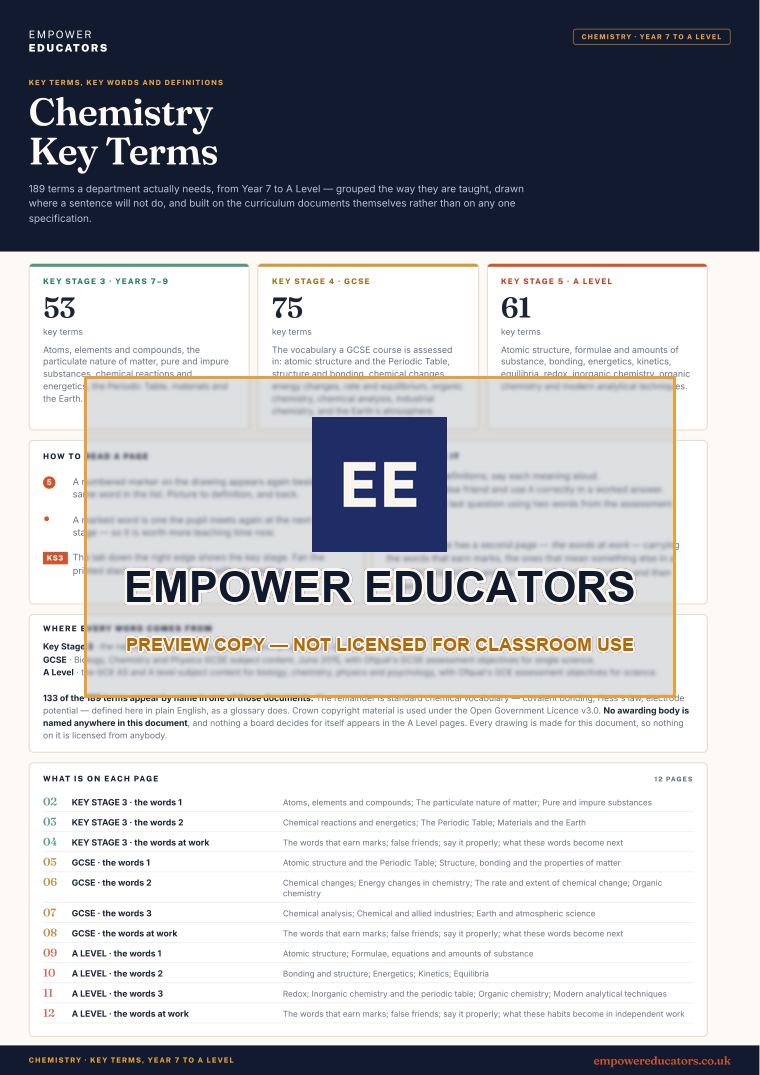
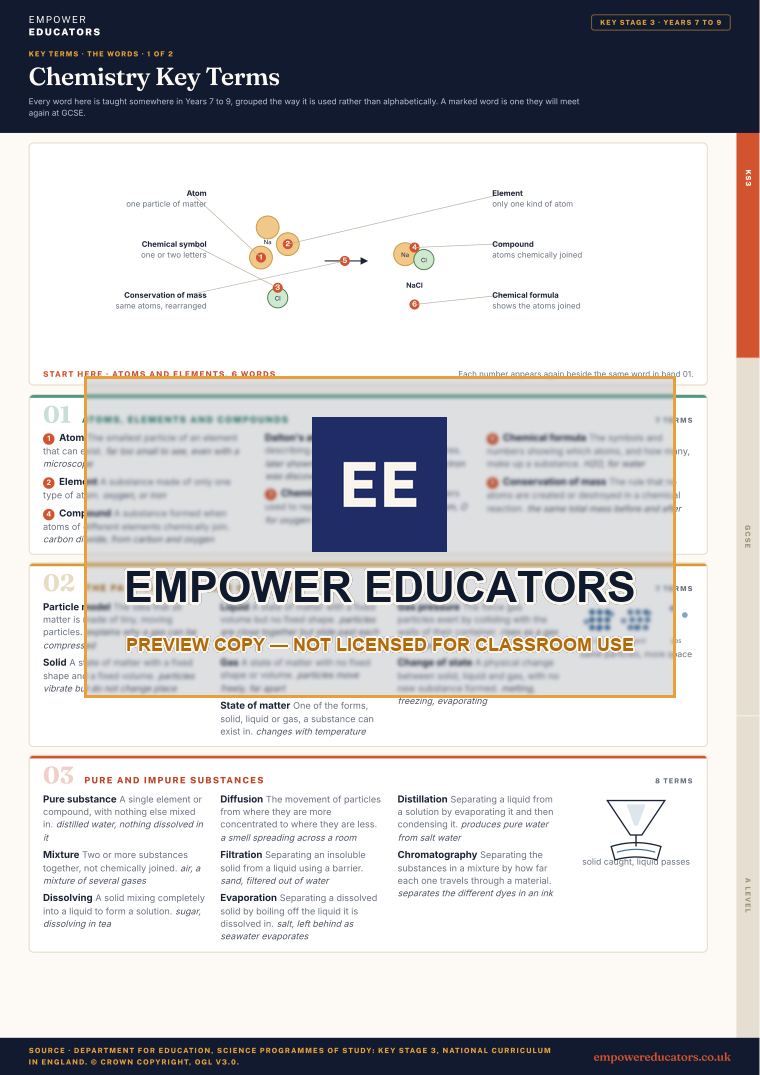
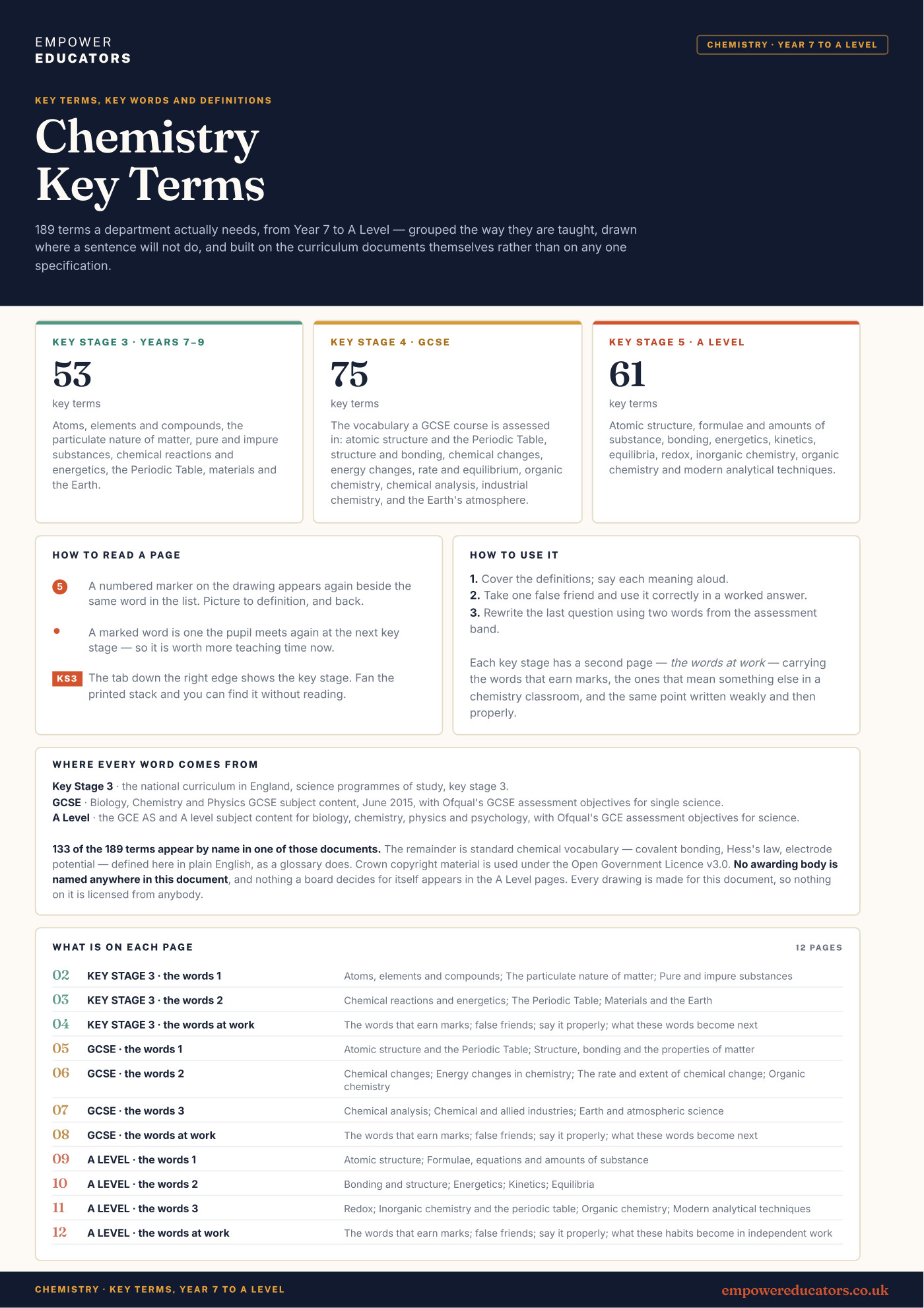
Every word a chemistry department teaches, Year 7 to A Level, in one A4 book. Each key stage gets its own pages: the terms grouped the way they are taught rather than alphabetically, a definition that fits on two lines, and a worked example beside almost every one. Each key stage opens on a genuinely different model of the atom, drawn, because the real curriculum teaches three different ones in sequence — a Dalton-style particle scene at Key Stage 3 (the national curriculum names only that model, not the electron), a nucleus and electron shells at GCSE, and an electron-configuration diagram with a mass-spectrum inset at A Level — and the numbers on each appear again beside the same words in the list; a further twenty-one pages carry a real drawn figure wherever a picture genuinely teaches faster than a sentence: a reaction profile's hump, a titration curve's end point, the three ways atoms bond, Le Chatelier's balance tipping. Then a page on using the words: the ones the assessment itself is written in, the false friends that mean something else in a chemistry classroom — a solution is not an answer to a problem, reduce is not making something smaller, a radical is not extreme — the same point written weakly and then properly, and what each word becomes at the next key stage.
The DfE's science programmes of study at Key Stage 3 (September 2013, DFE-00185-2013), the Biology, Chemistry and Physics GCSE subject content (June 2015, DFE-00352-2014), and the GCE AS and A level subject content for biology, chemistry, physics and psychology (April 2014, DFE-00356-2014); GCSE and A Level also follow Ofqual's subject-level conditions, which set the assessment objectives quoted on the words-at-work pages, including the rule that mathematical skills make up at least 20% of an A Level chemistry assessment, double biology's 10%; 133 of 189 terms appear by name in one of those documents and the cover says so, the rest are standard chemical vocabulary defined here in plain English; no awarding body is named, and nothing a board decides for itself appears in the A Level pages · 12 pages, 11 sections ·For chemistry departments: printed one per pupil, kept in the front of an exercise book, or put on the wall by key stage