Empower
Educators
Search
All key terms

Chemistry · KS3 to A Level

Chemistry Key Terms

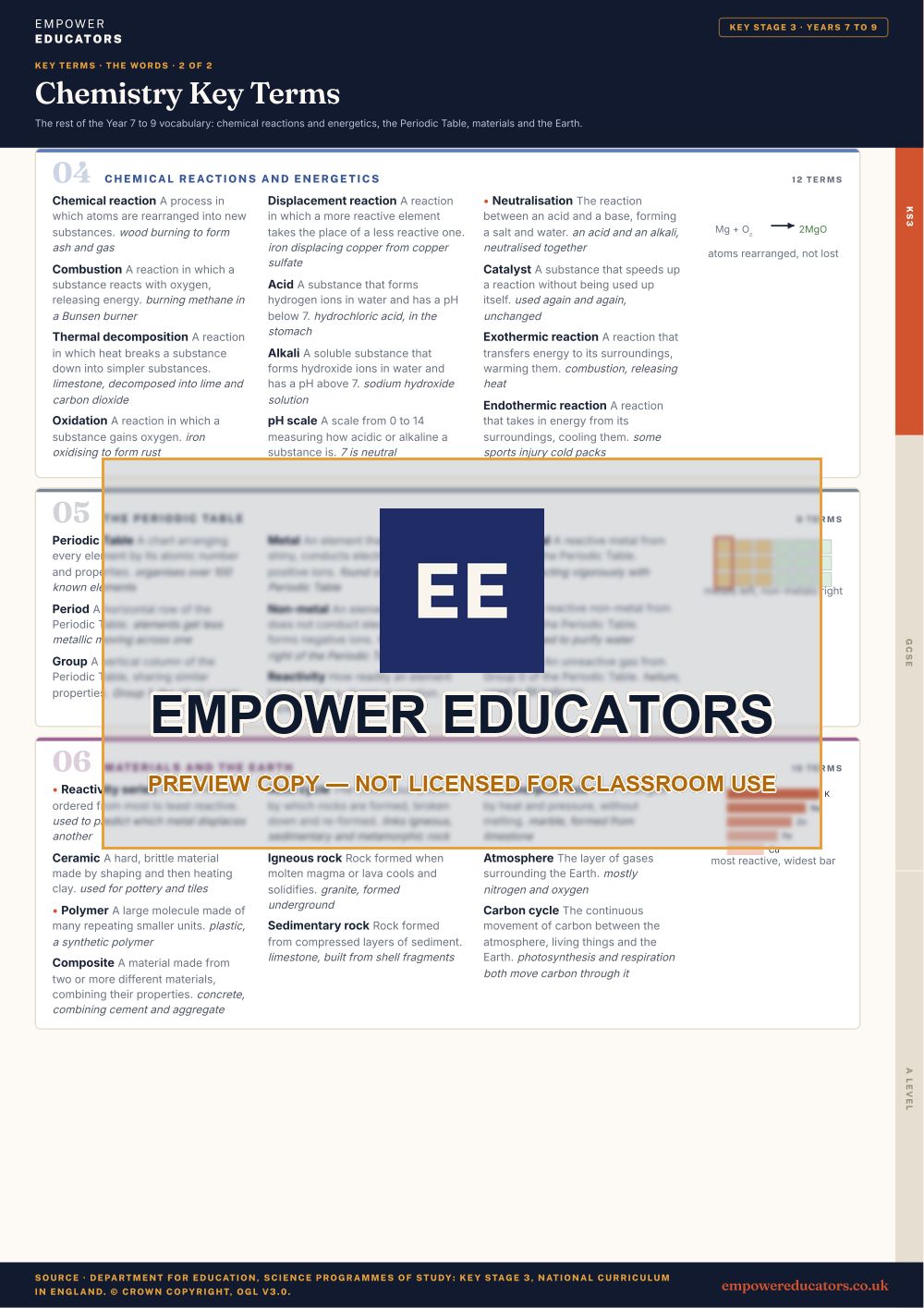
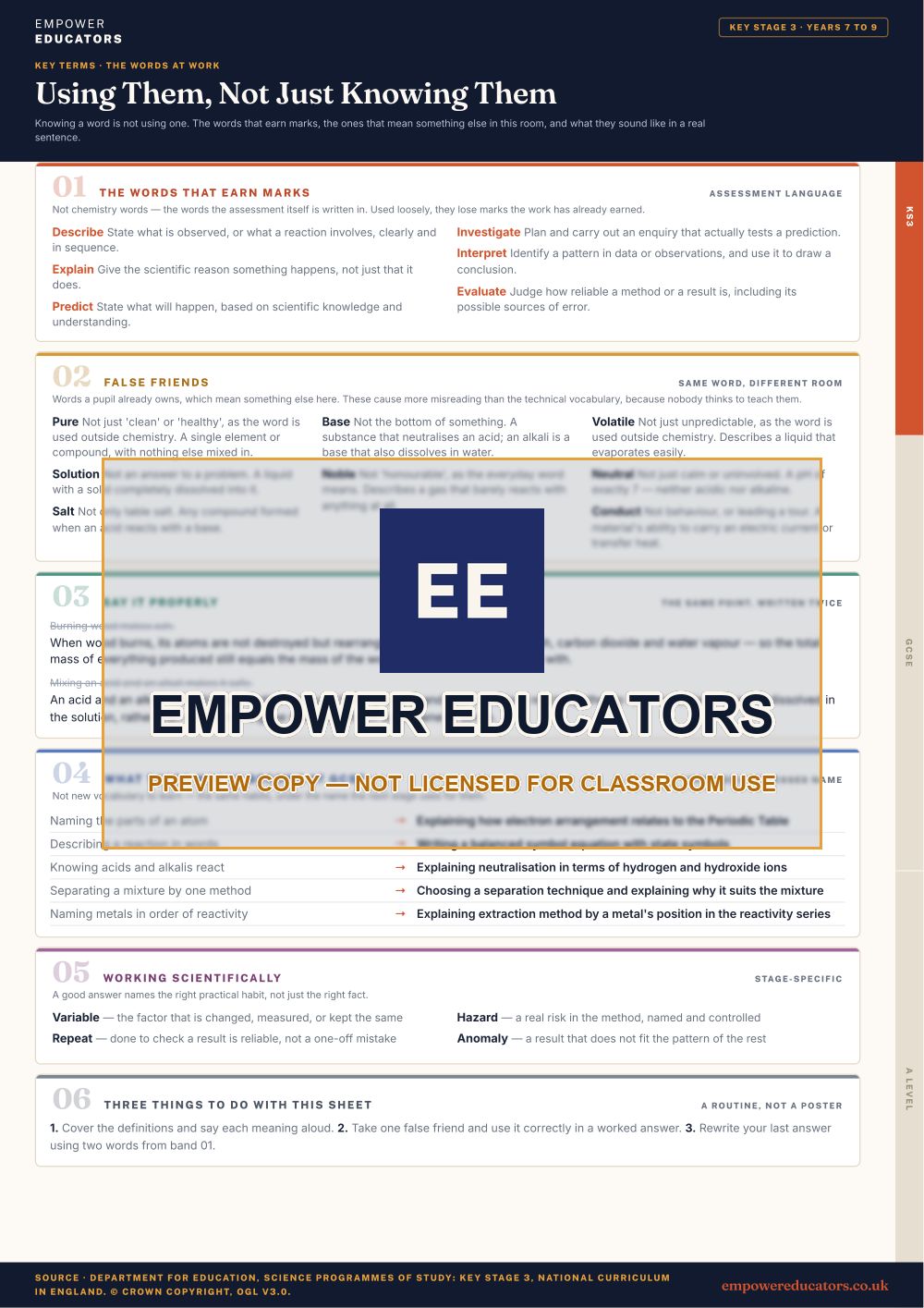
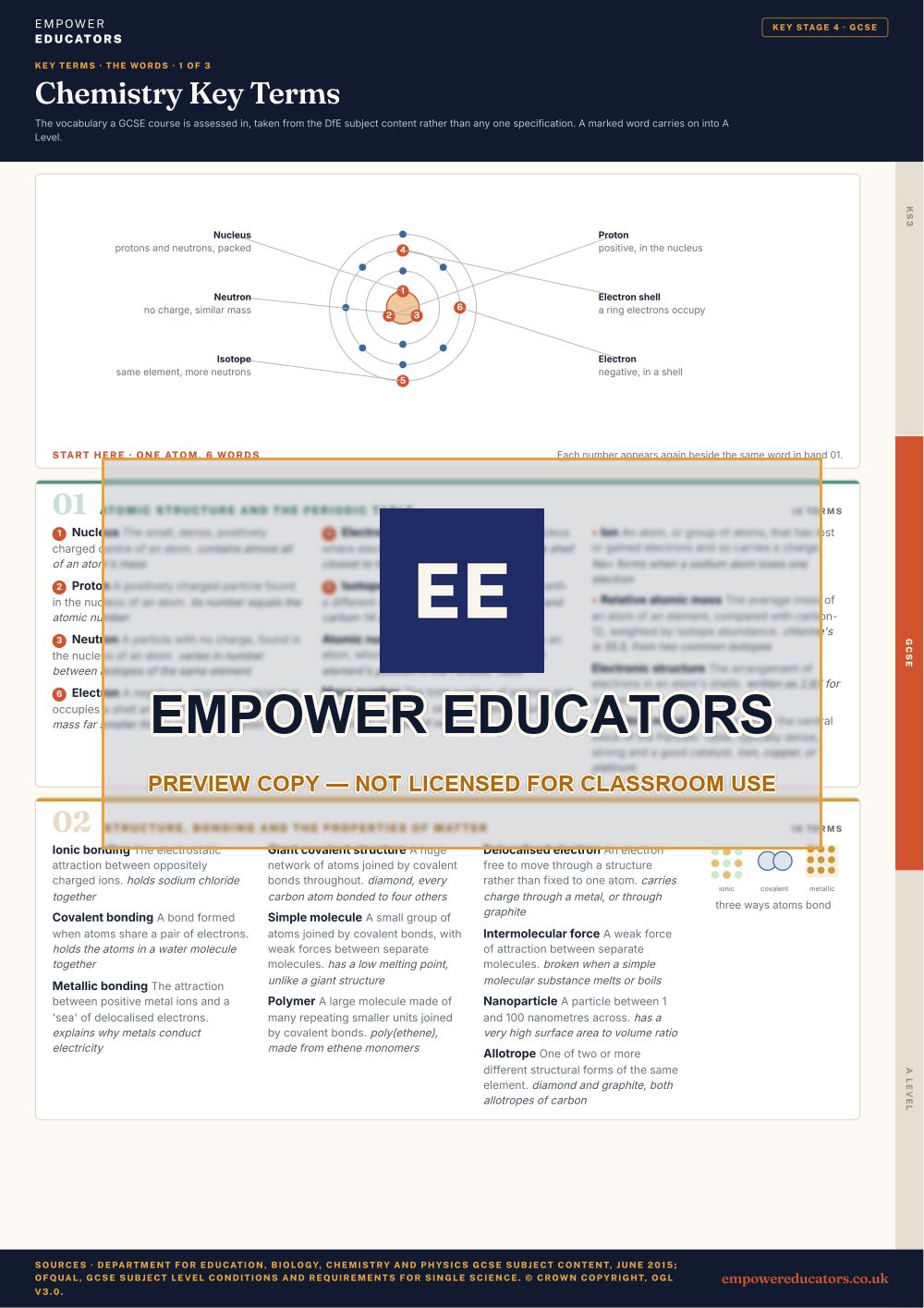
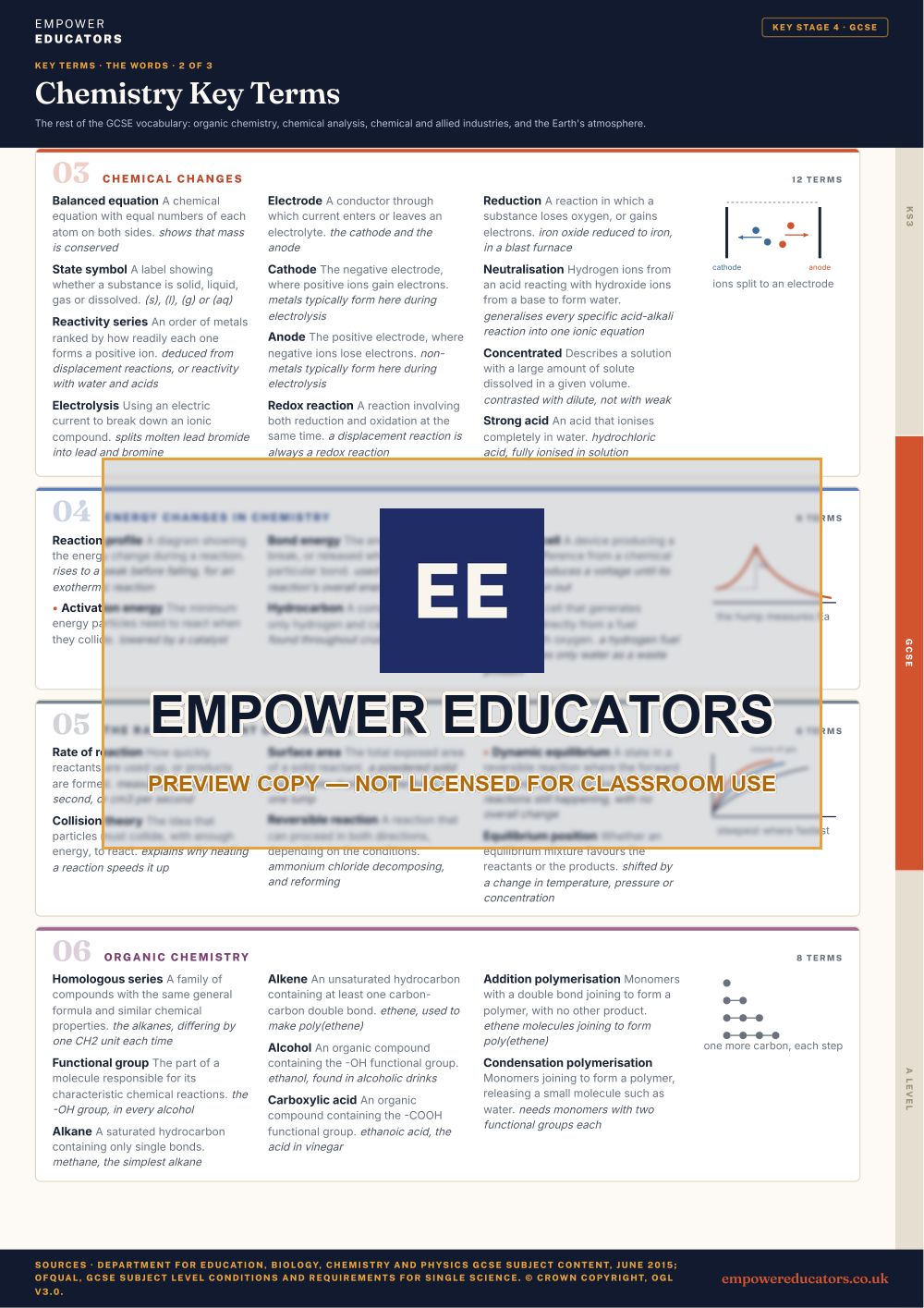
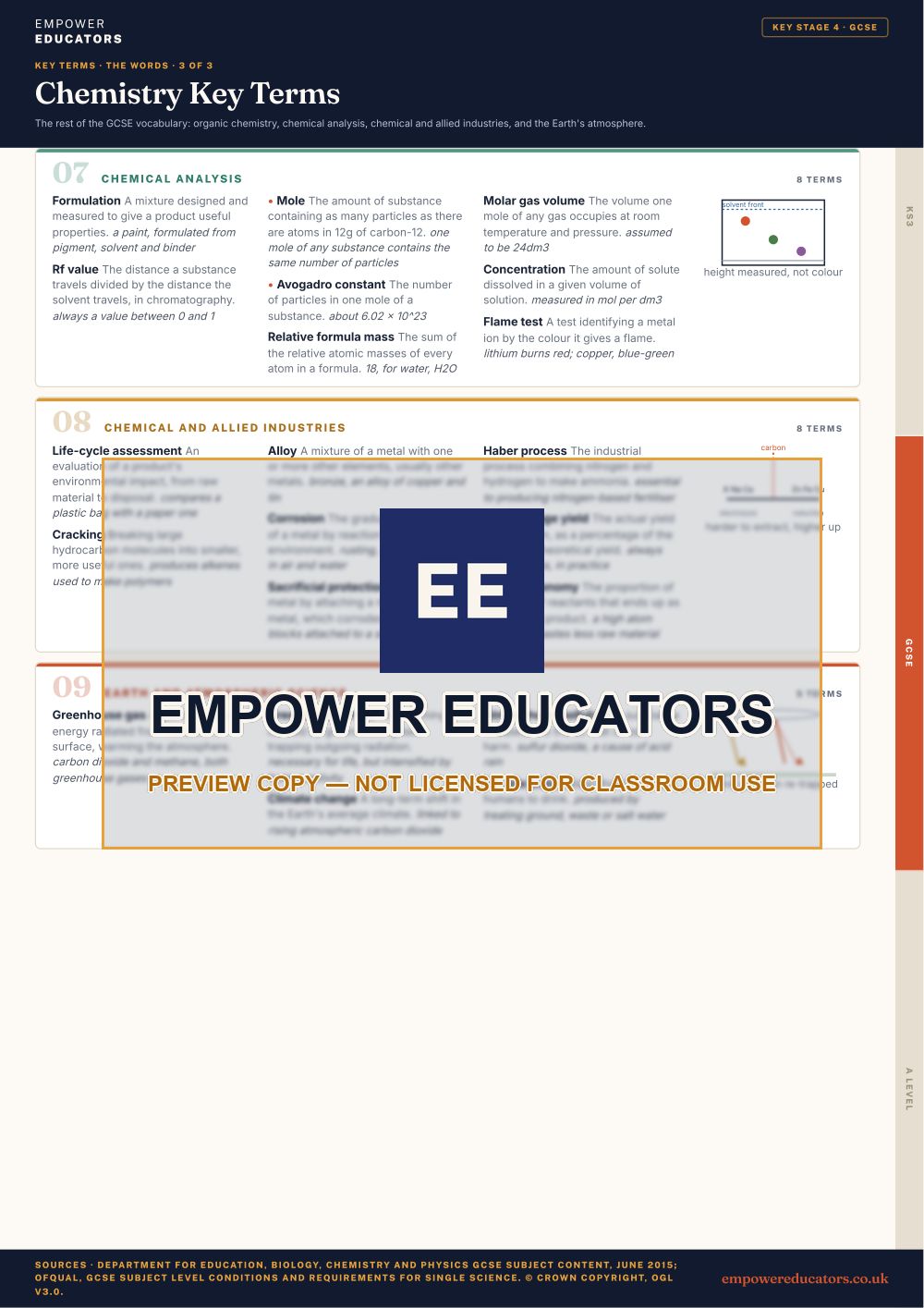
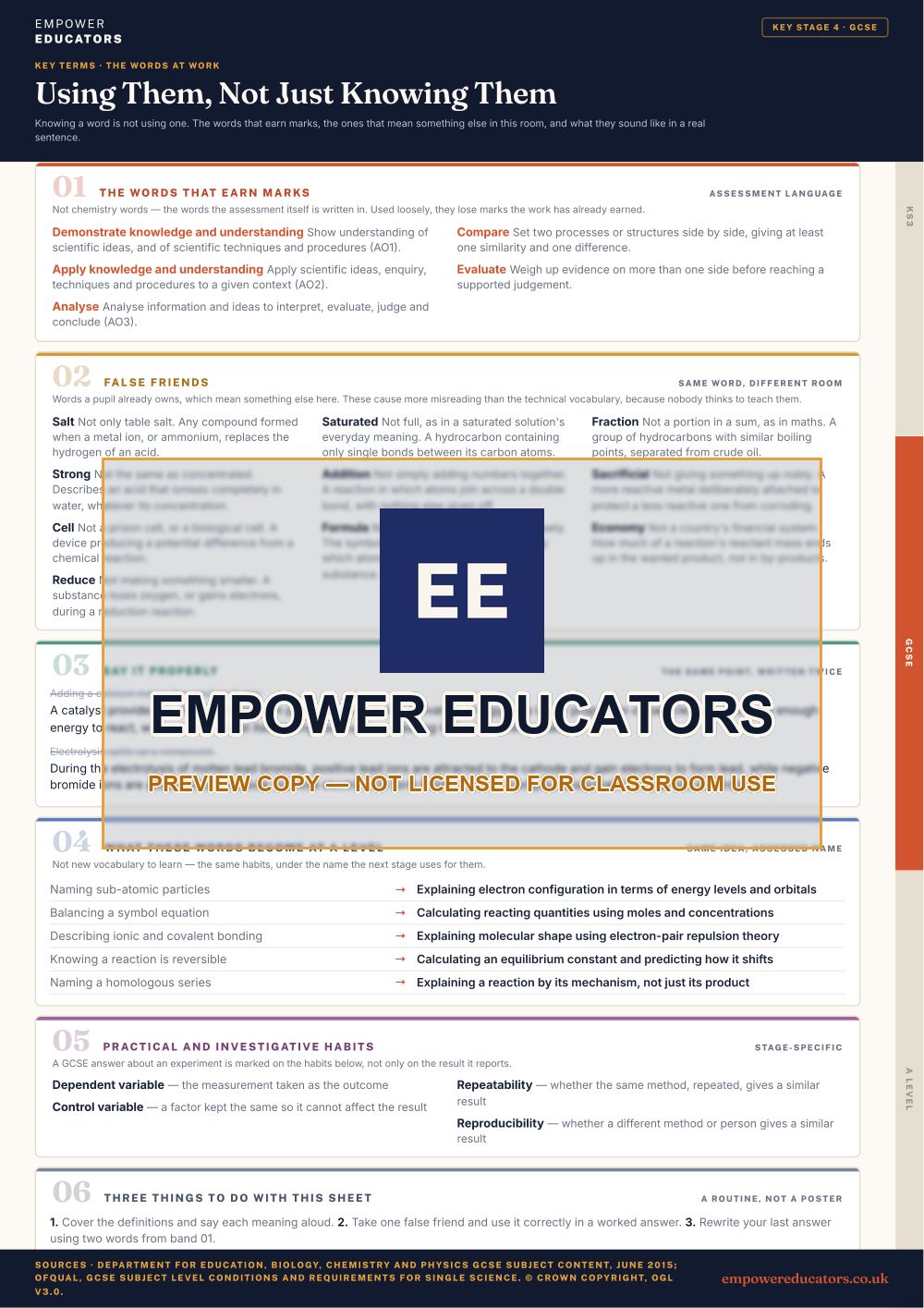
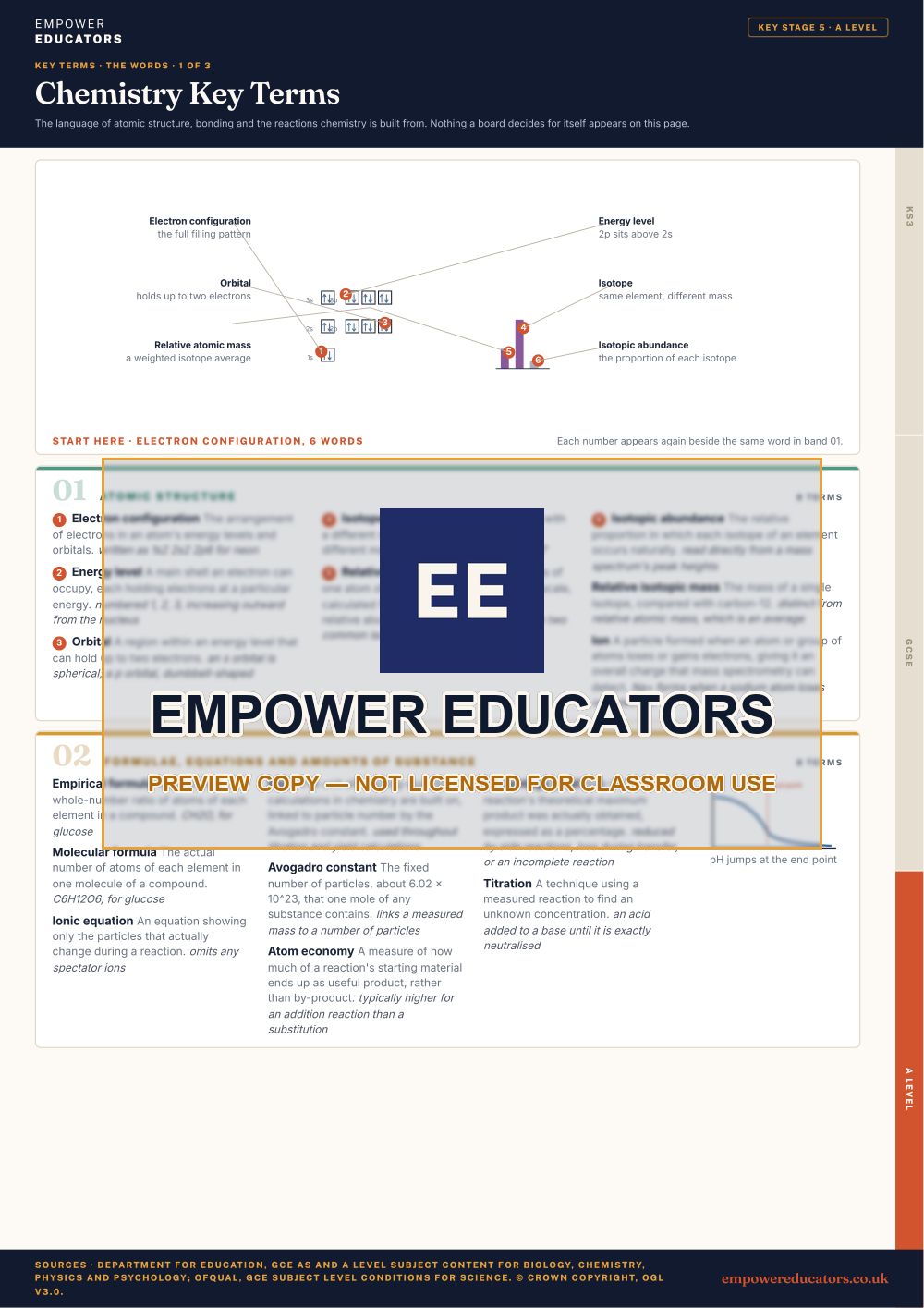
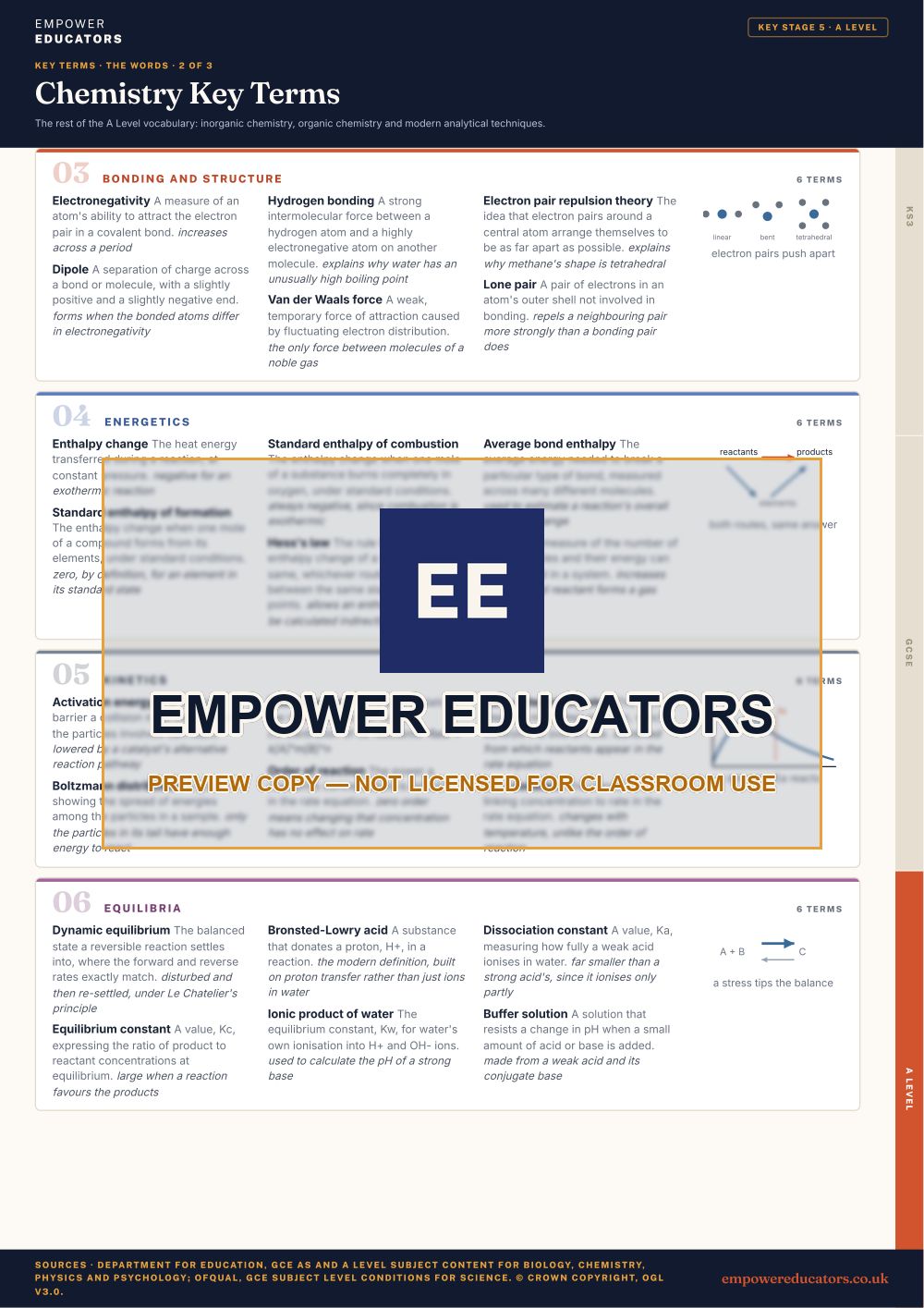
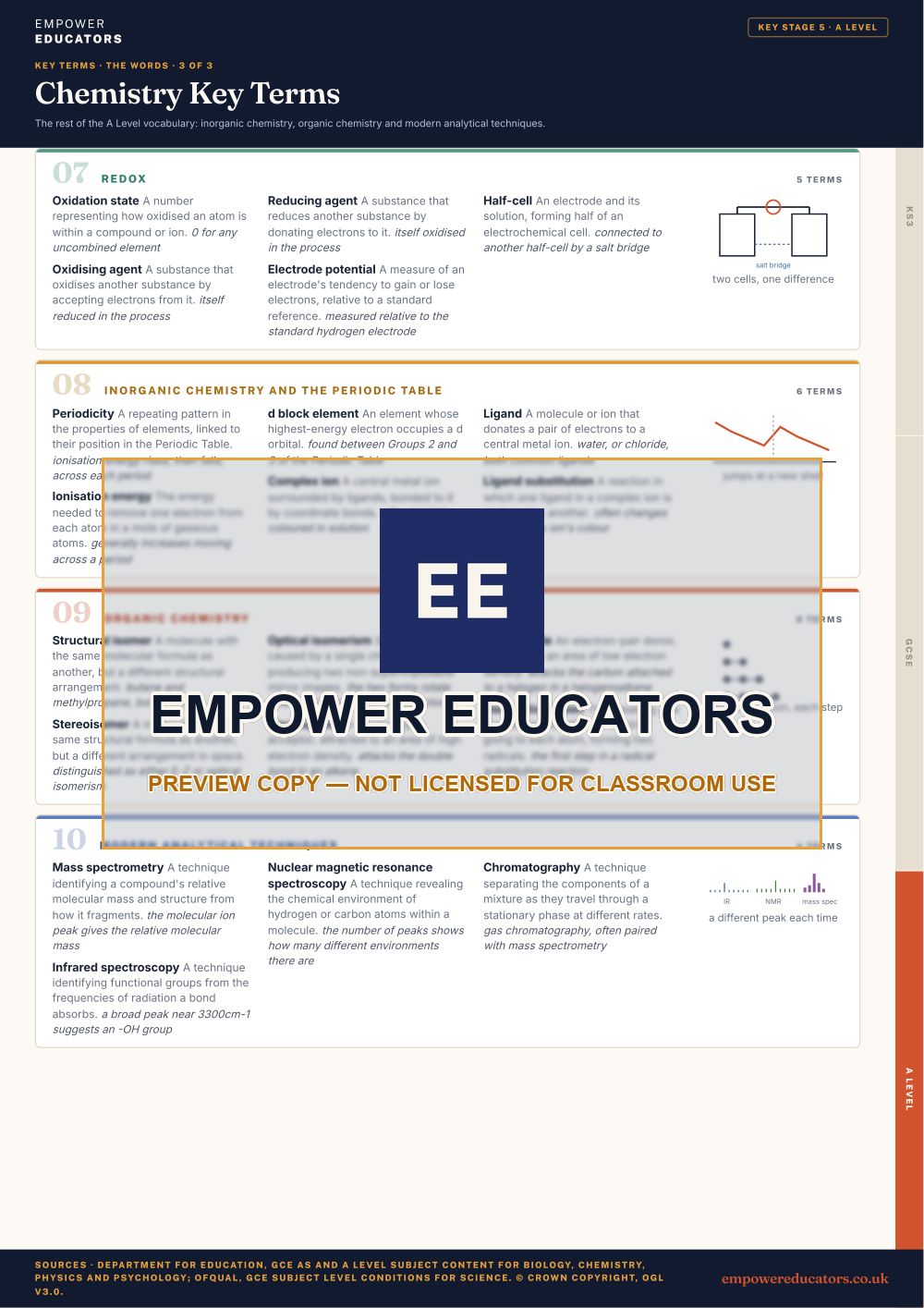
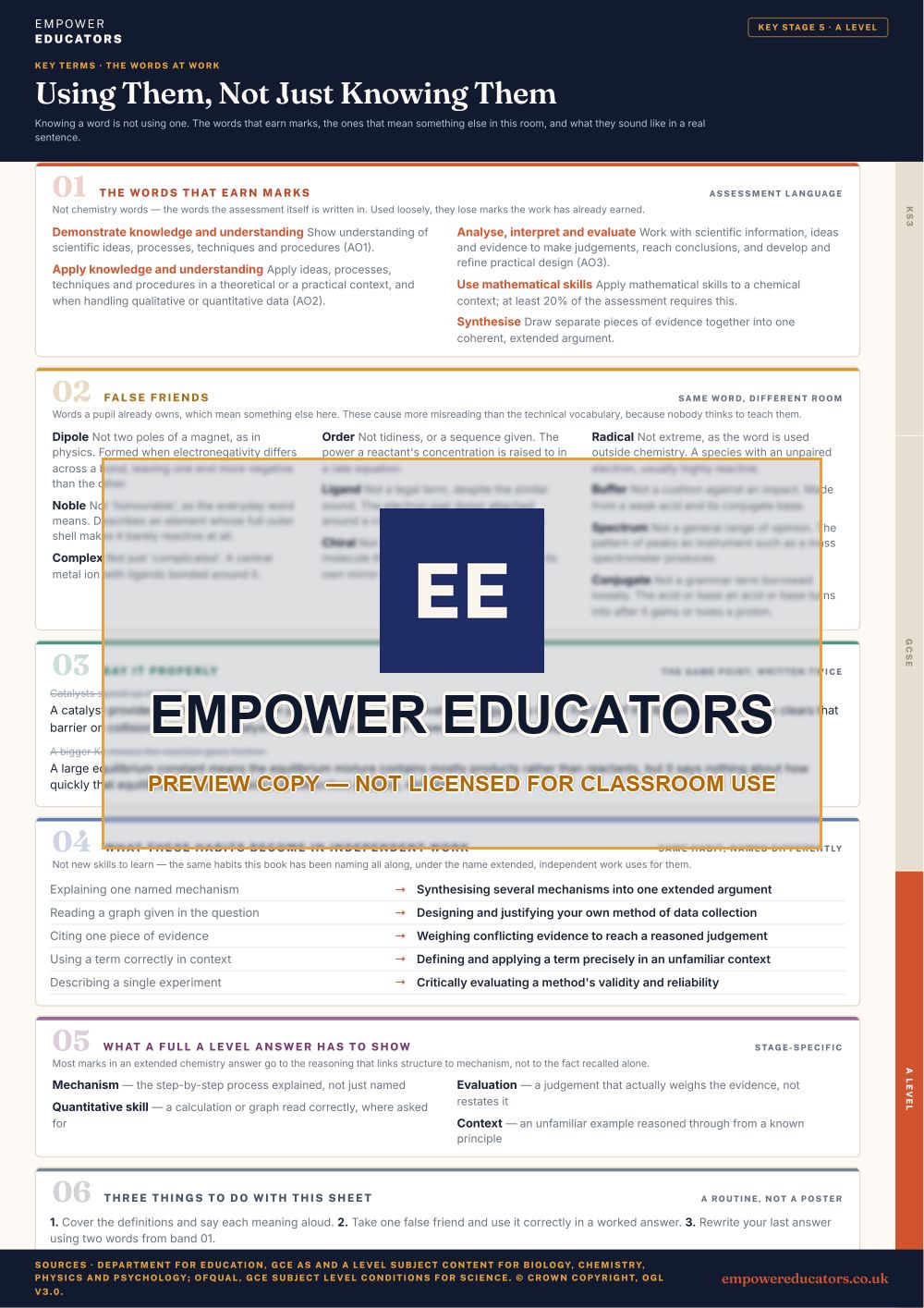
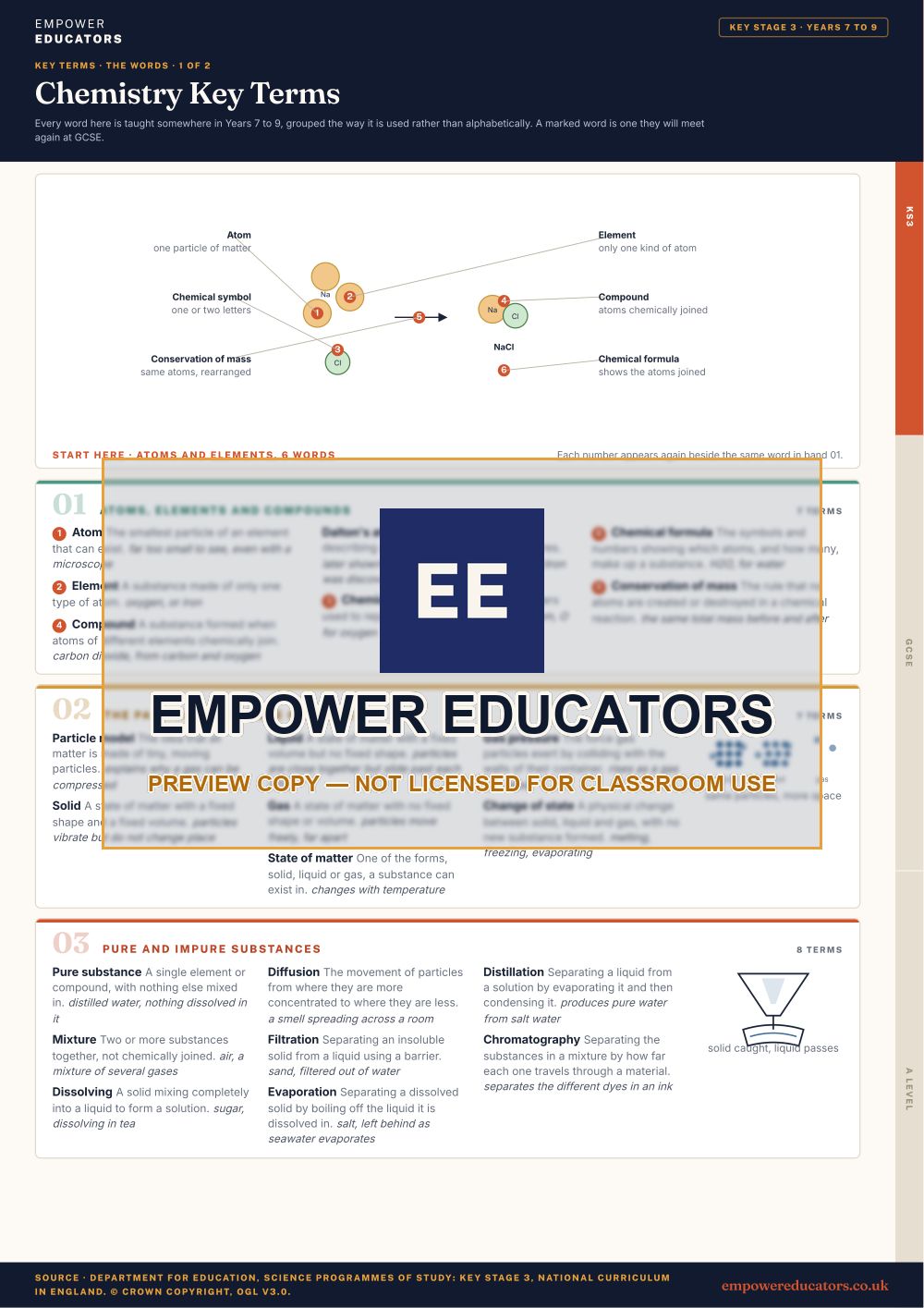
Every word a chemistry department teaches, Year 7 to A Level, in one A4 book. Each key stage gets its own pages: the terms grouped the way they are taught rather than alphabetically, a definition that fits on two lines, and a worked example beside almost every one. Each key stage opens on a genuinely different model of the atom, drawn, because the real curriculum teaches three different ones in sequence — a Dalton-style particle scene at Key Stage 3 (the national curriculum names only that model, not the electron), a nucleus and electron shells at GCSE, and an electron-configuration diagram with a mass-spectrum inset at A Level — and the numbers on each appear again beside the same words in the list; a further twenty-one pages carry a real drawn figure wherever a picture genuinely teaches faster than a sentence: a reaction profile's hump, a titration curve's end point, the three ways atoms bond, Le Chatelier's balance tipping. Then a page on using the words: the ones the assessment itself is written in, the false friends that mean something else in a chemistry classroom — a solution is not an answer to a problem, reduce is not making something smaller, a radical is not extreme — the same point written weakly and then properly, and what each word becomes at the next key stage.
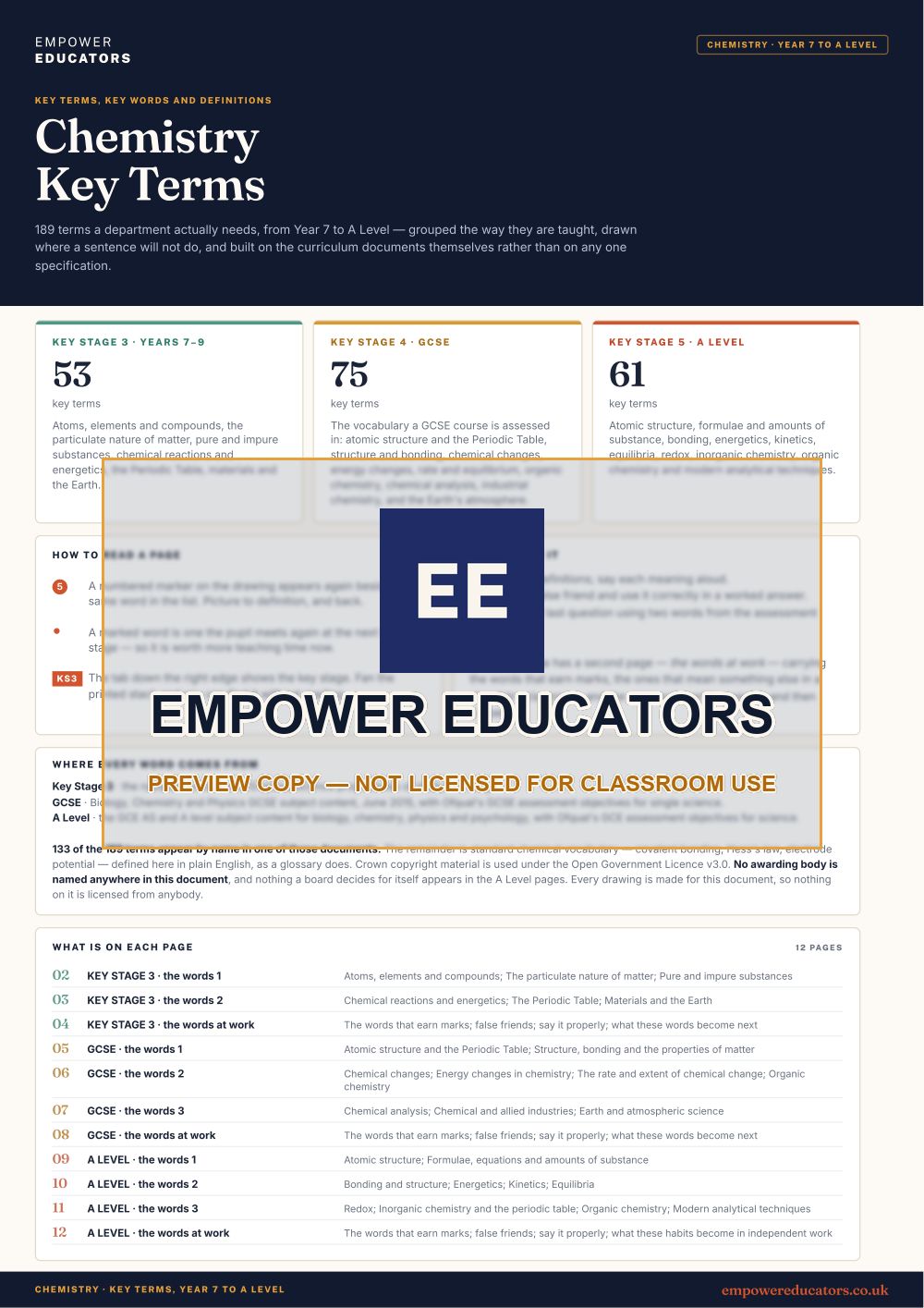
12 pages 11 sections 12 free to read here
All key terms
Page 1 of Chemistry Key Terms
Page 1
Key Stage 3 · the words 1: Atoms, elements and compounds; The particulate nature of matter; Pure and impure substances · Chemistry Key Terms, page 2
Page 2 Key Stage 3 · the words 1: Atoms, elements and compounds; The particulate nature of matter; Pure and impure substances
Key Stage 3 · the words 2: Chemical reactions and energetics; The Periodic Table; Materials and the Earth · Chemistry Key Terms, page 3
Page 3 Key Stage 3 · the words 2: Chemical reactions and energetics; The Periodic Table; Materials and the Earth
Key Stage 3 · the words at work: The words that earn marks; false friends; say it properly; what these words become next · Chemistry Key Terms, page 4
Page 4 Key Stage 3 · the words at work: The words that earn marks; false friends; say it properly; what these words become next
GCSE · the words 1: Atomic structure and the Periodic Table; Structure, bonding and the properties of matter · Chemistry Key Terms, page 5
Page 5 GCSE · the words 1: Atomic structure and the Periodic Table; Structure, bonding and the properties of matter
GCSE · the words 2: Chemical changes; Energy changes in chemistry; The rate and extent of chemical change; Organic chemistry · Chemistry Key Terms, page 6
Page 6 GCSE · the words 2: Chemical changes; Energy changes in chemistry; The rate and extent of chemical change; Organic chemistry
GCSE · the words 3: Chemical analysis; Chemical and allied industries; Earth and atmospheric science · Chemistry Key Terms, page 7
Page 7 GCSE · the words 3: Chemical analysis; Chemical and allied industries; Earth and atmospheric science
GCSE · the words at work: The words that earn marks; false friends; say it properly; what these words become next · Chemistry Key Terms, page 8
Page 8 GCSE · the words at work: The words that earn marks; false friends; say it properly; what these words become next
A Level · the words 1: Atomic structure; Formulae, equations and amounts of substance · Chemistry Key Terms, page 9
Page 9 A Level · the words 1: Atomic structure; Formulae, equations and amounts of substance
A Level · the words 2: Bonding and structure; Energetics; Kinetics; Equilibria · Chemistry Key Terms, page 10
Page 10 A Level · the words 2: Bonding and structure; Energetics; Kinetics; Equilibria
A Level · the words 3: Redox; Inorganic chemistry and the periodic table; Organic chemistry; Modern analytical techniques · Chemistry Key Terms, page 11
Page 11 A Level · the words 3: Redox; Inorganic chemistry and the periodic table; Organic chemistry; Modern analytical techniques
A Level · the words at work: The words that earn marks; false friends; say it properly; what these habits become in independent work · Chemistry Key Terms, page 12
Page 12 A Level · the words at work: The words that earn marks; false friends; say it properly; what these habits become in independent work

Ready for the classroom

Get the clean copy

You have seen the whole layout of all 12 sheets, with part of each blurred in the preview. What you buy is the same set without the watermark or the blur, at full print resolution, ready to run off for every class in the department.

  • Every sheet with no watermark, at print resolution
  • 5 print-and-use templates
  • Referenced to the DfE's science programmes of study at Key Stage 3 (September 2013, DFE-00185-2013), the Biology, Chemistry and Physics GCSE subject content (June 2015, DFE-00352-2014), and the GCE AS and A level subject content for biology, chemistry, physics and psychology (April 2014, DFE-00356-2014); GCSE and A Level also follow Ofqual's subject-level conditions, which set the assessment objectives quoted on the words-at-work pages, including the rule that mathematical skills make up at least 20% of an A Level chemistry assessment, double biology's 10%; 133 of 189 terms appear by name in one of those documents and the cover says so, the rest are standard chemical vocabulary defined here in plain English; no awarding body is named, and nothing a board decides for itself appears in the A Level pages
  • Instant PDF download, yours to keep and reproduce across the school that buys it — not for other schools

Your basket

Nothing in it yet.

Total £0.00

Checkout

Your download is ready straight after payment. Downloading it ends the 14-day right to cancel; a file that is faulty or not as described is always refunded. Refunds