Drama · Key Stage 3 · £4.99
Year 9
Drama
Scheme of Work
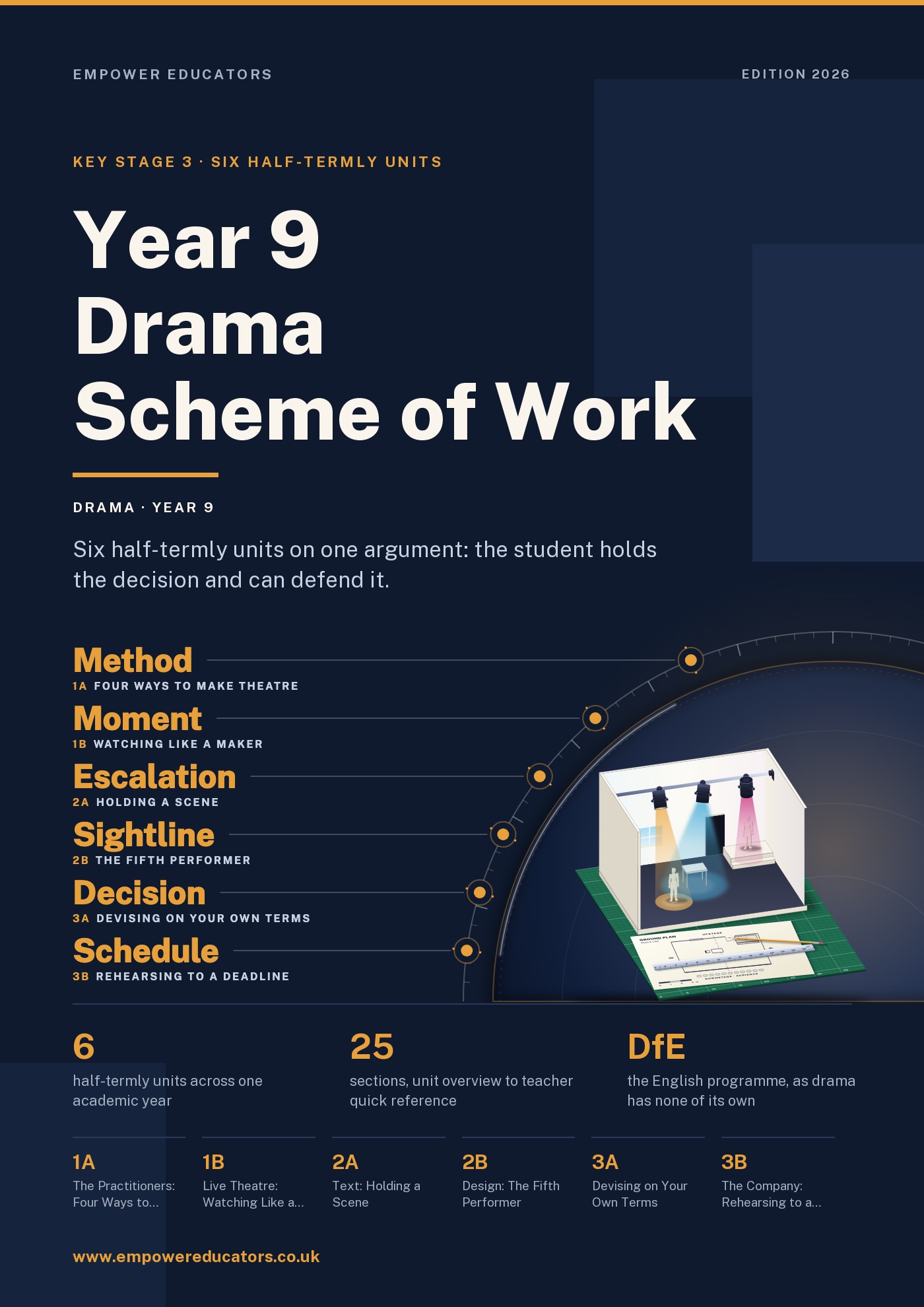
Six half-termly units on one argument: the student holds the decision and can defend it. Four practitioners' methods, a half term given entirely to watching live theatre, a sustained seven-minute Shakespeare scene, design as a discipline with a real ground plan, fully independent devising, and a company delivering on a fixed date. Romeo and Juliet is printed in full, completing the two Shakespeare plays the English programme of study requires across the key stage.
£4.99The Year 9 scheme: 6 half-termly units, 63 pages
- A4 PDF
- first 8 pages free to read
- instant download
Teaching all of Key Stage 3? Year 7, Year 8 and Year 9 as one set: £11.99, saving £2.98.
One purchase covers the school that buys it. Print it, copy it, hand it round your department. Not for passing to other schools or uploading anywhere.
PDF download, ready straight after payment. Downloading it ends the 14-day right to cancel; a file that is faulty or not as described is always refunded. Refunds
Read before publication by serving senior leaders, in school.
5.0 from 25+ reviews on Google
Schools that have bought from Empower Educators include Nottingham High School, Northampton High School GDST and Sutton Valence School.
The whole key stage: KS3 Drama scheme of work
Everything else this site has for Drama: Drama teaching resources
- 1aThe Practitioners: Four Ways to Make Theatre
- 1bLive Theatre: Watching Like a Maker
- 2aText: Holding a Scene
- 2bDesign: The Fifth Performer
- 3aDevising on Your Own Terms
- 3bThe Company: Rehearsing to a Deadline
Ten sections per unit, in the same order as Years 7 and 8.
Read Year 8's six progression rows together and they say the same thing six times: selects, chooses, justifies, sustains. So Year 9 is built on one argument rather than six topics: the student holds the decision and can defend it. Four practitioners' methods; a half term given entirely to watching live theatre, which almost no Key Stage 3 curriculum does and every specification examines in writing; a sustained seven-minute Shakespeare scene; design taught as a discipline with a real ground plan and a runnable cue sheet; fully independent devising; and a company delivering on a fixed date with named roles.
Nothing here is a GCSE course. A third of the class will not continue, and a year taught as preparation is a year wasted on them, so this is written as the last year of a subject, not the first year of a qualification.
Romeo and Juliet is printed in full, completing the two Shakespeare plays the English programme of study requires across the key stage, together with a printable live theatre analysis frame.
- Written to
- The statutory key stage 3 English programme of study (DfE, 2014) — drama has no programme of study of its own
- Intended for
- heads of drama, subject leaders and every teacher who has to deliver it, specialist or not
- Extent
- 63 pages · 25 sections
The sequence
What this scheme of work covers, unit by unit
The 6 units of the Year 9 Drama Scheme of Work, in teaching order, with the term each one runs in and the question it is built to answer.
1a
The Practitioners: Four Ways to Make Theatre
Autumn 1 · approx. 7 weeks · September – October
If you can make theatre four different ways, how do you decide which one this idea needs?
1b
Live Theatre: Watching Like a Maker
Autumn 2 · approx. 6 weeks · November – December
How do you watch a play so that you can say something worth hearing about it?
2a
Text: Holding a Scene
Spring 1 · approx. 6 weeks · January – February
What changes when you have to hold a character for seven minutes rather than two?
2b
Design: The Fifth Performer
Spring 2 · approx. 6 weeks · February – April
What can a set, a light or a sound say that an actor cannot?
3a
Devising on Your Own Terms
Summer 1 · approx. 7 weeks · April – May
You choose the stimulus, the form, the method and the audience. What are you going to make?
3b
The Company: Rehearsing to a Deadline
Summer 2 · approx. 6 weeks · June – July
How does a company actually get a show on — and what happens to the work when there is a real date?
Look inside
Real pages, straight from the PDF
Click any page to see it full size.
Contents
All 25 sections
Taken from the book’s own contents page, so the page numbers are the real ones.