English Literature · GCSE · £6.99
GCSE English Literature
Questions
& Answers
Nearly every literature answer that stalls in the middle band does the same thing: it names a method and then assumes the effect. These hundred pages separate the two and supply the questions that move a student across. Every text quoted is out of copyright and every quotation is checked character by character against its source on each build. Because the anthology poems and modern set texts are still in copyright, the unseen and modern material is written for the book, which is what an unseen ought to be anyway.
£6.99100 questions, each answered three times (weak, middling, strong), 107 pages
- A4 PDF
- first 14 pages free to read
- instant download
One purchase covers the school that buys it. Print it, copy it, hand it round your department. Not for passing to other schools or uploading anywhere.
PDF download, ready straight after payment. Downloading it ends the 14-day right to cancel; a file that is faulty or not as described is always refunded. Refunds
Read before publication by the serving head of that department and by senior leaders, in school.
5.0 from 24+ reviews on Google
Schools that have bought from Empower Educators include Nottingham High School, Northampton High School GDST and Sutton Valence School.
Complete your English Literature
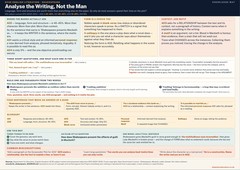
Everything else this site has for English Literature: English Literature teaching resources
- 1Shakespeare
- 2The nineteenth-century novel
- 3Poetry since 1789
- 4Comparing poems
- 5Modern prose and drama
- 6Unseen poetry
- 7Unseen prose
- 8Context that earns marks
- 9Writing about literature
Not a bank of questions with the answers printed underneath. The three banded responses are the starting point, not the output: what follows each one is the discriminator, named out loud, then the questions you actually ask to move a student from the first answer to the last, then the mark scheme that shows what each line was worth.
Literature needs a mark scheme the other subjects do not, and it is the one that answers the complaint every English department hears — I wrote pages about language and got eighteen. On the extended questions the same answer is marked once for each assessment objective, so a response can sit in the top band for analysis of method and the bottom band for context, and the grid shows exactly that. No revision guide prints it, and it is the fastest way to explain a mark a student thinks is wrong.
Every text quoted here is out of copyright in the United Kingdom, and the book proves it rather than asserts it: the life-plus-seventy rule is applied at build time, so an author who died after 1955 cannot be quoted at all. Every one of the hundred and thirteen quotations is then checked character by character against its source text on each build. An edition difference in Owen was caught that way, and the edition each extract came from is printed under it.
That constraint rules out the modern set texts and every board anthology, all of which are still in copyright. What is here instead is Shakespeare, six nineteenth-century novels, nine poets from Blake to Owen. For the unseen and modern sections there are five poems, three prose passages and a one-act play written for this book. An unseen is supposed to be unfamiliar, so writing them is the better answer as well as the legal one, and it means every page carries the text it asks about rather than a summary of it.
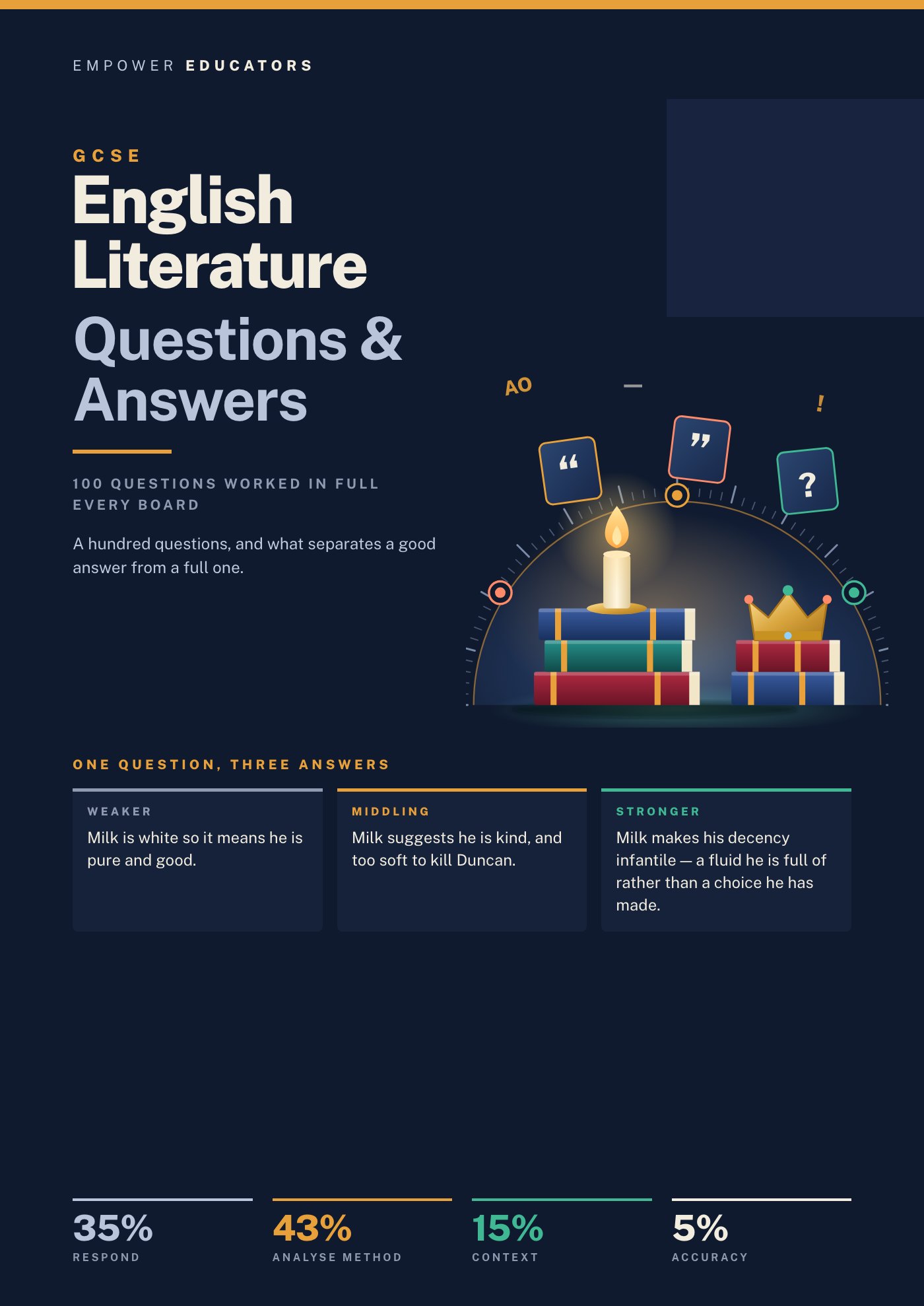
The assessment objectives in literature are published as ranges rather than fixed percentages, which is why two boards can weight them differently and both be right. This book is built to sit inside every range at once: AO1 35.7%, AO2 43.3%, AO3 15.9%, AO4 5.1%, with comparison at 20.9%. The figures are computed from the hundred questions each time it is built. The build stops if any of them falls outside. No board is named anywhere in it.
- Written to
- The GCSE subject content for English literature published by the Department for Education, and the assessment objective weightings it sets as ranges, which this book is built to sit inside on every build
- Intended for
- English teachers and heads of department. Used with a class, not a student revision guide
- Extent
- 107 pages · 9 sections
Sample questions
Sample GCSE English Literature questions and answers
Seven questions from the book, printed exactly as they appear in it: the question, the answers it works through, and the mark each one scores. All of them are in the free preview.
Question 2·Shakespeare·4 marks
12 Fair is foul, and foul is fair:
13 Hover through the fog and filthy air.
Identify the device in the witches’ line and explain what it sets up for the play.
Weaker0 marks
It is a metaphor. It makes the witches sound spooky and creates a mysterious atmosphere for the audience.
Middling2 marks
It is a paradox, because fair and foul are opposites and they cannot both be true at once. It makes the witches sound strange.
Stronger4 marks
It is a paradox: the line makes two opposites change places, so nothing can be taken at face value. It sets up a play in which a loyal soldier becomes a murderer and a king’s guest becomes his killer — and Macbeth’s own first line, “So foul and fair a day I have not seen” , unknowingly repeats it.
What separates them
“Spooky atmosphere” is the answer that could be written without reading the line. The middling answer names the device correctly and then stops at what a paradox is — which is a definition, not an effect. The mark is for what this particular paradox sets up: a play where appearance and reality come apart, and where the audience is warned about it in the first twelve lines.
The full-mark answer4 marks
The line is a paradox: it puts two opposites in each other’s places, so that neither word can be trusted. Coming twelve lines into the play, it tells the audience how to watch everything that follows — a king who calls Macbeth a worthy gentleman is about to be murdered by him, and a castle described as pleasant is where it happens. Shakespeare then puts a version of the witches’ own line into Macbeth’s mouth before he has met them, which ties him to them before either of them speaks.
Question 3·Shakespeare·5 marks
Embed the given quotation into a sentence of your own about Macbeth.
Weaker1 mark
Lady Macbeth thinks Macbeth is too nice. Here is a quote to prove it: “It is too full o’ th’ milk of human kindness” .
Middling3 marks
Lady Macbeth says that Macbeth is “too full o’ th’ milk of human kindness” , which shows that she thinks he is too kind to kill Duncan.
Stronger5 marks
Lady Macbeth’s fear that her husband is “too full o’ th’ milk of human kindness” turns his decency into a substance that can be measured out, and finds him over-supplied with it.
What separates them
The first answer bolts the quotation on with a colon: remove it and the sentence still stands, which is the test it fails. The second embeds it grammatically and is worth having — but it uses the quotation as proof of a point already made. The third makes the quotation part of the argument: the sentence cannot be said without it, and the phrasing (fear, over-supplied) is already reading the image rather than reporting it. Embedding is not a presentational rule. It is the difference between evidence you have used and evidence you have attached.
The full-mark answer5 marks
Lady Macbeth’s fear that her husband is “too full o’ th’ milk of human kindness” turns his decency into a substance that can be measured out, and finds him over-supplied with it — a judgement that treats kindness as a defect of quantity rather than a virtue.
Question 5·Shakespeare·8 marks
39 Come, you spirits
40 That tend on mortal thoughts, unsex me here,
41 And fill me, from the crown to the toe, top-full
42 Of direst cruelty! make thick my blood,
43 Stop up th’ access and passage to remorse,
44 That no compunctious visitings of nature
Write one analytical paragraph on how Shakespeare presents Lady Macbeth in this extract.
Weaker2 marks
Lady Macbeth is presented as evil. She calls on spirits to make her cruel and she wants to be unsexed. This shows that she is a bad person and the audience would not like her.
Middling5 marks
Shakespeare presents Lady Macbeth as determined. She commands the spirits to “Come, you spirits That tend on mortal thoughts, unsex me here” , and the imperative shows she is taking control. ‘Unsex’ suggests she thinks her gender is stopping her. A Jacobean audience would find this shocking.
Stronger8 marks
Shakespeare presents a woman who has identified her own womanhood as the obstacle. “Come, you spirits That tend on mortal thoughts, unsex me here” asks for a negation, not a transformation: she wants to be un-made as a woman, not made a man. And it is an order, given to spirits. For an audience whose king had written a book on witchcraft, that is not merely wicked — it is a claim to an authority she was denied.
What separates them
The weak answer has a judgement (‘evil’) and no method. The middling answer is genuinely good: it quotes, names the imperative, and reads ‘unsex’ — and its context sentence is bolted to the end doing no work — the commonest shape of a Level 2 literature paragraph. The stronger answer makes the context part of the analysis: because spirits were believed real, the imperative is not merely forceful but transgressive. One sentence, earning AO2 and AO3 at once.
The full-mark answer8 marks
Shakespeare presents a woman who has identified her own womanhood as the obstacle. “Come, you spirits That tend on mortal thoughts, unsex me here” asks for a negation rather than a transformation — not to be made male, only to be un-made as female — and the prefix does the work a whole speech of argument would need. It is issued in the imperative, to spirits, which puts her above them for the length of the speech. To an audience whose king had written a treatise on witchcraft, that is not simply wickedness; it is a claim to authority she was denied.
Question 6·Shakespeare·6 marks
39 Come, you spirits
40 That tend on mortal thoughts, unsex me here,
41 And fill me, from the crown to the toe, top-full
42 Of direst cruelty! make thick my blood,
43 Stop up th’ access and passage to remorse,
44 That no compunctious visitings of nature
Explain the effect of the imperative verbs in Lady Macbeth’s soliloquy.
Weaker1 mark
The imperatives make it sound forceful and show she is a strong character who is in control of the situation.
Middling4 marks
The imperatives — come, fill, make, stop up — make Lady Macbeth sound commanding. She gives orders rather than asking, which shows determination and makes her seem powerful.
Stronger6 marks
The imperatives pile up with no statement between them, so the speech never pauses to reflect. What they are issued to is the point: spirits, night, her own blood, none of which can obey. The mood performs a control she has not got, and the more of them there are, the more the speech sounds like a plea dressed as an order.
What separates them
Both of the first two answers are correct, and the second is a sound Level 2: it quotes the verbs, names the mood, and reads it as determination. The third asks a question the others do not — who is being commanded? Once you notice that every imperative is addressed to something incapable of obeying, the mood stops meaning power and starts meaning its opposite. That reversal is the whole of the difference, and it comes from the grammar, not from a bigger adjective.
The full-mark answer6 marks
The soliloquy is built almost entirely of imperatives — “Come, you spirits That tend on mortal thoughts, unsex me here” — with no declarative sentence to slow them. The effect turns on who receives them: spirits, the night, her own blood, none of which can obey. The mood stages an authority she does not possess, and the accumulation makes the speech sound less like command as it goes on and more like a woman asking for nerve.
Question 7·Shakespeare·4 marks
Explain what a soliloquy allows a dramatist to do that dialogue cannot.
Weaker1 mark
A soliloquy is when a character speaks on their own on the stage. It lets the audience know what they are thinking about.
Middling3 marks
A soliloquy gives the audience the character’s private thoughts, which they could not get from dialogue because the character would be lying or hiding things from other people.
Stronger4 marks
In dialogue every line is aimed at somebody, so it can be a performance. A soliloquy removes the listener, which removes the motive to lie — and it lets the audience know something the other characters do not, which is where dramatic irony comes from.
What separates them
The first answer defines the term. The second gets to privacy, which is the right idea and is worth three of four. The fourth mark is for the consequence: once the audience knows something a character does not, every later scene is watched differently. Duncan calling Macbeth’s castle pleasant is only unbearable because we have heard Macbeth’s soliloquy and Duncan has not.
The full-mark answer4 marks
In dialogue every line has a listener, so it can be shaped for them. A soliloquy takes the listener away and with them the motive to perform, so what the audience hears can be taken as thought rather than as speech. It also puts the audience ahead of the other characters, which is the engine of dramatic irony for the rest of the play.
Question 13·Shakespeare·35 marks
How does Shakespeare present the corrupting effect of ambition in Macbeth?
WeakerBand 1
Macbeth is very ambitious and this leads to his downfall. He kills Duncan because he wants to be king and then he has to kill more people to stay king. This shows ambition is bad and it corrupts him because at the start he was a hero.
MiddlingBand 3
Shakespeare shows ambition corrupting Macbeth through the language of disease. Macbeth calls it “Vaulting ambition, which o’erleaps itself” , which suggests something that goes too far and falls. The metaphor shows his ambition is out of his control, and a Jacobean audience would have believed such a man was damned.
StrongerBand 5
Shakespeare gives ambition a body before he gives it a victim. “Vaulting ambition, which o’erleaps itself” makes it an athlete that overshoots its own landing, so the failure is built into the movement rather than imposed as a punishment — Macbeth is destroyed by the mechanics of wanting, not by a moral. That is why the play needs no judge: an order that punishes overreaching automatically is exactly the order a Jacobean audience believed they lived in.
What separates them
The first paragraph tells the story and calls it corruption. The second is a solid Band 3 and is what most competent candidates write: it quotes, names the metaphor, explains the effect, and adds a context sentence at the end. The third reads the internal logic of the image: vaulting fails by its own momentum, so the metaphor argues that ambition destroys itself without help. The context then follows from that reading instead of being attached to it — one sentence earning AO2 and AO3 at once.
The same paragraph, at the top bandBand 5
Shakespeare gives ambition a body before he gives it a victim. “Vaulting ambition, which o’erleaps itself” makes it an athlete that overshoots its own landing, so failure is built into the movement rather than imposed on it afterwards — Macbeth is undone by the mechanics of wanting rather than by a moral. This is also why the play needs no judge: an order in which overreaching punishes itself is precisely the order a Jacobean audience understood themselves to inhabit, which is why the murder is answered by disorder in nature rather than by an investigation.
Question 48·Comparing poems·8 marks
1 How do I love thee? Let me count the ways.
2 I love thee to the depth and breadth and height
13 Smiles, tears, of all my life!—and, if God choose,
14 I shall but love thee better after death.
13 Since then, keen lessons that love deceives,
14 And wrings with wrong, have shaped to me
15 Your face, and the God-curst sun, and a tree,
Compare the attitudes to love in Sonnet 43 and Neutral Tones.
Weaker2 marks
Barrett Browning is positive about love and Hardy is negative. She loves someone very much and he has had a relationship that ended badly, so the two poems are opposites.
Middling5 marks
Barrett Browning presents love as limitless, measuring it by “I love thee to the depth and breadth and height” and extending it beyond life itself in “I shall but love thee better after death” . Hardy presents love as something that damages the person afterwards: “Since then, keen lessons that love deceives” have taught him that love deceives. One poem looks forward, the other back.
Stronger8 marks
Both poems measure love by what it does to time. Barrett Browning’s love annexes the future — it will be better “I shall but love thee better after death” — while Hardy’s has annexed the past, rewriting a winter afternoon he cannot now see any other way. Neither speaker is describing a feeling in the present tense. Both are describing something that has taken possession of a stretch of their life, and they differ only in which direction it reached.
What separates them
The first answer sorts the poems into positive and negative. The second is a proper comparison, well evidenced, and finds the forward and backward orientation — a real observation. The third makes that orientation the shared idea rather than the difference: both loves have colonised a period of time the speaker no longer controls. Once the similarity is established, the difference in direction becomes worth something.
The full-mark answer8 marks
Both poems measure love by what it has done to time rather than by how it feels. Barrett Browning’s love takes possession of the future, extending past the end of life in “I shall but love thee better after death” . Hardy’s has taken possession of the past: “Since then, keen lessons that love deceives” have shaped “Your face, and the God-curst sun, and a tree” , so a single afternoon has been repainted and cannot be recovered. Neither speaker is in the present. They differ in the direction the love reached, not in its reach.
Twelve more GCSE English Literature questions, with answers, free
Look inside
Real pages, straight from the PDF
Click any page to see it full size.
Contents
All 9 sections
Taken from the book’s own contents page, so the page numbers are the real ones.