History · GCSE
Medicine through time, c1250–present
GCSE History knowledge mat
From Superstition to Science
Seven hundred and fifty years on one landscape page, and the question that actually earns marks: why the change was so slow for so long. A dated timeline of the turning point in each of the four periods, three period cells, the six people a GCSE answer needs with their portraits, and the factors (what drove change and what blocked it). Seven terms to define, a worked exam-style sentence, and the misconceptions that cost marks.
£3.99All 4 GCSE History knowledge mats, one landscape sheet each
- Landscape A4 PDF
- the whole sheet shown below, part-blurred
- instant download
One purchase, all 4 GCSE History sheets, £3.99 for the set: this one · Medicine and the Western Front · Weimar and Nazi Germany, 1918–1939 · Elizabethan England, 1558–1603
One purchase covers the school that buys it. Print it, copy it, hand it round your department. Not for passing to other schools or uploading anywhere.
PDF download, ready straight after payment. Downloading it ends the 14-day right to cancel; a file that is faulty or not as described is always refunded. Refunds
Read before publication by serving senior leaders, in school.
5.0 from 25+ reviews on Google
Schools that have bought from Empower Educators include Nottingham High School, Northampton High School GDST and Sutton Valence School.
Complete your History


Everything else this site has for History: History teaching resources
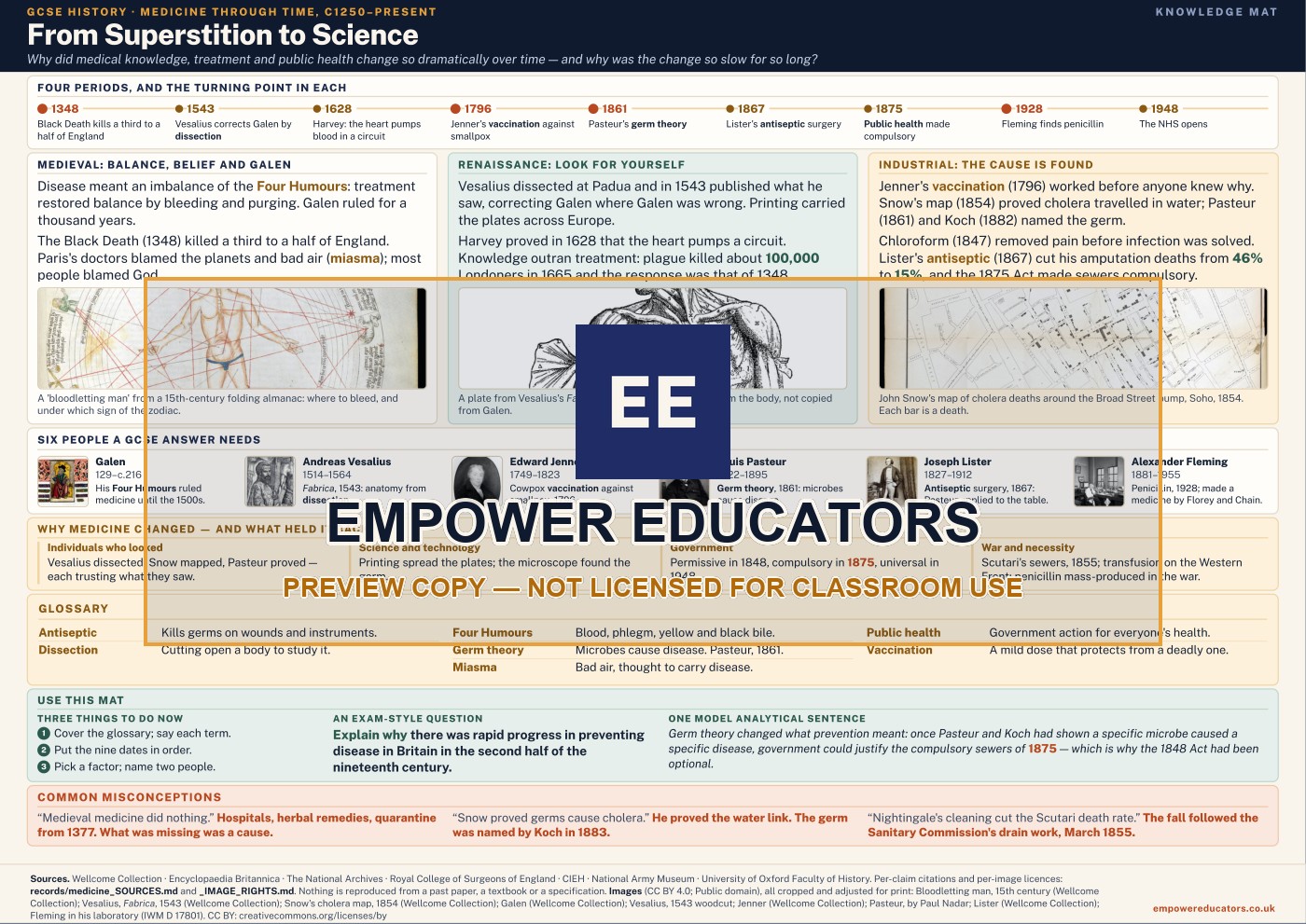
One landscape A4 page on one topic, led by the photographs rather than the headings. It carries the medieval world of Galen and the four humours, the Renaissance turn to looking for yourself, the industrial discovery of cause, six people, and what held medicine back. Then the vocabulary, a worked exam-style sentence and the misconceptions that cost marks.
Every image on the sheet is a real archival or scientific photograph, not an illustration and not AI-generated. Each one was checked against its own licence template rather than a label, and the running foot names every creator, states that the images have been cropped and adjusted for print, and links the licence, so the sheet can be photocopied for a class and stay compliant. Nothing is reproduced from a past paper, a textbook or a specification.
A knowledge organiser stores a unit and is revised from afterwards; this is meant to be on the table while the work is happening.
- Written to
- The DfE subject content for history and the period as the awarding bodies set it. Every portrait and photograph is a sourced archival image, licensed for reuse and credited on the sheet
- Intended for
- history teachers. On the desk during the lesson, not a student revision guide
- Extent
- One landscape A4 sheet · 9 sections
Look inside
Real pages, straight from the PDF
Click any page to see it full size.
Contents
What’s on the sheet
The sections on the sheet, in the order they appear.