498·Art & Design · GCSE
How a Mark
Carries Meaning
GCSE Art Knowledge Mat — Visual Language (PDF)
Two students draw the same shell for the same hour — so why does one drawing say something and the other only record it? The formal elements the DfE actually names, and why it never says there are five of them; visual language as the DfE defines it, wider than the elements; and the drawing requirement with the footnote most departments miss. Three drawn figures: four ways of making one grey, a full tonal range, and one object drawn three times for three different jobs. Twelve terms to define, a model annotation, and the misconceptions that cost marks.
Everything else this site has for Art & Design: Art & Design teaching resources
One purchase covers the school that buys it. Print it, copy it, hand it round your department. Not for passing to other schools or uploading anywhere.
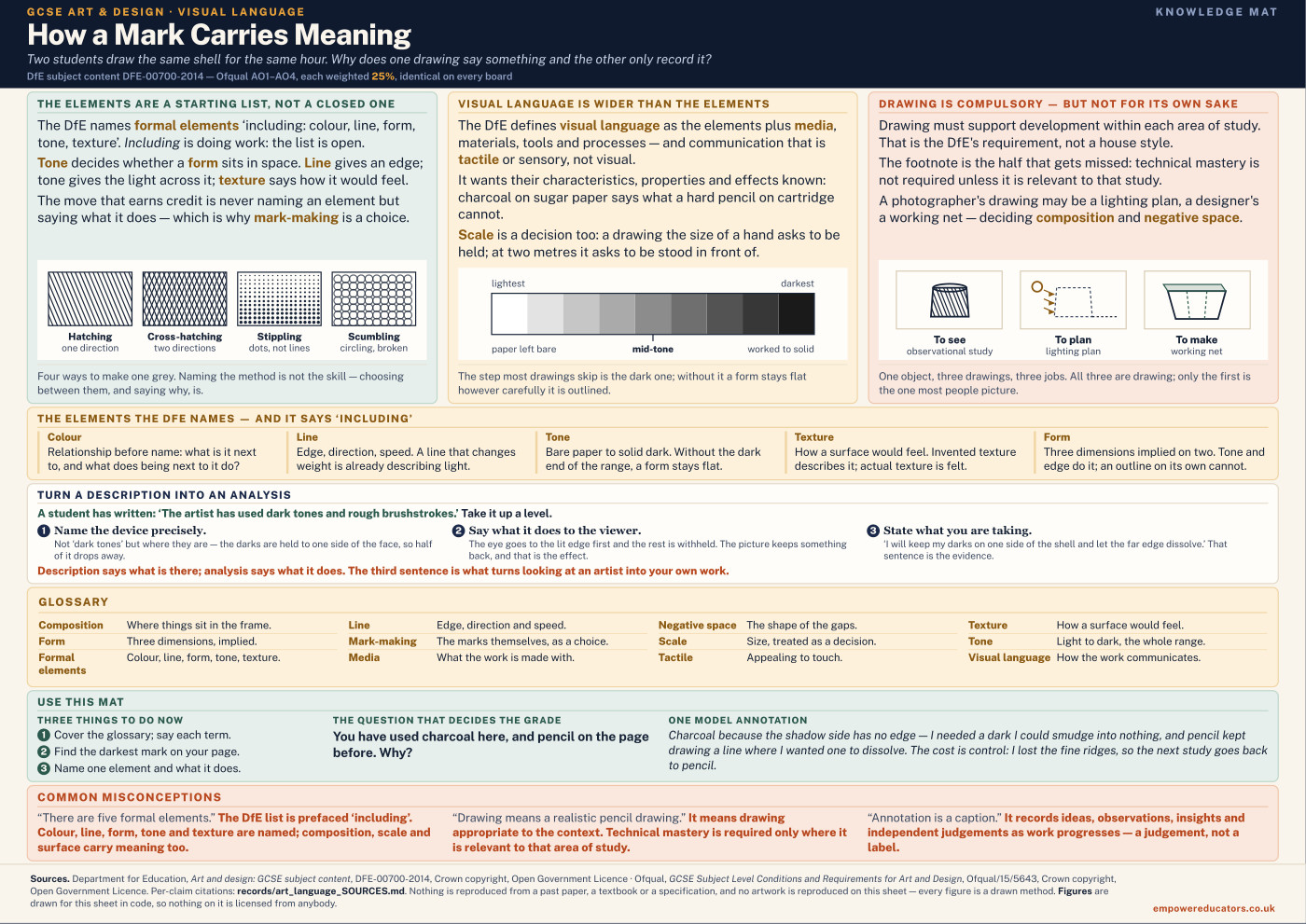
One landscape A4 page on one part of the GCSE Art & Design course, anchored to the DfE's own subject content (DFE-00700-2014) and Ofqual's subject level conditions (Ofqual/15/5643) rather than a board's paraphrase — so it holds whichever specification a department follows. It carries the formal elements and what each one does, visual language in the DfE's wider sense, and drawing as a job rather than a performance — then the vocabulary, a worked step from description to analysis, and the misconceptions that cost marks.
Art and design is assessed entirely by non-exam assessment, so nothing on these sheets pretends to be exam practice: the question that decides the grade is the one a moderator asks of a page, and that is the question each sheet models an answer to. No artwork is reproduced anywhere, including work that is out of copyright — every figure is a drawn method, which is not copyrightable, so a department can photocopy any of these four sheets with no rights question at all.
Sold by subject: all four Art & Design sheets for one price. A knowledge organiser stores a unit and is revised from afterwards; this is meant to be on the table while the work is happening.
- Written to The DfE GCSE art and design subject content (DFE-00700-2014) and Ofqual's subject level conditions (Ofqual/15/5643), quoted; no board's specification or mark scheme. No artwork is reproduced anywhere — every figure is a drawn method, so the sheet can be photocopied with no rights question
- Intended for art teachers — on the desk during the lesson, not a student revision guide
- Extent 1 page · 8 sections
—·Look inside
Real pages, straight from the PDF
Click any page to see it full size.
—·Contents
All 8 sections
Taken from the booklet’s own contents page, so the page numbers are the real ones.