459·English Language · GCSE
Say What the Other
Word Would Have Lost
Analysing language knowledge mat for secondary schools (PDF)
Everyone can name a simile. What is the sentence that turns naming a device into analysing it? What AO2 actually asks; word, effect, why — with the substitution test; sentence form, semantic fields and personification; the opening of Bleak House, out of copyright and verified against the text, annotated; a noticing turned into an AO2 answer; four moves worth more than naming a device. Seven terms to define, a model analytical sentence, and the misconceptions that cost marks.
Everything else this site has for English: English teaching resources
One purchase covers the school that buys it. Print it, copy it, hand it round your department. Not for passing to other schools or uploading anywhere.
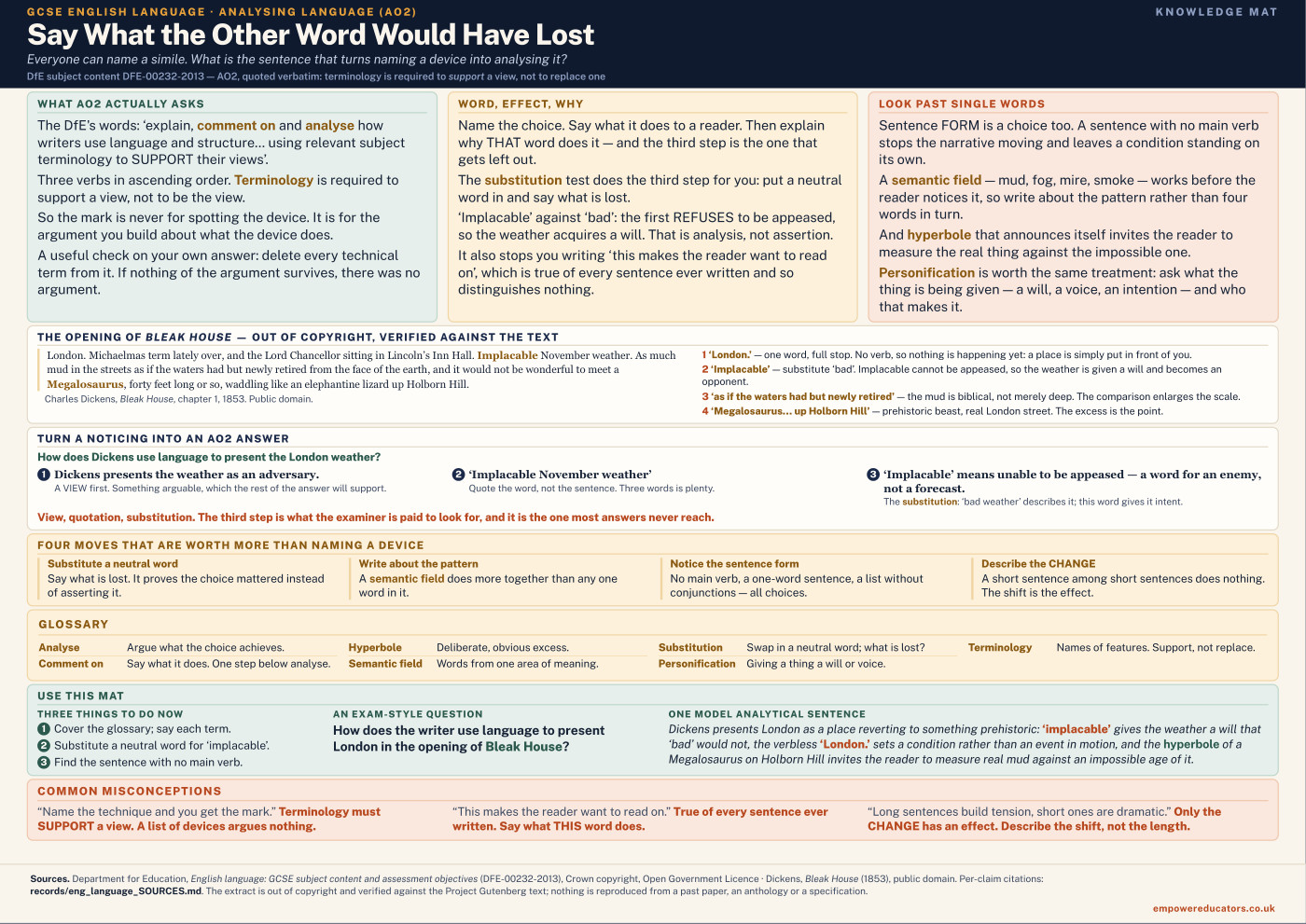
One landscape A4 page on one skill, built on the DfE's own assessment objectives rather than a board's paraphrase. It carries what AO2 asks, the word-effect-why method with its substitution test, sentence form and semantic fields, and the opening of Bleak House annotated — then the vocabulary, a worked exam-style answer and the misconceptions that cost marks.
The extracts are written for the sheet, or out of copyright and verified against the text — so nothing is quoted from an anthology, a set text or a past paper, and the sheet can be photocopied for a class and stay compliant. Every claim is sourced, and the assessment objectives are quoted verbatim from the DfE document.
Sold by subject: all four English Language sheets for one price. A knowledge organiser stores a unit and is revised from afterwards; this is meant to be on the table while the work is happening.
- Written to The DfE GCSE English language subject content (DFE-00232-2013), its assessment objectives quoted verbatim. Extracts are written for the sheet, or out of copyright and verified against the text
- Intended for English Language teachers — on the desk during the lesson, not a student revision guide
- Extent 1 page · 9 sections
—·Look inside
Real pages, straight from the PDF
Click any page to see it full size.
—·Contents
All 9 sections
Taken from the booklet’s own contents page, so the page numbers are the real ones.