Physical Education
PE is the most cancelled subject in school. More time is only half the answer.
Only 57% of teachers say their school manages the recommended two hours a week. Winning that time back is the easier half of the problem.
Written in response to the Youth Sport Trust’s PE and School Sport Report 2026, launched at a parliamentary roundtable. Read on 17 August 2026. Empower Educators is not affiliated with the Youth Sport Trust.
What the report found
- 2.1myoung people in England average under thirty minutes of activity a day
- 57%of teachers say their school delivers the recommended two hours of PE a week
- 46%of young people are active for thirty minutes during the school day
- 1 in 3spend three hours or more a day on screens outside schoolwork
Youth Sport Trust, PE and School Sport Report 2026
The Youth Sport Trust took its PE and School Sport Report 2026 to Parliament in June, to a roundtable chaired by Rachel Taylor MP of the All-Party Parliamentary Group for Sport and Physical Activity. It reported that PE is the most frequently cancelled subject in schools, that only 57% of teachers say their school delivers the recommended two hours a week, and that only 46% of young people are active for thirty minutes during the school day. The room’s central proposal was to make two hours of weekly PE a requirement. Youth Sport Trust, PE and School Sport Report 2026
That is the right ask, and every head of PE reading this has lost a lesson to an exam hall, a vaccination programme, a rehearsal or a wet-weather cancellation that would never have touched a maths lesson.
Curriculum time is the precondition for everything else.
But read the third figure next to the first two. Only 46% are active for thirty minutes during the school day, and the school day includes PE. Which means the time already timetabled is not, by itself, producing activity. A school could win the argument, double the allocation tomorrow, and move that number very little.
The same Year 9 lesson, three departments
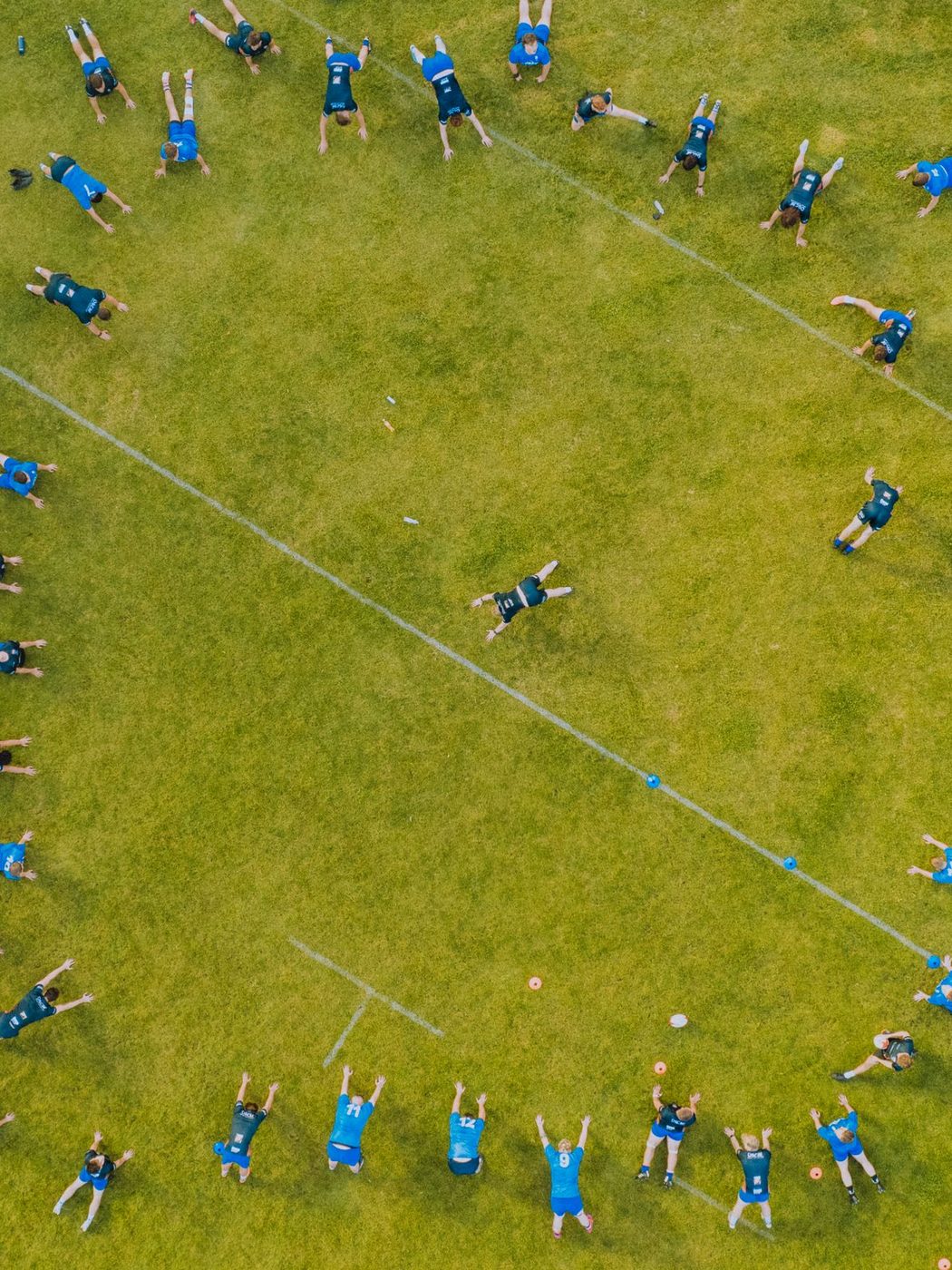
Below is one lesson, taught three ways. Same fifty minutes, same staffing, same equipment, same sport, and all three go into the scheme of work as the same line. The filled marks are the pupils who actually touched the ball.
-
Weak
8 of 30 involved
Register, a lap, straight into a full-sided game. Teacher referees for fifty minutes.
The same eight pupils touch the ball. No skill is taught, practised or corrected.
Logged as: Football, week 4
-
Strong
16 of 30 involved
Warm-up on topic. One skill demonstrated, a drill, then a conditioned game.
Most are involved, and the feedback mostly reaches the confident. Half the group learns.
Logged as: Football, week 4
-
Outstanding
30 of 30 involved
Practice shaped so the decision has to be made. A constraint: three-touch, or no pass back.
Play frozen twice, two questions, restart. Every pupil makes the target decision eight times.
Logged as: Football, week 4
This is why more time, on its own, is only half an answer. A department that rolls the ball out gets two hours of the first column instead of one. The pupils in the unfilled circles are not being taught in either.
One in five, every lesson
Non-participation is unique to physical education. No other subject has a daily, socially sanctioned mechanism by which a pupil can opt out of the lesson while remaining present in it: a note, forgotten kit, a vague injury, a bench at the side. It is the only subject where a pupil can attend for five years and never do the subject.
And it hides inside good-looking data. Here is a participation summary of the kind a department takes to governors, read twice. The figures are illustrative. They are the only numbers in this article that are not published and attributed.
“Participation is good”
- 82% of pupils take part in PE lessons.
- Extra-curricular attendance up 12%.
- Teams reached three county finals.
- 71% say they enjoy PE.
The same figures, read properly
- 18% are not taking part. Nearly one in five, every lesson.
- The 12% rise is mostly existing club members attending more often.
- Those county finals involve about 30 pupils out of 900.
- Split the 71% by year and by sex. It is rarely flat.
The figures on the left are all true, and not one of them names a problem. That is what makes them dangerous at a governors' meeting.
Six reasons pupils stop. Only one is about PE.
Ask a department why participation falls and the answer is usually about the activities on offer. Ask the pupils and it is almost never that. These are the six reasons they give. Only the third is about PE teaching at all.
- 01 Being watched Changing, running, failing, all in public. How the lesson is organised
- 02 Kit Cost, colour, fit, laundry. Often poverty, read as defiance. How the lesson is organised
- 03 Competence They cannot do it, and the lesson makes that visible. PE teaching
- 04 Changing rooms Privacy, safety, noise. Frequently the real one. How the lesson is organised
- 05 Menstruation Rarely asked about, rarely accommodated. How the lesson is organised
- 06 Being picked last Captains choosing teams. It still happens. How the lesson is organised
Which is the useful finding in the whole list: five of the six can be addressed without changing a single thing about the curriculum. Kit policy, changing-room privacy, a stated period policy, private assessment in place of public ranking, and small groups instead of an audience of twenty-nine. None of that needs a funding settlement or a statutory two hours. Most of it could be agreed in a department meeting in September.
A PE department is judged by its results and remembered by its non-participants.
Taught to Move, Confident Schools
The sixty per cent nobody chose
There is a second reason PE gets cancelled, and it has nothing to do with the timetable. The subject is widely assumed not to be academic. Anyone who has taught the GCSE knows better. Written papers carry 60% of GCSE PE across every English board, and the content is closer to a science than to a sport: the pathway of blood through the heart, gaseous exchange at the alveoli, the three energy systems, agonist and antagonist pairs, first and second class levers, arousal theories.
Departments that accept this early build the vocabulary into Key Stage 3, in the ninety seconds of a Year 7 warm-up: naming the hamstring instead of saying the back of your leg. In the ones that do not, pupils meet antagonistic pair for the first time at fifteen, and Year 11 goes on catch-up sessions about the heart. It costs no extra curriculum time, and it is the most reliable single grade in the subject.
Win the two hours. Then count the touches.
The campaign is worth supporting, and a statutory entitlement would stop PE being the first thing moved when the hall is needed. Nothing here argues otherwise. But a department that gets its second hour and teaches it the way it taught the first has doubled the time the same eight pupils spend touching the ball.
So watch one lesson this term and count. Do not count the pupils on the field. Count the ones who actually made the decision the lesson was about. If the honest answer is eight out of thirty, the problem was never the timetable, and no amount of extra time will fix it.