Drama · Key Stage 3 · £4.99
Year 7
Drama
Scheme of Work
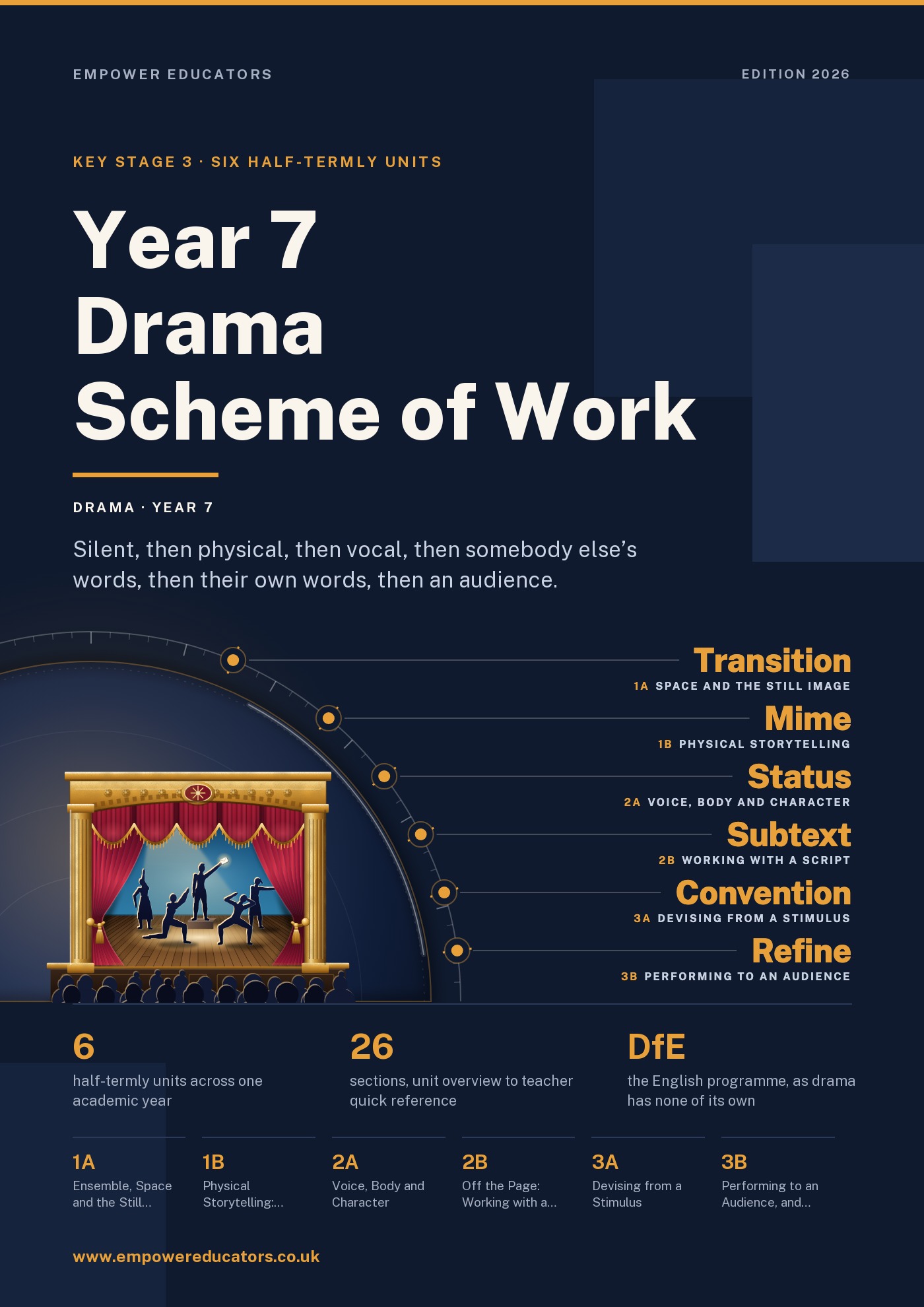
Six half-termly units across one academic year, written backwards from what Year 8 assumes on entry. The year runs silent, then physical, then vocal, then somebody else’s words, then their own words, then an audience. Two units in which nobody has to speak: that is the load-bearing decision of the year and the single best thing you can do for a class arriving from twelve different primary schools.
£4.99The Year 7 scheme: 6 half-termly units, 66 pages
- A4 PDF
- first 8 pages free to read
- instant download
Teaching all of Key Stage 3? Year 7, Year 8 and Year 9 as one set: £11.99, saving £2.98.
One purchase covers the school that buys it. Print it, copy it, hand it round your department. Not for passing to other schools or uploading anywhere.
PDF download, ready straight after payment. Downloading it ends the 14-day right to cancel; a file that is faulty or not as described is always refunded. Refunds
Read before publication by serving senior leaders, in school.
5.0 from 25+ reviews on Google
Schools that have bought from Empower Educators include Nottingham High School, Northampton High School GDST and Sutton Valence School.
The whole key stage: KS3 Drama scheme of work
Everything else this site has for Drama: Drama teaching resources
- 1aEnsemble, Space and the Still Image
- 1bPhysical Storytelling: Mime, Movement and Narration
- 2aVoice, Body and Character
- 2bOff the Page: Working with a Script
- 3aDevising from a Stimulus
- 3bPerforming to an Audience, and Saying Why
Ten sections per unit, in the same order every time. Lessons are one row each rather than a page each, enough to teach from and not so much that it cannot be maintained across a department.
Drama has no programme of study at key stage 3. It is statutory, but only inside English, and exactly one sentence in the whole national curriculum describes drama practice at this key stage. This book quotes that sentence, maps every unit to it honestly, and then says plainly that everything else is a curriculum design decision. The Curriculum and Assessment Review found that the absence is precisely why school drama curricula vary so much. A scheme that pretends the requirement exists is no use to the head of department who has to defend theirs.
Six lessons are written out in full, one per unit — timings, what the teacher actually says, and what to do when it goes wrong — so that a non-specialist can teach a drama lesson well at the first attempt. With a warm-up bank indexed by purpose, a seventy-five-term glossary, and three original scripts printed at the back that the school may photocopy without limit.
- Written to
- The statutory key stage 3 English programme of study (DfE, 2014) — drama has no programme of study of its own
- Intended for
- heads of drama, subject leaders and every teacher who has to deliver it, specialist or not
- Extent
- 66 pages · 26 sections
The sequence
What this scheme of work covers, unit by unit
The 6 units of the Year 7 Drama Scheme of Work, in teaching order, with the term each one runs in and the question it is built to answer.
1a
Ensemble, Space and the Still Image
Autumn 1 · approx. 7 weeks · September – October
How does a group of people make something that none of them could make alone?
1b
Physical Storytelling: Mime, Movement and Narration
Autumn 2 · approx. 7 weeks · November – December
How do you make an audience believe in something that isn't there?
2a
Voice, Body and Character
Spring 1 · approx. 6 weeks · January – February
What makes an audience believe you are someone else?
2b
Off the Page: Working with a Script
Spring 2 · approx. 6 weeks · February – April
A script gives you the words. Where does everything else come from?
3a
Devising from a Stimulus
Summer 1 · approx. 6 weeks · April – May
How do you turn an object, an image or a headline into a piece of theatre?
3b
Performing to an Audience, and Saying Why
Summer 2 · approx. 6 weeks · June – July
What makes a performance work for an audience — and how do you say why it worked?
Look inside
Real pages, straight from the PDF
Click any page to see it full size.
Contents
All 26 sections
Taken from the book’s own contents page, so the page numbers are the real ones.