Art & Design · Key Stage 3 · £4.99
Year 9
Art & Design
Scheme of Work
Six half-termly units across one academic year, each building something the next one assumes. It ends with an independent personal response that rehearses how a 14–16 course actually works.
£4.99The Year 9 scheme: 6 half-termly units, 38 pages
- A4 PDF
- first 8 pages free to read
- instant download
Teaching all of Key Stage 3? Year 7, Year 8 and Year 9 as one set: £11.99, saving £2.98.
One purchase covers the school that buys it. Print it, copy it, hand it round your department. Not for passing to other schools or uploading anywhere.
PDF download, ready straight after payment. Downloading it ends the 14-day right to cancel; a file that is faulty or not as described is always refunded. Refunds
Read before publication by serving senior leaders, in school.
5.0 from 24+ reviews on Google
Schools that have bought from Empower Educators include Nottingham High School, Northampton High School GDST and Sutton Valence School.
Complete your Art & Design
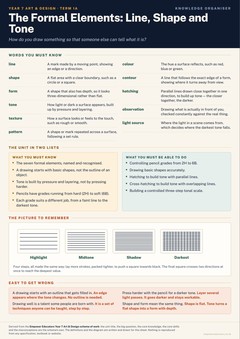
The whole key stage: KS3 Art & Design scheme of work
Everything else this site has for Art & Design: Art & Design teaching resources
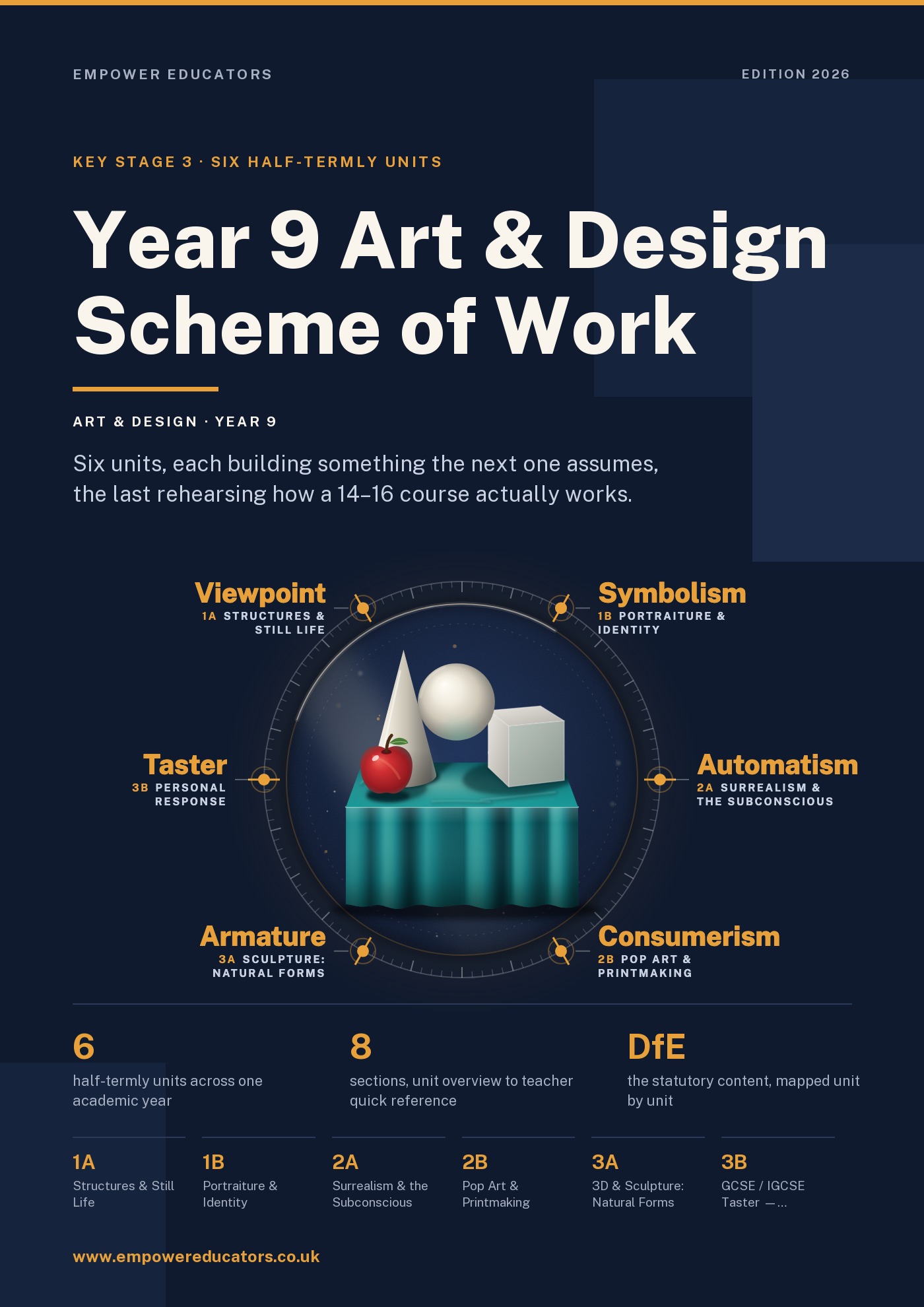
- 1aStructures & Still Life
- 1bPortraiture & Identity
- 2aSurrealism & the Subconscious
- 2bPop Art & Printmaking
- 3a3D & Sculpture: Natural Forms
- 3bGCSE / IGCSE Taster — Personal Response
Eight sections per unit, in the same order every time. Lessons are one row each rather than a page each — enough to teach from, not so much that it cannot be maintained across a whole department.
Experimentation is the one principle that applies identically to every unit, so it is stated once at the front: it is not extra work, it is the process, and no student moves to a final piece without a visible trail of tried, reviewed and changed decisions.
Every duration, material, artist and assessment word is a strong default rather than a fixed rule. Year 9 means ages 13–14, or S2–S3 in Scotland.
- Written to
- The statutory programme of study for key stage 3 art and design (DfE, 2013)
- Intended for
- heads of art, subject leaders and every teacher who has to deliver it
- Extent
- 38 pages · 8 sections
The sequence
What this scheme of work covers, unit by unit
The 6 units of the Year 9 Art & Design Scheme of Work, in teaching order, with the term each one runs in and the question it is built to answer, what students make, the artists they meet and the vocabulary they learn.
1a
Structures & Still Life
Autumn 1 · approx. 7 weeks · September – October
How can I use tone and structure to make something ordinary look extraordinary?
- End outcome
- A final A3 tonal still life composition of a personal object arrangement, developed through sketchbook experimentation and one artist-response study.
- Core skills
- Accurate proportion via sighting/measuring. · Tonal range: light, mid-tone, dark, reflected light. · Composition: cropping, viewpoint, negative space.
- Key artists
- Giorgio Morandi, Paul Cézanne, Wayne Thiebaud
- Key vocabulary
- tone, form, composition, viewpoint, proportion, negative space, light source
1b
Portraiture & Identity
Autumn 2 · approx. 7 weeks · November – December
How can I show who someone is, not just what they look like?
- End outcome
- A final expressive mixed-media self-portrait, developed through grid, mirror-study and symbolic-collage experimentation.
- Core skills
- Facial proportion via guideline grid. · Mixed-media experimentation. · Structured evaluative writing.
- Key artists
- Chuck Close, Frida Kahlo, Kehinde Wiley
- Key vocabulary
- symbolism, expression, proportion (facial), mixed media, identity, autobiography
2a
Surrealism & the Subconscious
Spring 1 · approx. 6 weeks · January – February
Where do ideas come from, and how can I generate images I couldn’t have planned?
- End outcome
- A final surreal composition in paint or mixed media, developed through automatic drawing, exquisite corpse and scale-distortion experimentation.
- Core skills
- Automatic drawing. · Collaborative and independent idea generation. · Combining unrelated imagery into a coherent composition.
- Key artists
- Salvador Dalí, René Magritte, Leonora Carrington
- Key vocabulary
- juxtaposition, scale, distortion, subconscious, surrealism, automatism
2b
Pop Art & Printmaking
Spring 2 · approx. 6 weeks · February – April
How can repetition and process change the meaning of an everyday object?
- End outcome
- A final printed edition (3–4 prints) of a personal-object design, developed through cutting practice and colour/registration trials.
- Core skills
- Relief-block cutting. · Print registration and repeat printing. · Colour layering and control.
- Key artists
- Andy Warhol, Roy Lichtenstein, Corita Kent
- Key vocabulary
- edition, relief, registration, repetition, consumerism, Ben-Day dots
3a
3D & Sculpture: Natural Forms
Summer 1 · approx. 6 weeks · April – May
How does material choice change what a form can say?
- End outcome
- A final 3D piece in clay, plaster or mixed natural materials, developed through a wire maquette and photographic documentation of an outdoor response.
- Core skills
- Maquette-making. · 3D construction using a range of materials. · Considered material and scale decision-making.
- Key artists
- Andy Goldsworthy, Henry Moore, Ai Weiwei
- Key vocabulary
- form, mass, armature, ephemeral, site-specific
3b
GCSE / IGCSE Taster — Personal Response
Summer 2 · approx. 6 weeks · June – July
If I designed my own art project, what would I make — and is this something I want to keep doing?
- End outcome
- A mini project folder (mind-map/mood-board, one artist-research page, one final personal-response piece) applying the whole year’s skills independently, used as an Options-evening exemplar.
- Core skills
- Independent starting-point generation (mind-map/mood-board). · Independent artist research. · Applying self-selected media/technique to a personal outcome.
- Key artists
- Student’s choice — revisit a favourite from the year, or research a new artist such as Jean-Michel Basquiat or Yayoi Kusama
- Key vocabulary
- assessment objectives, NEA, externally set task, starting point
Look inside
Real pages, straight from the PDF
Click any page to see it full size.
Contents
All 8 sections
Taken from the book’s own contents page, so the page numbers are the real ones.