Art & Design · Key Stage 3 · £4.99
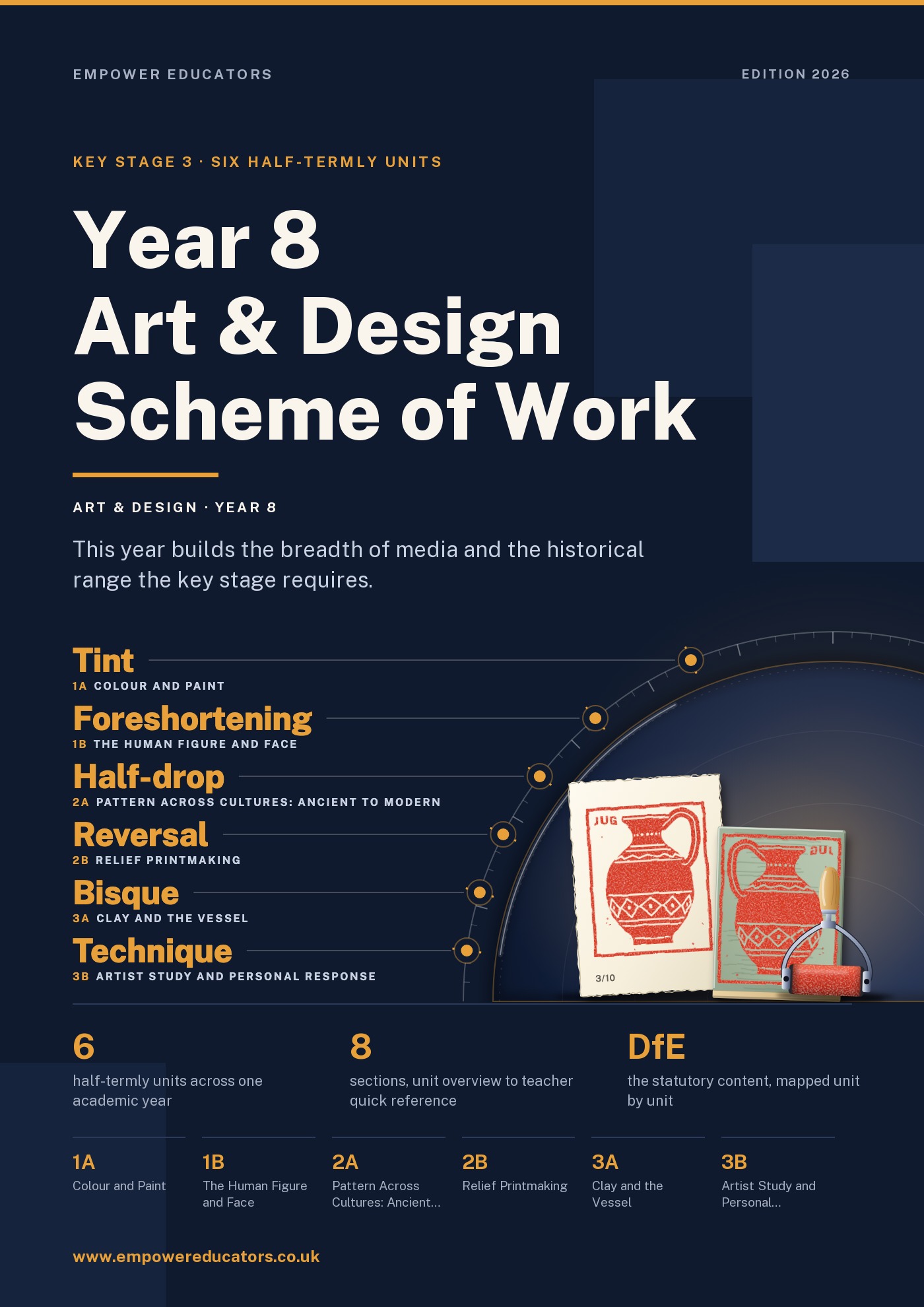
Year 8
Art & Design
Scheme of Work
Six half-termly units across one academic year, sequenced so each builds what the next assumes. Year 7 establishes the formal elements; this year builds the breadth of media and the historical range the key stage requires.
£4.99The Year 8 scheme: 6 half-termly units, 35 pages
- A4 PDF
- first 8 pages free to read
- instant download
Teaching all of Key Stage 3? Year 7, Year 8 and Year 9 as one set: £11.99, saving £2.98.
One purchase covers the school that buys it. Print it, copy it, hand it round your department. Not for passing to other schools or uploading anywhere.
PDF download, ready straight after payment. Downloading it ends the 14-day right to cancel; a file that is faulty or not as described is always refunded. Refunds
Read before publication by serving senior leaders, in school.
5.0 from 24+ reviews on Google
Schools that have bought from Empower Educators include Nottingham High School, Northampton High School GDST and Sutton Valence School.
Complete your Art & Design
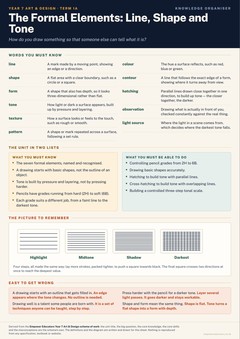
The whole key stage: KS3 Art & Design scheme of work
Everything else this site has for Art & Design: Art & Design teaching resources
- 1aColour and Paint
- 1bThe Human Figure and Face
- 2aPattern Across Cultures: Ancient to Modern
- 2bRelief Printmaking
- 3aClay and the Vessel
- 3bArtist Study and Personal Response
Ten sections per unit, in the same order every time. Lessons are one row each rather than a page each: enough to teach from, not so much that it cannot be maintained across a whole department.
One principle applies to every unit and is stated once at the front: experimentation is not extra work, it is the process. No student moves to a final piece without a visible trail of tried, reviewed and changed decisions.
Every duration, material, artist and assessment word is a strong default rather than a fixed rule. Year 8 means ages 12–13, or S1–S2 in Scotland.
- Written to
- The statutory programme of study for key stage 3 art and design (DfE, 2013)
- Intended for
- heads of art, subject leaders and every teacher who has to deliver it
- Extent
- 35 pages · 8 sections
The sequence
What this scheme of work covers, unit by unit
The 6 units of the Year 8 Art & Design Scheme of Work, in teaching order, with the term each one runs in and the question it is built to answer, what students make, the artists they meet and the vocabulary they learn.
1a
Colour and Paint
Autumn 1 · approx. 7 weeks · September – October
Why does the same colour look different depending on what sits next to it?
- End outcome
- An A3 painted study of a still life or landscape source, mixed from a limited palette.
- Core skills
- Mixing accurately from three primaries and white · Controlling paint consistency · Applying paint in layers · Matching a mixed colour to an observed one
- Key artists
- J.M.W. Turner, Sonia Delaunay, Josef Albers
- Key vocabulary
- primary, secondary, tertiary, hue, tint, shade, tone, complementary, harmonious, palette, consistency
1b
The Human Figure and Face
Autumn 2 · approx. 7 weeks · November – December
What has to be right before a drawing of a person starts to look like a person?
- End outcome
- An A3 half-length figure or portrait study, constructed on guidelines and finished in tone.
- Core skills
- Constructing guidelines · Measuring and checking placement · Gesture drawing at speed · Tonal modelling on a curved surface
- Key artists
- Leonardo da Vinci, Käthe Kollwitz, Amrita Sher-Gil
- Key vocabulary
- proportion, guideline, gesture, plane, foreshortening, contour, likeness, distortion
2a
Pattern Across Cultures: Ancient to Modern
Spring 1 · approx. 6 weeks · January – February
Who does a pattern belong to, and what changes when it travels?
- End outcome
- A designed repeat pattern developed from a researched historical source, with the source properly named.
- Core skills
- Geometric construction with compass and ruler · Stylising a source into a motif · Block, half-drop and rotational repeats
- Key artists
- Ancient Egyptian decorative tradition, Islamic geometric tradition, William Morris
- Key vocabulary
- motif, repeat, half-drop, tessellation, symmetry, rotation, stylisation, provenance, appropriation
2b
Relief Printmaking
Spring 2 · approx. 6 weeks · February – April
What does a process give you that drawing by hand cannot?
- End outcome
- A hand-printed edition of three consistent prints from a cut block, developed from the Unit 2a motif.
- Core skills
- Transferring and reversing a design · Safe, controlled cutting · Inking evenly · Registration · Editioning
- Key artists
- Katsushika Hokusai, Elizabeth Catlett, Edward Bawden
- Key vocabulary
- relief, block, proof, edition, registration, reduction, burnishing, brayer, reversal
3a
Clay and the Vessel
Summer 1 · approx. 6 weeks · April – May
Why has almost every civilisation made pots, and why do they all look different?
- End outcome
- A hand-built vessel with a designed surface, referenced to a named historical ceramic tradition.
- Core skills
- Pinch, coil and slab forming · Scoring and slipping · Impressing and incising · Working to a drawn profile
- Key artists
- Ancient Greek black-figure pottery, Nok terracotta, Magdalene Odundo
- Key vocabulary
- vessel, profile, coil, slab, score, slip, leather-hard, greenware, bisque, burnish, incise
3b
Artist Study and Personal Response
Summer 2 · approx. 6 weeks · June – July
If I choose the artist and the outcome myself, can I still work like an artist?
- End outcome
- A personal response to a self-chosen artist, presented with the research, experiments and rejected options.
- Core skills
- Selecting an artist for a usable technique · Recording, experimenting, developing and refining independently · Annotating decisions
- Key artists
- Student-selected from a curated departmental list
- Key vocabulary
- response, research, development, refinement, rationale, independence, evidence
Look inside
Real pages, straight from the PDF
Click any page to see it full size.
Contents
All 8 sections
Taken from the book’s own contents page, so the page numbers are the real ones.