Art & Design · A Level · £6.99
A Level Art & Design
Scheme of Work
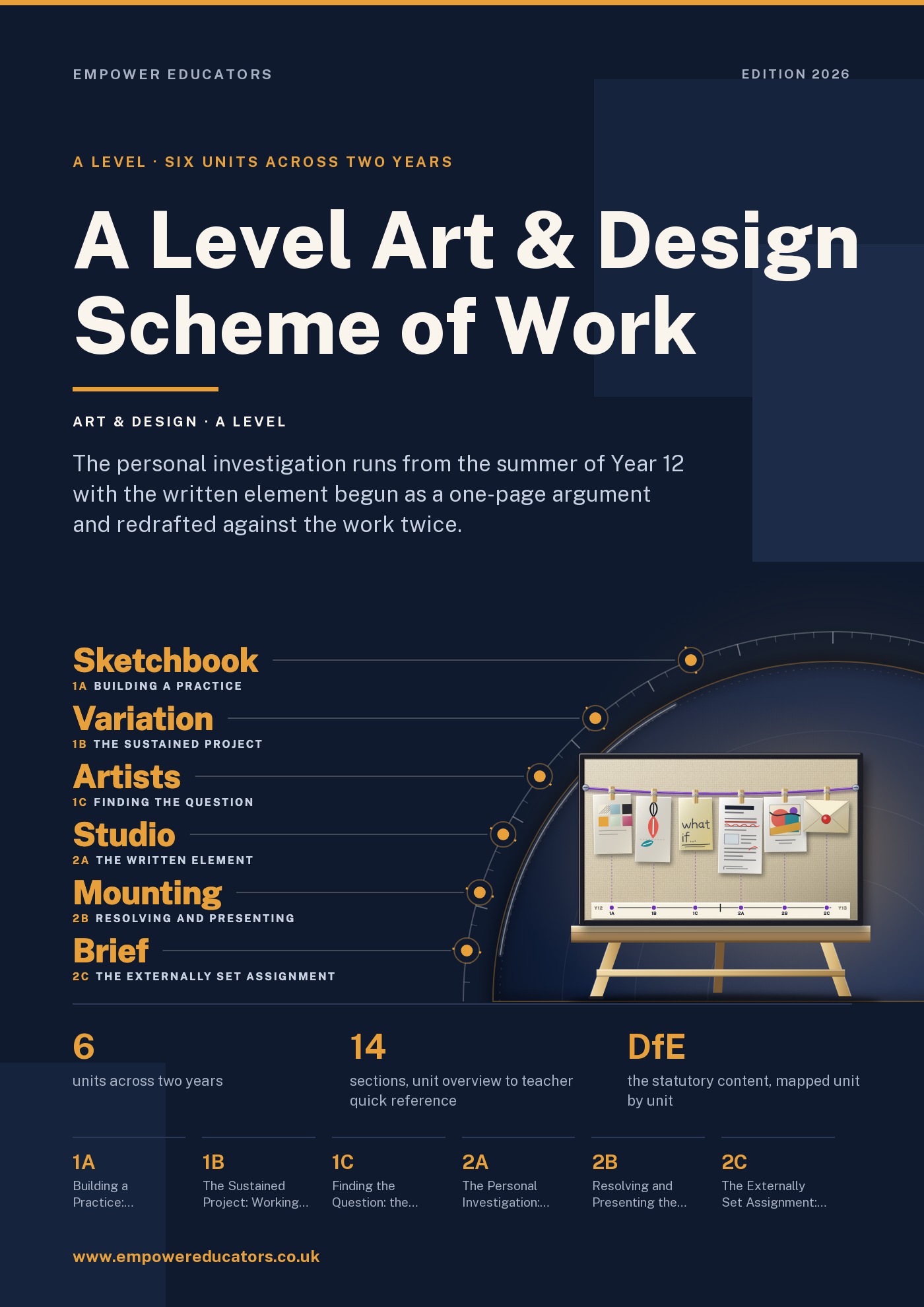
Forty-eight pages across two years, board-neutral by construction: every requirement comes from the DfE subject content for art and design or from Ofqual’s subject level conditions, and no specification is reproduced anywhere. The personal investigation runs from the summer of Year 12 with the written element begun as a one-page argument and redrafted against the work twice. Boards genuinely differ on the objective weightings inside Ofqual’s 20–30 per cent ranges, the preparatory period, and whether a word count is set. Those differences are collected in one table rather than guessed at.
£6.99The A Level scheme: 6 units across Year 12 and Year 13, 48 pages
- A4 PDF
- first 8 pages free to read
- instant download
One purchase covers the school that buys it. Print it, copy it, hand it round your department. Not for passing to other schools or uploading anywhere.
PDF download, ready straight after payment. Downloading it ends the 14-day right to cancel; a file that is faulty or not as described is always refunded. Refunds
Read before publication by serving senior leaders, in school.
5.0 from 24+ reviews on Google
Schools that have bought from Empower Educators include Nottingham High School, Northampton High School GDST and Sutton Valence School.
Complete your Art & Design

Every key stage: Art & Design scheme of work
Everything else this site has for Art & Design: Art & Design teaching resources
- 1aBuilding a Practice: Recording, Media and the Habit of Enquiry
- 1bThe Sustained Project: Working From a Theme
- 1cFinding the Question: the Personal Investigation Begins
- 2aThe Personal Investigation: Sustained Development and the Written Element
- 2bResolving and Presenting the Personal Investigation
- 2cThe Externally Set Assignment: the Preparatory Period and the Supervised Period
Ten sections per unit, in the same order every time. Weeks rather than single lessons, because A Level art is taught in sessions of two or three hours.
The subject content sets no topics, which is why a scheme of work matters more in this subject than in most: almost every decision about what is actually taught belongs to the department. What the content does require is that the study is integrated and that A level allows greater depth than AS, and this scheme takes extended development of a theme as its spine.
Year 12 builds a practice with no deadline attached to an outcome. Year 13 spends it.
- Written to
- The DfE subject content for GCE AS and A level art and design, and Ofqual’s GCE subject level conditions
- Intended for
- heads of department, subject leaders and every teacher who has to deliver it
- Extent
- 48 pages · 14 sections
The sequence
What this scheme of work covers, unit by unit
The 6 units of the A Level Art & Design Scheme of Work, in teaching order, with the term each one runs in and the question it is built to answer, what students make, the artists they meet and the vocabulary they learn.
1a
Building a Practice: Recording, Media and the Habit of Enquiry
Year 12 · Autumn · approx. 13 weeks · September – December
What can you do that a photograph cannot?
- End outcome
- A sketchbook, two contextual studies, and a stated line of enquiry.
- Assessment objectives
- AO1, AO2 and AO3 are built here. AO4 is deliberately left until Unit 1b.
1b
The Sustained Project: Working From a Theme
Year 12 · Spring · approx. 11 weeks · January – March
How do you keep going when the first good idea runs out?
- End outcome
- One resolved outcome, full development, one written abandonment.
- Assessment objectives
- All four. AO4 enters here for the first time, and the resolved outcome is what carries it.
1c
Finding the Question: the Personal Investigation Begins
Year 12 · Summer · approx. 12 weeks · April – July
What will still interest you in fourteen months?
- End outcome
- A question, a source base, four artists, a one-page argument, a plan.
- Assessment objectives
- AO1 and AO3 dominate. AO2 enters through the material trials; AO4 is not assessed this term.
2a
The Personal Investigation: Sustained Development and the Written Element
Year 13 · Autumn · approx. 13 weeks · September – December
Is the work answering the question, or has the question quietly changed?
- End outcome
- Sustained development, a full draft of the written element, one abandonment.
- Assessment objectives
- All four, with AO1 and AO2 carrying the term. AO4 is prepared for but resolved in Unit 2b.
2b
Resolving and Presenting the Personal Investigation
Year 13 · Spring 1 · approx. 6 weeks · January – February
What does this work need to be finished, and what does it need to be left alone?
- End outcome
- A complete, presented, photographed submission.
- Assessment objectives
- AO4 carries this unit — presenting a personal and meaningful response that realises intentions.
2c
The Externally Set Assignment: the Preparatory Period and the Supervised Period
Year 13 · Spring 2 into Summer · approx. 8 weeks · February – May
Can you do in eight weeks what you just did in fourteen months?
- End outcome
- Preparatory work and a supervised outcome.
- Assessment objectives
- All four, in one cycle. AO1 and AO4 are where compressed projects most often lose marks.
Look inside
Real pages, straight from the PDF
Click any page to see it full size.
Contents
All 14 sections
Taken from the book’s own contents page, so the page numbers are the real ones.