523·Psychology · A Level
A Level Psychology
Revision Guide
A Level Psychology revision guide for secondary schools
The whole of A level psychology in ten pages: how the course is assessed, then a page each for the five areas the DfE names — cognitive, social, developmental, individual differences and biological — followed by the four approaches, research methods, describing data and inferential statistics. Five drawings on every page, all made for the guide: a Stroop card in colour, the Strange Situation as one room in four moments, a brain and a neuron, people being allocated to conditions, a scatter whose correlation is computed from the points you can see, and the five per cent that decides significance shaded on the distribution it comes from. Three core ideas, a worked example in three steps, three misconceptions and eight cover-and-test questions on every page.
One purchase covers the school that buys it. Print it, copy it, hand it round your department. Not for passing to other schools or uploading anywhere.
Read before publication by serving heads of department and senior leaders, in school.
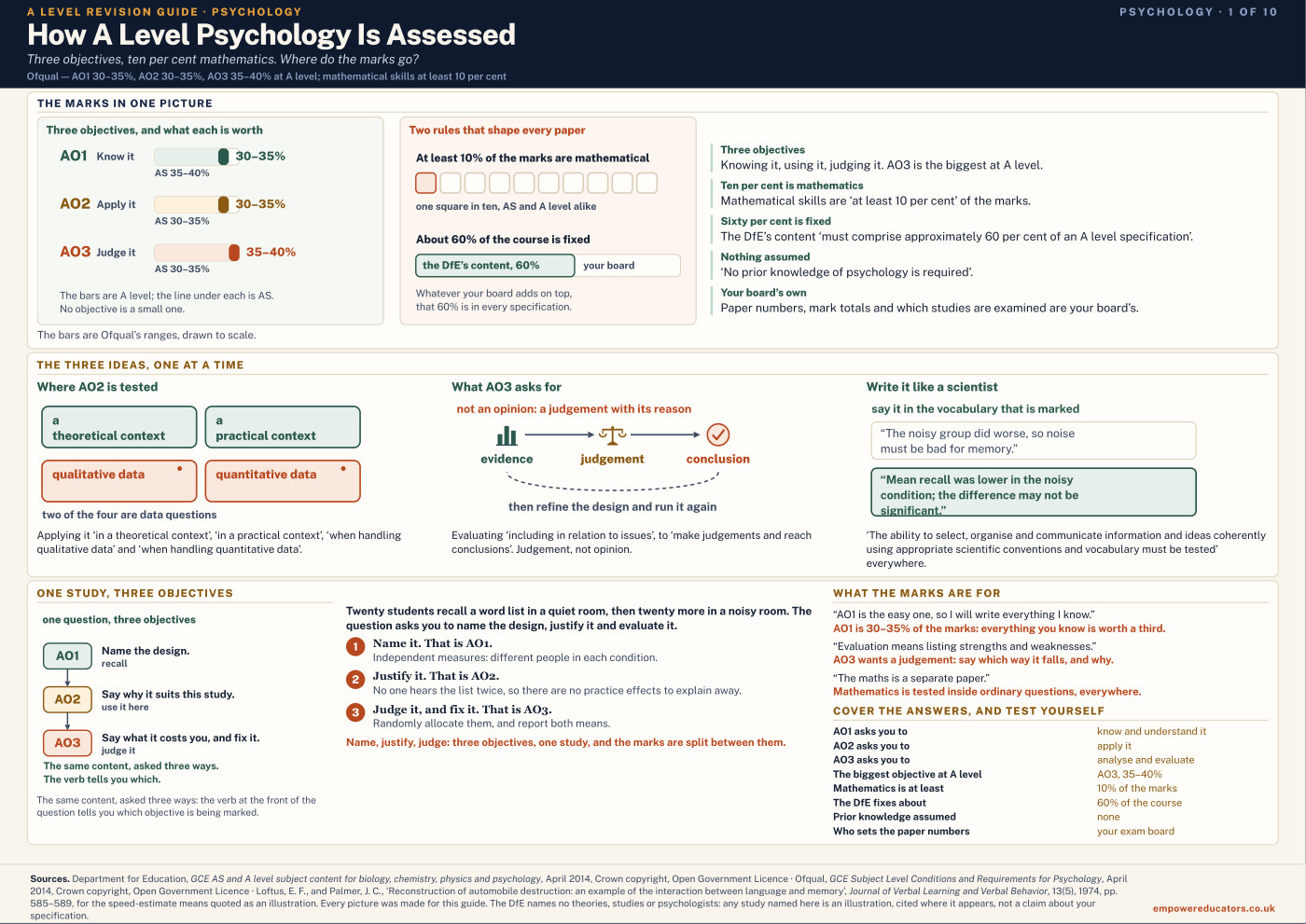
A level psychology is one subject taught from several different specifications. The Department for Education sets the content every board must cover — the five areas of psychology, the four approaches, research methods and statistics — and leaves each board to choose the theories and studies that carry it. This guide teaches what the DfE sets and what Ofqual’s assessment objectives reward, quoting both word for word, and leaves everything your board decides to your specification. No paper numbers, no component names and no mark totals appear anywhere in it, so it holds whichever specification you are sitting.
It is built around pictures rather than paragraphs. There is a Stroop card printed in colour so the effect happens on the page, the Strange Situation drawn as one room in four moments, a brain with its lobes and a neuron with its synapse magnified, and the three designs shown as people being allocated to conditions rather than named in a table. The statistics are real: the correlation is computed from the points plotted, the chi-square is calculated rather than copied, and the standard deviation is worked through from the numbers shown. Where a classic study is named it is named as an illustration of a method, with its full citation on the page, never as a claim about what your board examines.
- Written to
- The DfE’s GCE AS and A level subject content for biology, chemistry, physics and psychology (April 2014), Appendix 4 for the psychology content and Appendix 6d for the mathematical requirements, with Ofqual’s GCE subject level conditions and requirements for psychology (Ofqual/14/5408), quoted word for word; no board’s specification, no paper or component names, and no claim about which studies your board examines
- Intended for
- A level psychology students revising the whole course, and for teachers to set as revision or use in lessons
- Extent
- 10 pages · 10 sections
—·Look inside
Real pages, straight from the PDF
Click any page to see it full size.
—·Contents
All 10 sections
Taken from the booklet’s own contents page, so the page numbers are the real ones.