524·Biology · A Level
A Level Biology
Revision Guide
A Level Biology revision guide for secondary schools (PDF)
The whole of A level biology in ten pages: how the course is assessed, then a page for each of the eight areas the DfE names — biodiversity, exchange and transport, cells, biological molecules, ecosystems, control systems, genetics and evolution, and energy for biological processes — and a page on working scientifically and the Practical Endorsement. Five drawings on every page, all made for the guide: a quadrat with thirty plants in it, three cubes for surface area to volume, a plant cell beside a prokaryote at the same scale, a double helix, an ATP molecule losing its last phosphate, a reflex arc, two Punnett squares, a mitochondrion and a chloroplast, and the twelve pieces of apparatus the content names. Three core ideas, a worked example in three steps, three misconceptions and eight cover-and-test questions on every page.
Everything else this site has for Biology: Biology teaching resources
One purchase covers the school that buys it. Print it, copy it, hand it round your department. Not for passing to other schools or uploading anywhere.
Read before publication by serving heads of department and senior leaders, in school.
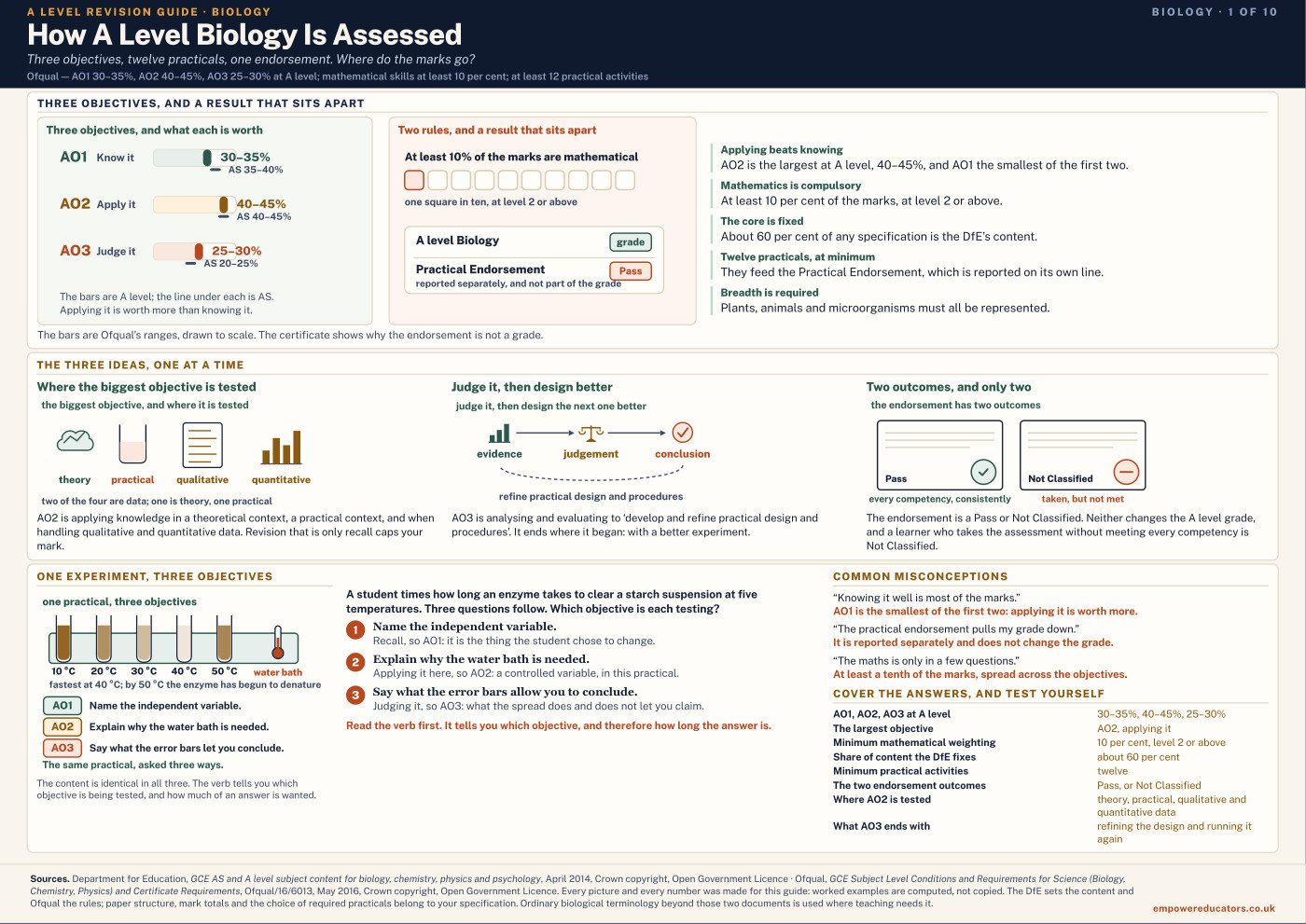
A level biology is one subject taught from several different specifications. The Department for Education sets eight areas of content every board must cover, and leaves each board to choose the order, the examples and the required practicals. This guide is those eight areas, in the DfE’s own order, with the assessment rules Ofqual sets around them, both quoted word for word. No paper numbers, no component names and no mark totals appear anywhere in it, so it holds whichever specification you are sitting.
Every number in it is worked out by the code that draws the figure beside it, and checked before the guide is built. The index of diversity comes from the thirty plants you can count in the quadrat; the surface area to volume ratios come from the cube side lengths; the magnification comes from the two lengths given; the transfer efficiencies come from the three energy figures in the pyramid; the 3:1 and 9:3:3:1 are counted off the cells of the Punnett squares; and the chi-square is calculated along with its critical value rather than read off a table. It is built around pictures rather than paragraphs: a stoma closing between its guard cells, two water molecules hydrogen-bonded, a reflex arc from skin to muscle, a heart with its valves, and a certificate showing exactly where the Practical Endorsement appears and why it is not a grade.
- Written to
- The DfE’s GCE AS and A level subject content for biology, chemistry, physics and psychology (April 2014), Appendix 1 for the content, Appendix 5 and 5c for the practical skills and apparatus, and Appendix 6a for the mathematics, with Ofqual’s GCE subject level conditions and requirements for science (Ofqual/16/6013), quoted word for word; no board’s specification, no paper or component names, and no claim about which practicals your board sets
- Intended for
- A level biology students revising the whole course, and for teachers to set as revision or use in lessons
- Extent
- 10 pages · 10 sections
—·Look inside
Real pages, straight from the PDF
Click any page to see it full size.
—·Contents
All 10 sections
Taken from the booklet’s own contents page, so the page numbers are the real ones.