Physics · A Level · £4.99
A Level Physics
Revision Guide
The whole of A level physics in fifteen pages: how the course is assessed, then the content the DfE names — measurement and uncertainty, vectors and kinematics, forces and Newton's laws, work, energy and momentum, circular motion and oscillations, materials, electric circuits, capacitance, waves and superposition, matter and thermal physics, quantum and nuclear physics, gravitational and electric fields, magnetic fields and induction — closing on working scientifically and the Practical Endorsement. Every page has a drawing made for it, three ideas, a worked example in three steps, three misconceptions and eight cover-and-test questions.
£4.99The A Level Physics revision guide, 15 pages
- Landscape A4 PDF
- every page shown, part-blurred
- instant download
One purchase covers the school that buys it. Print it, copy it, hand it round your department. Not for passing to other schools or uploading anywhere.
PDF download, ready straight after payment. Downloading it ends the 14-day right to cancel; a file that is faulty or not as described is always refunded. Refunds
Read before publication by the serving head of that department and by senior leaders, in school.
5.0 from 24+ reviews on Google
Schools that have bought from Empower Educators include Nottingham High School, Northampton High School GDST and Sutton Valence School.
Everything else this site has for Physics: Physics teaching resources
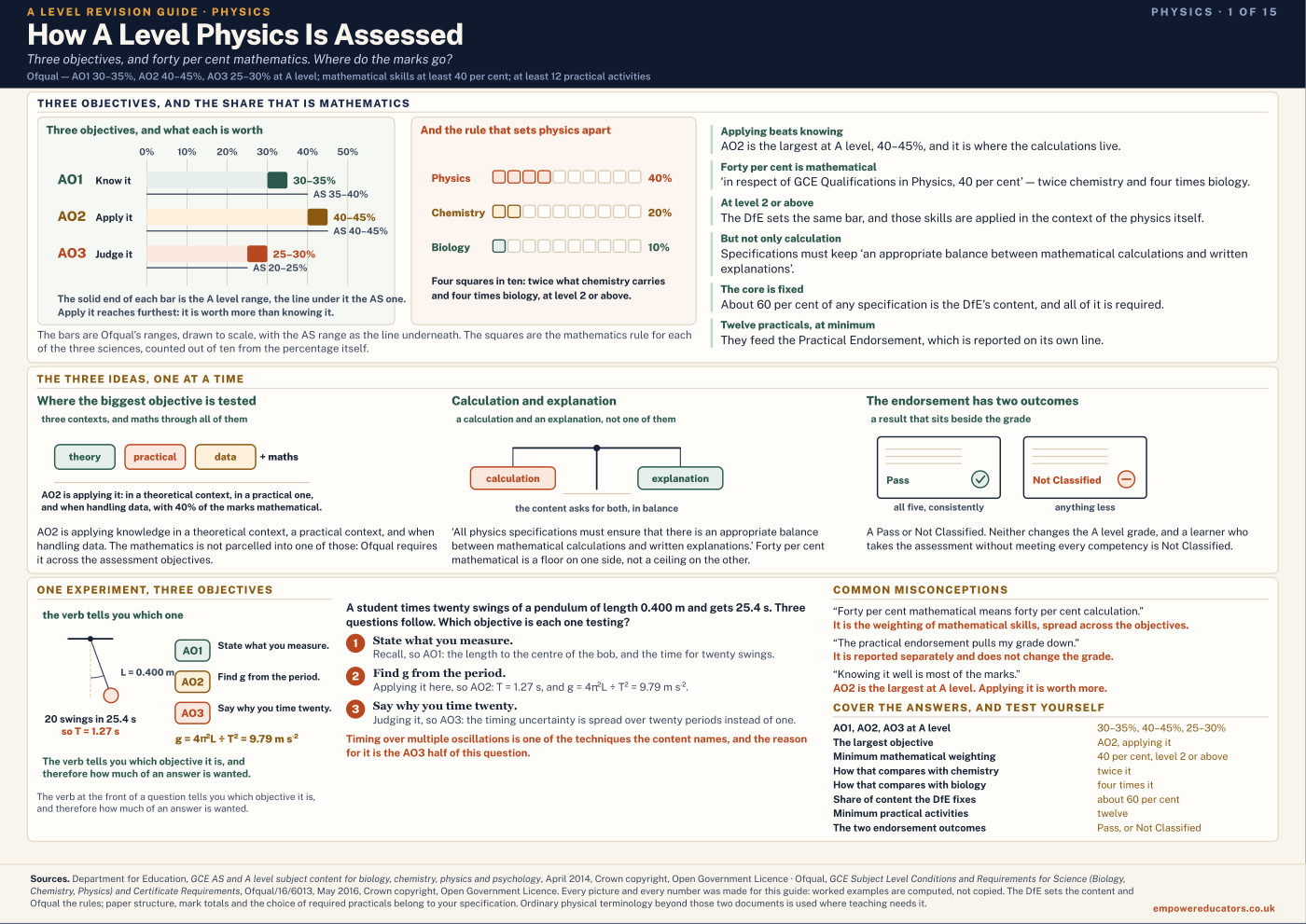
A level physics is one subject taught from several specifications. The Department for Education sets the content every board must cover, and leaves each board the order, the examples and the required practicals. This guide is that content in the DfE's own order, with the assessment rules Ofqual sets around it, both quoted word for word.
The DfE's physics content is long in some places and short in others. Mechanics runs to six sub-areas in one paragraph, so it takes four pages; electric circuits and capacitance take two; fields and magnetism take two. Measurement, materials, waves, matter, quantum and nuclear physics, and working scientifically take one each. No paper numbers, no component names and no mark totals appear anywhere in it.
Every number in it is computed by the code that draws the figure beside it, and asserted before the guide will build. The pendulum's g comes from its period and length; the spring's period and maximum speed come from its stiffness and mass; the emf of a coil comes from the rate at which its flux linkage changes; the force between two protons is worked out twice, once by Coulomb's law and once by Newton's, and the two are compared. Where a drawing has to be right as well as the arithmetic, such as the direction of a force on a current or the shape of a field line, it is checked by its own test, because a figure generated from correct numbers can still draw something false.
- Written to
- The DfE's GCE AS and A level subject content for biology, chemistry, physics and psychology (April 2014), Appendix 3 for the physics content, Appendices 5, 5a, 5b and 5c for the practical skills and apparatus, and Appendix 6 for the mathematics, with Ofqual's GCE subject level conditions and requirements for science (Ofqual/16/6013), quoted word for word; no board's specification, no paper or component names, and no claim about which practicals your board sets
- Intended for
- A level physics students revising the whole course, and for teachers to set as revision or use in lessons
- Extent
- 15 pages · 15 sections
Look inside
Real pages, straight from the PDF
Click any page to see it full size.
Contents
All 15 sections
Taken from the book’s own contents page, so the page numbers are the real ones.