—·Chemistry · GCSE
Strong Bonds, Weak Forces
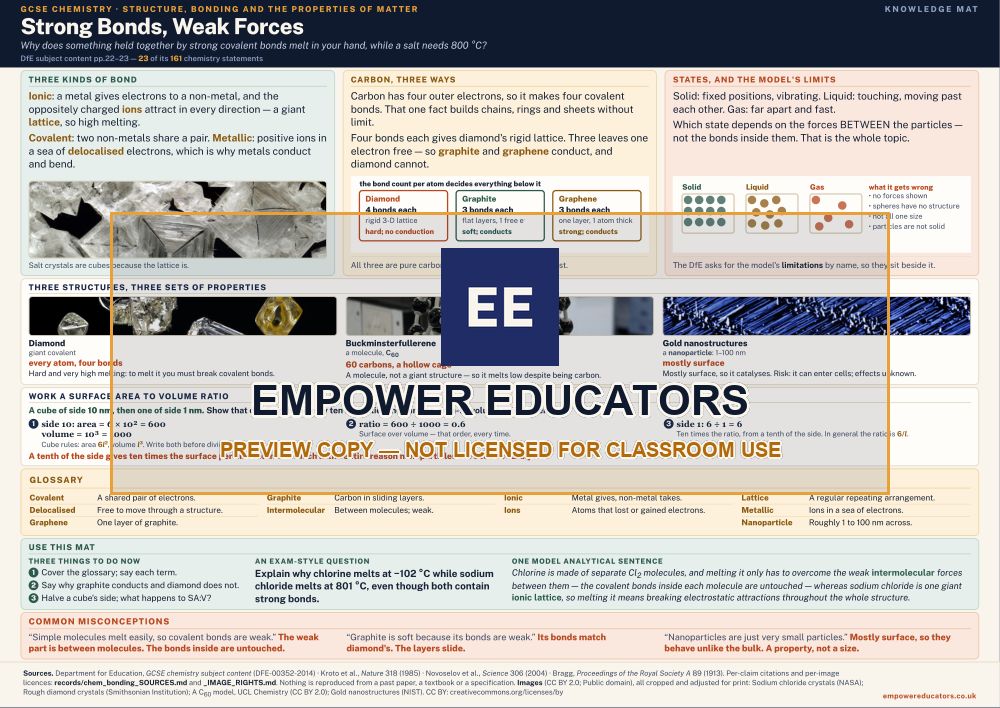
Why something held together by strong covalent bonds melts in your hand while a salt needs 800 °C. Ionic, covalent and metallic bonding; carbon three ways — diamond, graphite and graphene — with the bond count that decides everything; the three states and the particle model's own limitations; diamond, buckminsterfullerene and gold nanoparticles compared; a worked surface-area-to-volume ratio. Ten terms to define, a model answer contrasting chlorine and sodium chloride, and the misconceptions that cost marks.
Ready for the classroom
Get the clean copy
You have seen all 1 sheets — nothing is held back. What you buy is the same set without the watermark, at full print resolution, ready to run off for every class in the department.
- Every sheet with no watermark, at print resolution
- 1 print-and-use template
- Referenced to the DfE GCSE subject content for chemistry (DFE-00352-2014). Every photograph is a sourced archival or scientific image, licensed for reuse and credited on the sheet; every diagram is drawn in code for the sheet
- Instant PDF download, yours to keep and reproduce across the school that buys it — not for other schools