Religious Education · KS3 to A Level · £4.99
Religious Studies
Key Terms
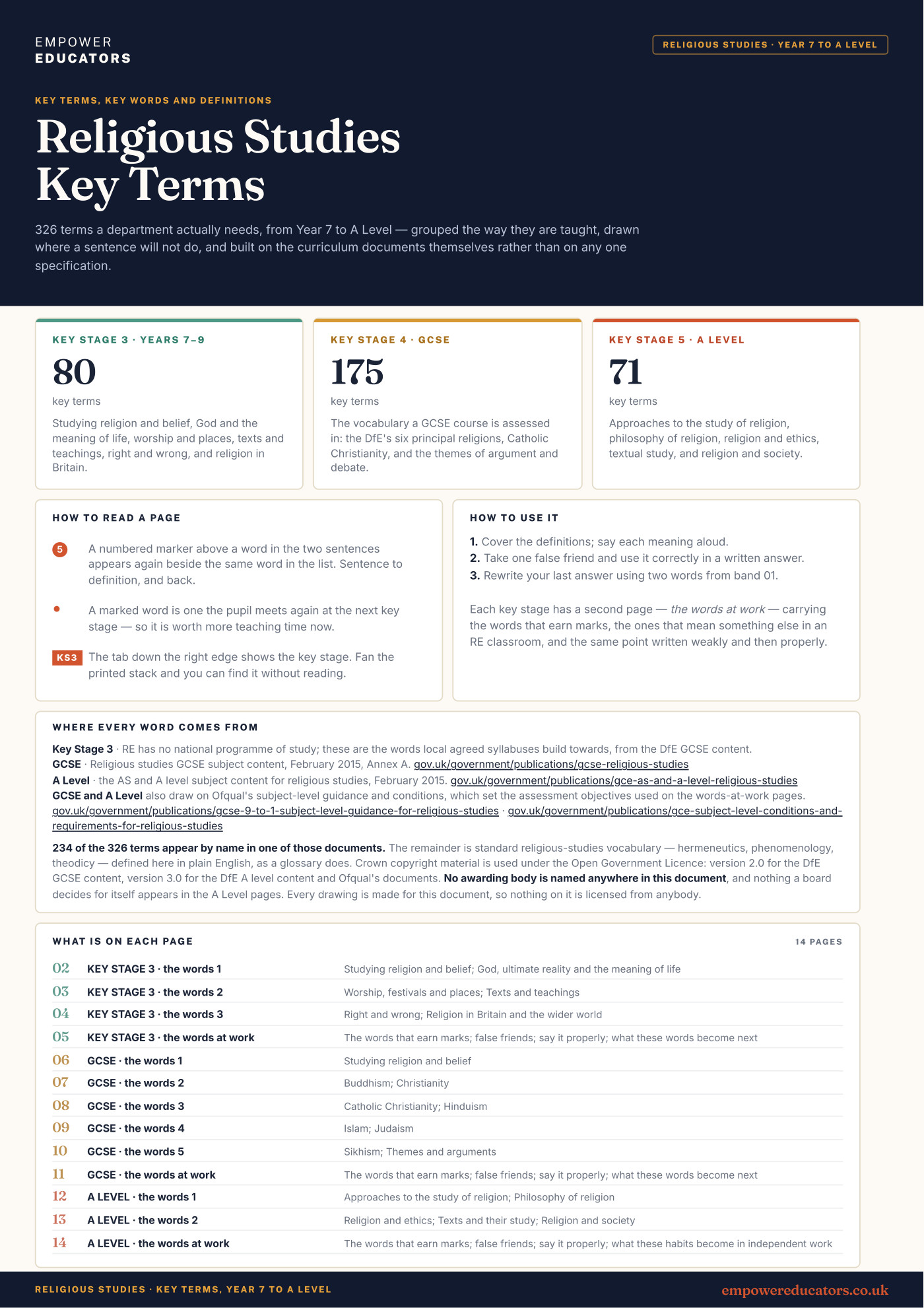
Every word a religious studies department teaches, Year 7 to A Level, in one A4 book. Each key stage gets its own pages: the terms grouped the way they are taught rather than alphabetically, a definition that fits on two lines, and a worked example beside almost every one. Each key stage opens on two short sentences, annotated: studying religion and belief, the one skill every other band assumes, which means asking who holds a view, where believers differ and what a source's authority rests on. The numbers on those sentences appear again beside the same words in the list. GCSE then goes religion by religion, following the DfE's list, before the themes and arguments; A Level covers approaches to the study of religion, philosophy of religion, religion and ethics, texts and their study, and religion and society. Then a page on using the words: the ones the assessment itself is written in, the false friends that mean something else in an RE classroom, the same point written weakly and then properly, and what each word becomes at the next key stage.
£4.99The whole book, Year 7 to A Level, 14 pages
- A4 PDF
- every page shown, part-blurred
- instant download
One purchase covers the school that buys it. Print it, copy it, hand it round your department. Not for passing to other schools or uploading anywhere.
PDF download, ready straight after payment. Downloading it ends the 14-day right to cancel; a file that is faulty or not as described is always refunded. Refunds
5.0 from 25+ reviews on Google
Schools that have bought from Empower Educators include Nottingham High School, Northampton High School GDST and Sutton Valence School.
£4.99 PDF · instant download
A pupil who knows a word is not yet using it. This book is built around that gap. The words for each key stage sit in the groups they are taught in, each with a short definition and a worked example, and a marked word is one the pupil meets again at the next key stage, so a department can see where its vocabulary carries forward and where it changes name. Every key stage opens on two annotated sentences, because band one is always the vocabulary of studying religion itself: scripture, practice and interpretation at Key Stage 3; common and divergent views, denomination and authority at GCSE; historical-critical and confessional approaches at A Level. A belief belongs to someone, and the first habit the subject asks of a pupil is to say whose it is. No sentence is attributed to a real person, text or community, and no page carries a picture of a person, a place of worship or a sacred object.
Every key stage closes on a page about using the words. The words the assessment is written in, taken from Ofqual's assessment objectives where they are theirs. The false friends: faith is not only confidence, a prophet does not predict the future, a canon is not a gun. The same point written weakly and then properly, so "Hindus believe in lots of gods" becomes a sentence a Hindu would recognise. And a table of what each habit is called at the next stage. Nothing a board decides for itself is in it: the DfE content names the religions and the themes, and which of them a specification offers, and how it is examined, belongs to the awarding organisation. The book has not been read by a practising RE teacher or by members of the faith communities it describes, and a department should read it with its own specification beside it.
- Written to
- RE is not part of the national curriculum and has no national programme of study, so the Key Stage 3 words are the vocabulary local agreed syllabuses build towards, taken from the DfE's religious studies GCSE subject content (February 2015); the GCSE pages follow that document's Annex A for Buddhism, Christianity, Catholic Christianity, Hinduism, Islam, Judaism and Sikhism, and its themes; the A Level pages follow the DfE's AS and A level religious studies subject content (February 2015); GCSE and A Level also draw on Ofqual's subject-level guidance and conditions, which set the assessment objectives used on the words-at-work pages; 234 of 326 terms appear by name in one of those documents and the cover says so, the rest are standard religious studies vocabulary defined here in plain English; no awarding body is named, and nothing a board decides for itself appears in the A Level pages
- Intended for
- RE and religious studies departments: printed one per pupil, kept in the front of an exercise book, or put on the wall by key stage
- Extent
- 14 pages · 13 sections
Look inside
Real pages, straight from the PDF
Click any page to see it full size.
Contents
All 13 sections
Taken from the book’s own contents page, so the page numbers are the real ones.