Empower
Educators
The resource hub

04·Questions and model answers

GCSE Questions and Model Answers

The questions, and what separates a good answer from a full one.

For subject teachers and heads of department

What these are

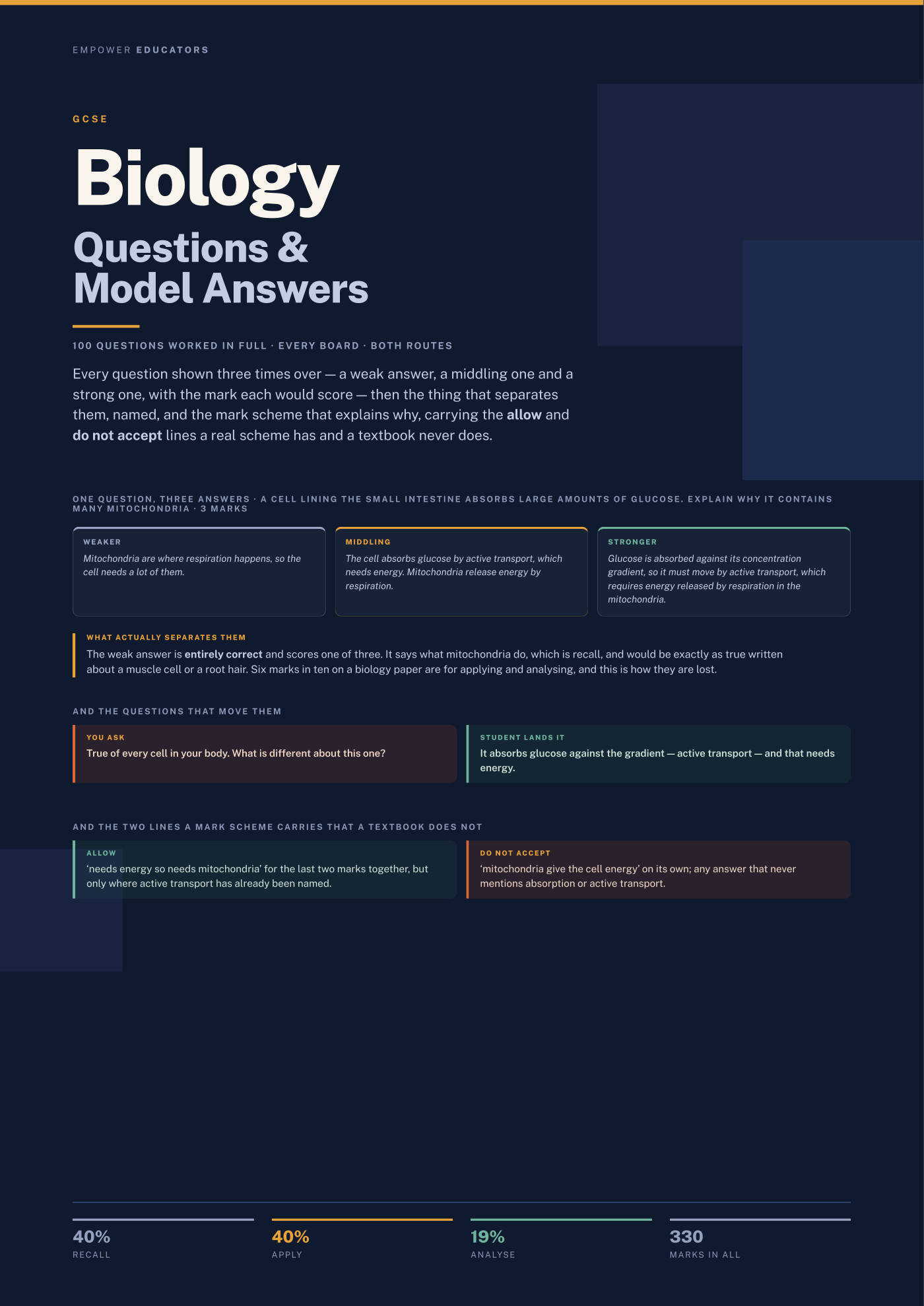
100 questions a subject, one page each, across 6 books. Every question is shown three times over — a weak answer, a middling one and a strong one — with the mark each would actually score, so a class can be handed the three and asked to sort them before anyone is told which is which.

What they are for

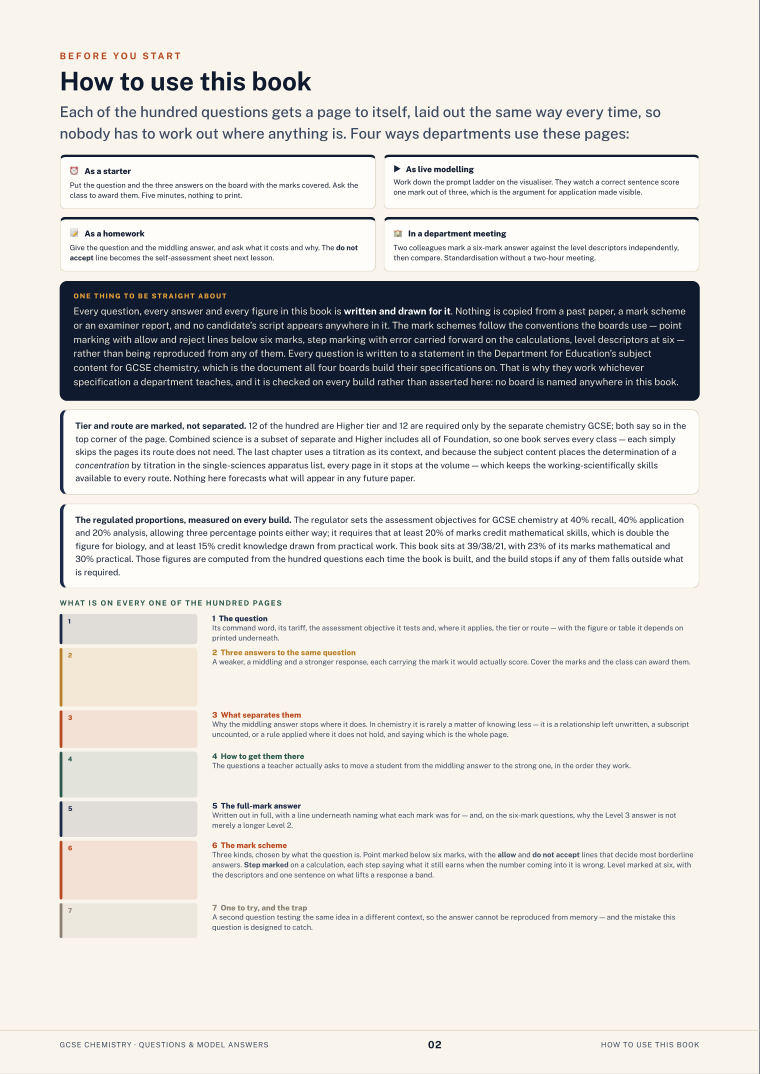
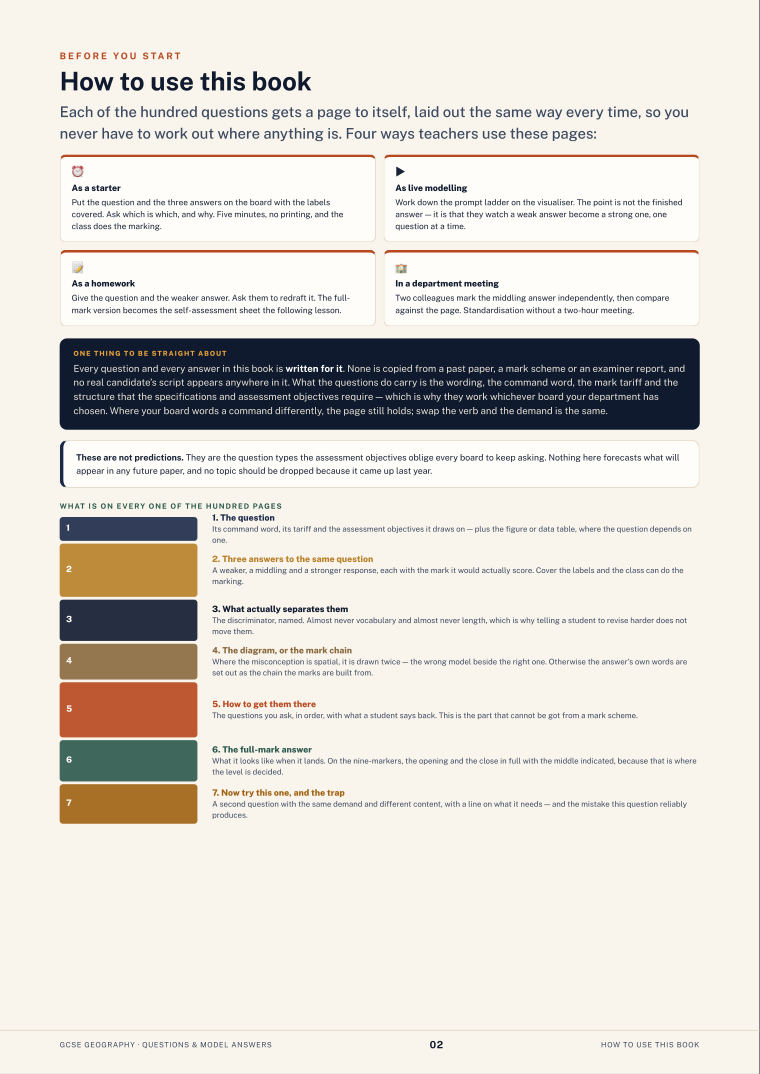
The lesson, not the revision session. A page works as a starter, as live modelling on a visualiser, as a homework, or as the thing two colleagues mark independently before comparing — which is standardisation without a two-hour meeting.

What is different about them

The model answer is the least of it. What follows each set of three is the discriminator, named out loud, and then the questions you actually ask to move a student from the first answer to the last. That prompt sequence is the part no mark scheme contains.

Cover of GCSE English Language Questions & Model Answers

English · GCSE £4.99

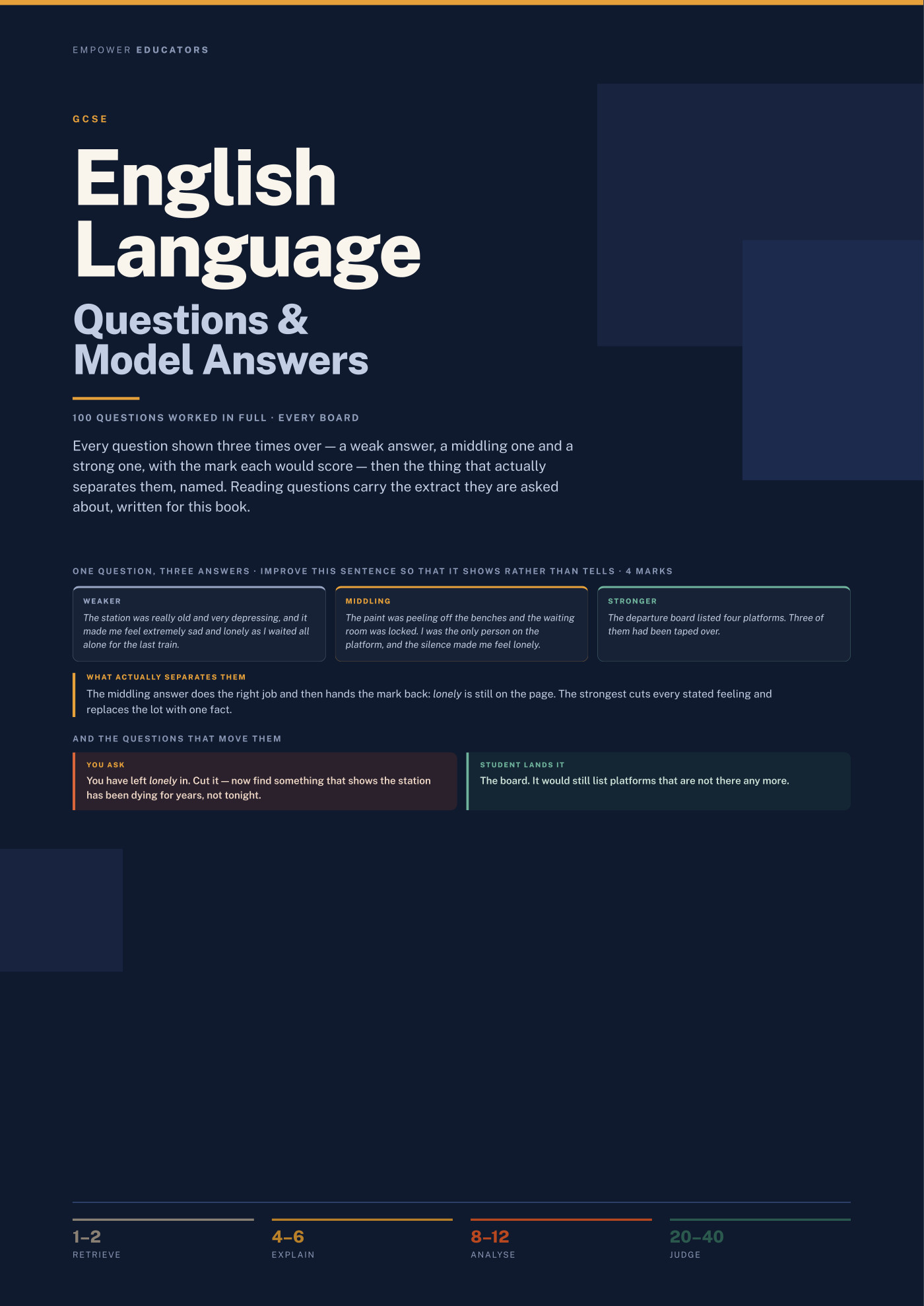
GCSE English Language Questions & Model Answers

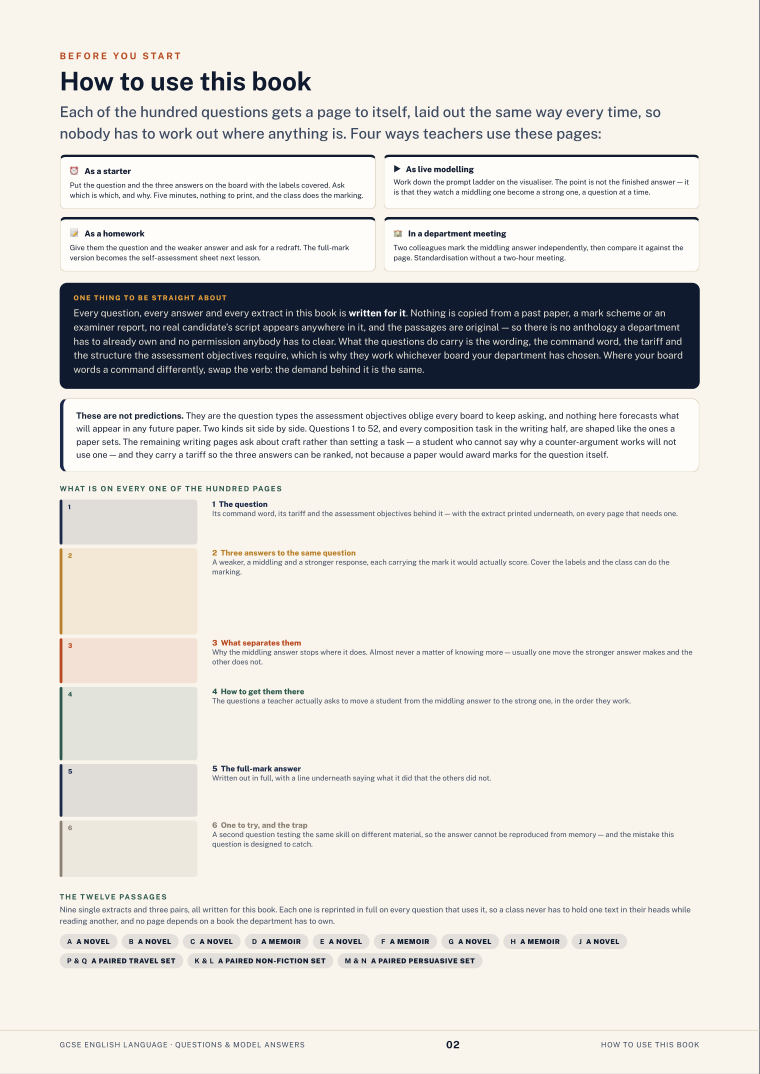
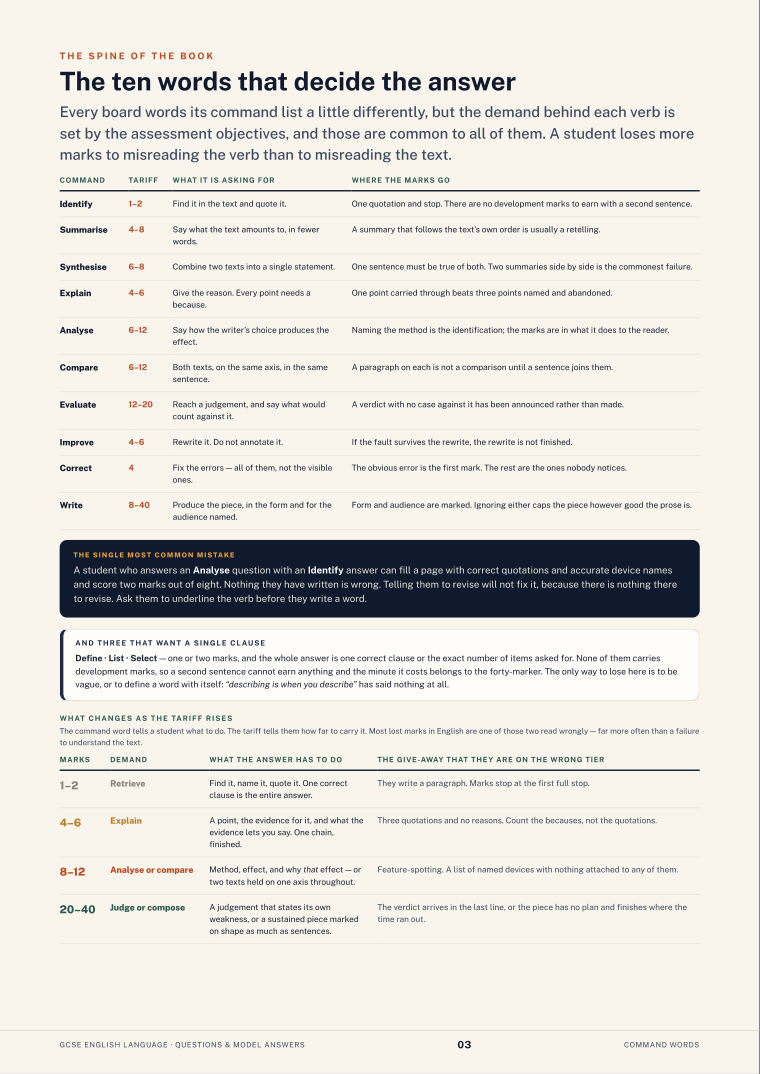
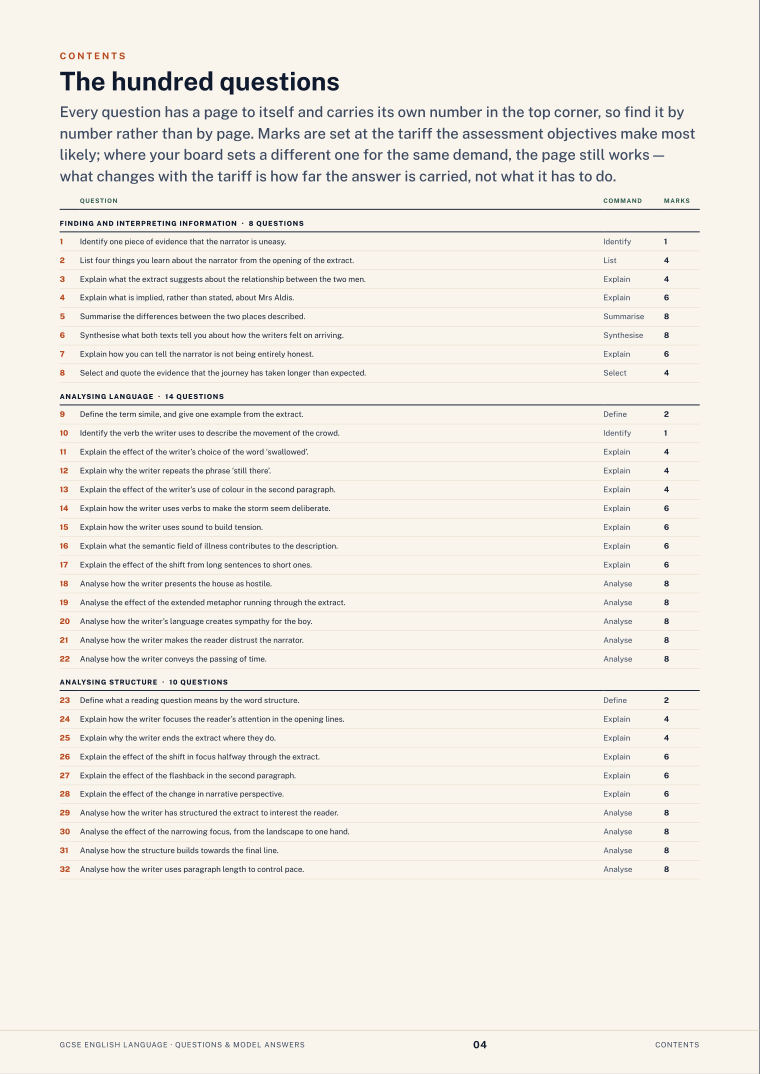
Feature-spotting is what caps an English answer: the device named, the effect assumed. Each of these hundred pages separates the two, then supplies the questions that move a student from one to the other. Twelve passages are written for the book and reprinted on every question that uses them, so no page depends on an anthology a department already has to own — fifty-two questions read those passages, and forty-eight write, up to the full forty-mark task.

  1. 1 Finding and interpreting information
  2. 2 Analysing language
  3. 3 Analysing structure
  4. 4 Comparing writers' perspectives
  5. 5 Evaluating a text critically
  6. 6 Descriptive writing
  7. 7 Narrative writing
  8. 8 Writing to argue or persuade
  9. 9 Writing to explain, inform and advise
  10. 10 Sentence craft and technical accuracy

The GCSE subject content for English language (DfE) and the assessment objectives set by Ofqual, which are worded identically across AQA, Edexcel, OCR and Eduqas · 106 pages, 10 sections · For English teachers and heads of department — used with a class, not a student revision guide
Preview — first 14 pages

🔒 92 more pages unlock on purchase

Cover of GCSE Mathematics Questions & Model Answers

Mathematics · GCSE £4.99

GCSE Mathematics Questions & Model Answers

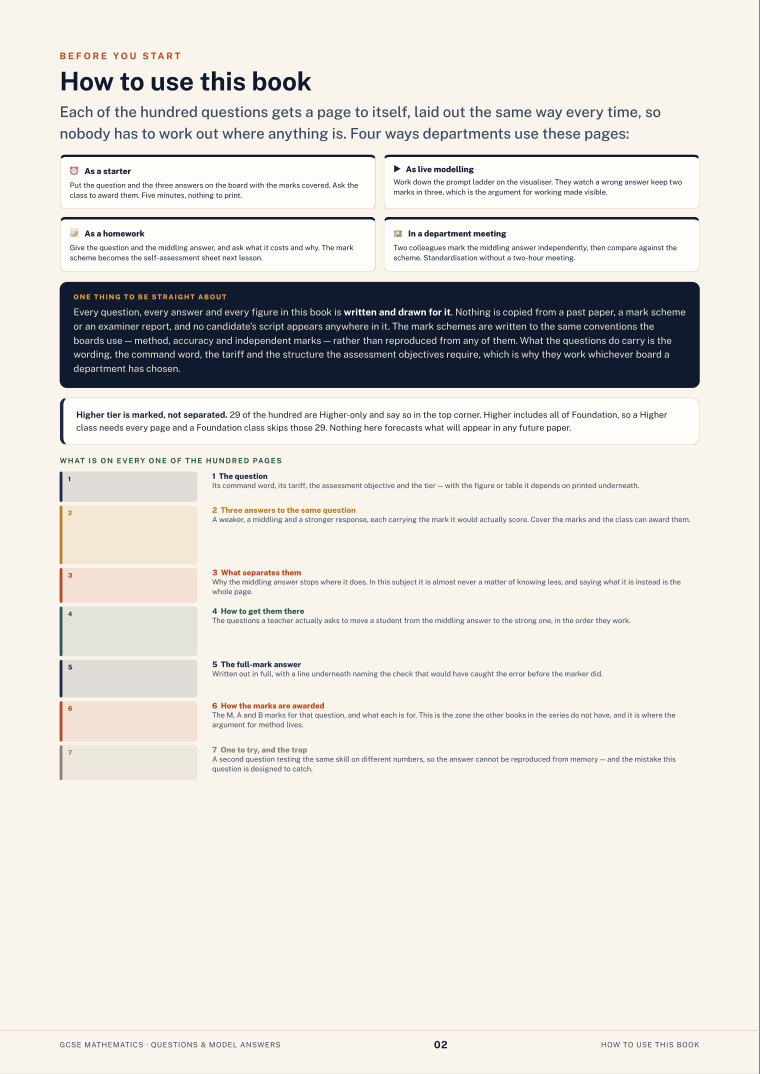
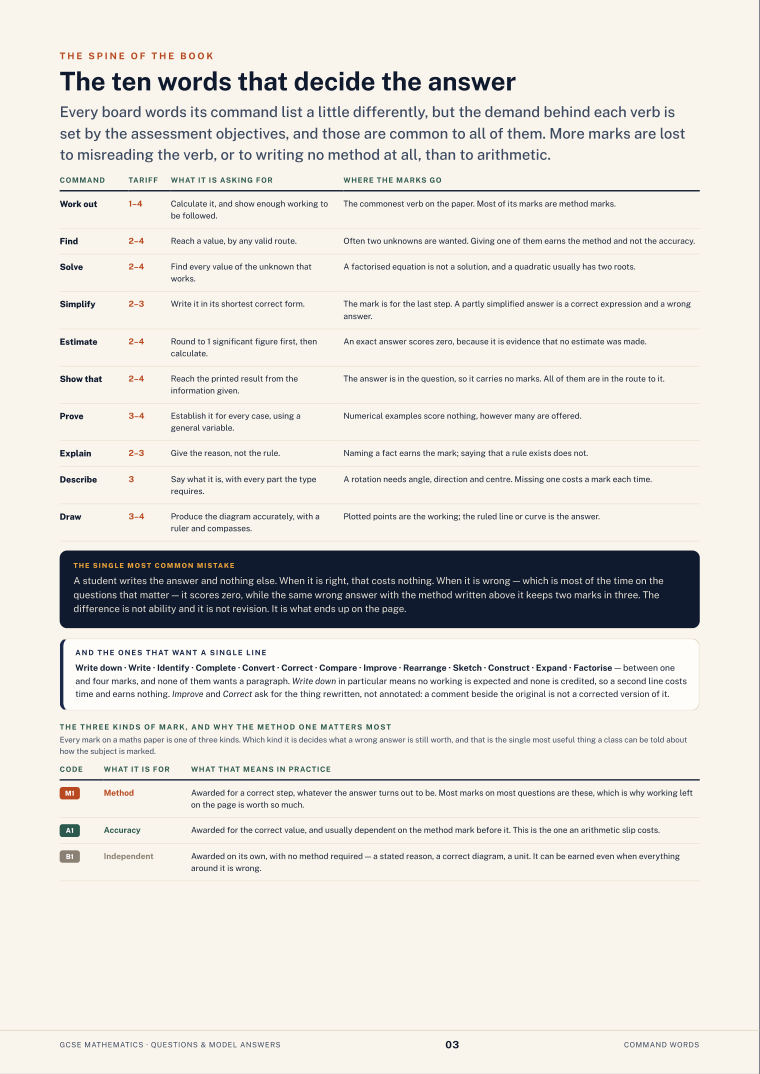
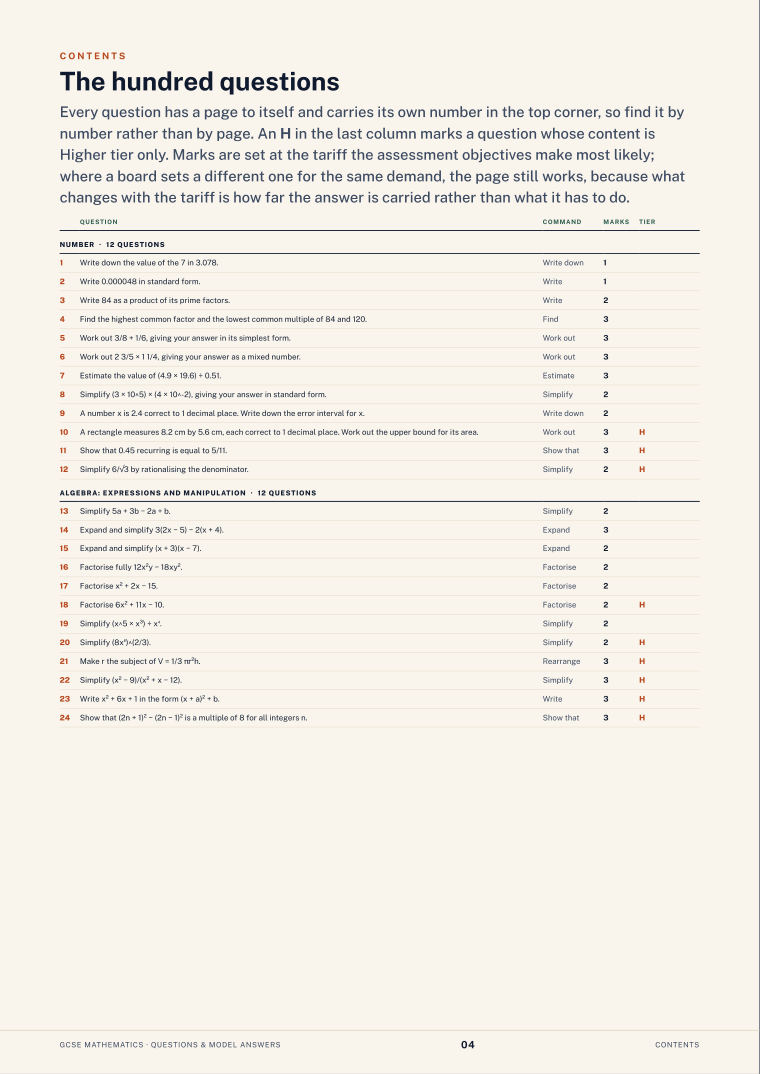
A wrong answer with the method written above it keeps two marks in three. The same wrong answer standing alone keeps none, and the difference is not ability — it is what ended up on the page. Every one of these hundred questions carries its own mark scheme, method, accuracy and independent marks set out separately, so a class can see which line earned what. Higher-tier content is marked on the page rather than split into a second book.

  1. 1 Number
  2. 2 Algebra: expressions and manipulation
  3. 3 Equations, inequalities and graphs
  4. 4 Ratio, proportion and rates of change
  5. 5 Geometry: angles, shape and properties
  6. 6 Mensuration, Pythagoras and trigonometry
  7. 7 Probability
  8. 8 Statistics
  9. 9 Method, working and communication

The GCSE subject content for mathematics (DfE) and the three assessment objectives set by Ofqual, which are worded identically across AQA, Edexcel, OCR and Eduqas · 107 pages, 9 sections · For mathematics teachers and heads of department — used with a class, not a student revision guide
Preview — first 14 pages

🔒 93 more pages unlock on purchase

Cover of GCSE Biology Questions & Model Answers

Biology · GCSE £4.99

GCSE Biology Questions & Model Answers

Six marks in ten on a biology paper are for applying and analysing, and the commonest way to lose them is to write something true — a sentence about mitochondria that would be just as correct on a page about a muscle cell. Every page here names what the question demanded and the answer never touched. The mark schemes carry the allow and do not accept lines a real scheme has and a textbook never does; at six marks they become level descriptors, with the one move that lifts a response from one band to the next written out in a sentence.

  1. 1 Cell biology and microscopy
  2. 2 Organisation and transport
  3. 3 Infection and response
  4. 4 Bioenergetics
  5. 5 Homeostasis and response
  6. 6 Inheritance, variation and evolution
  7. 7 Ecology
  8. 8 Apparatus and techniques
  9. 9 Working scientifically

The GCSE subject content for biology published by the Department for Education, which every board builds its specification on, and the three assessment objectives set by Ofqual · 107 pages, 9 sections · For biology and science teachers and heads of department — used with a class, not a student revision guide
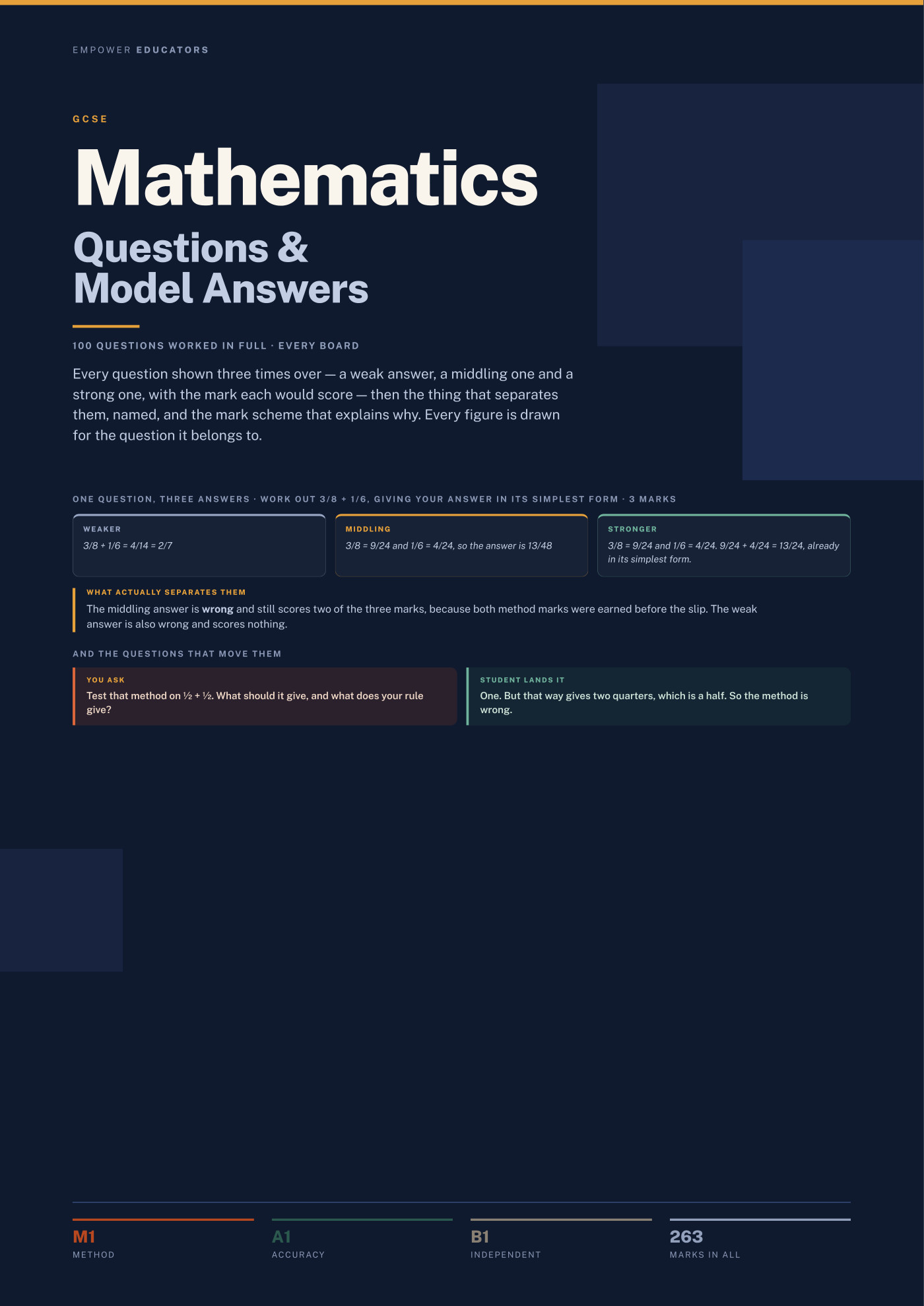
Preview — first 14 pages

🔒 93 more pages unlock on purchase

Cover of GCSE Chemistry Questions & Model Answers

Chemistry · GCSE £4.99

GCSE Chemistry Questions & Model Answers

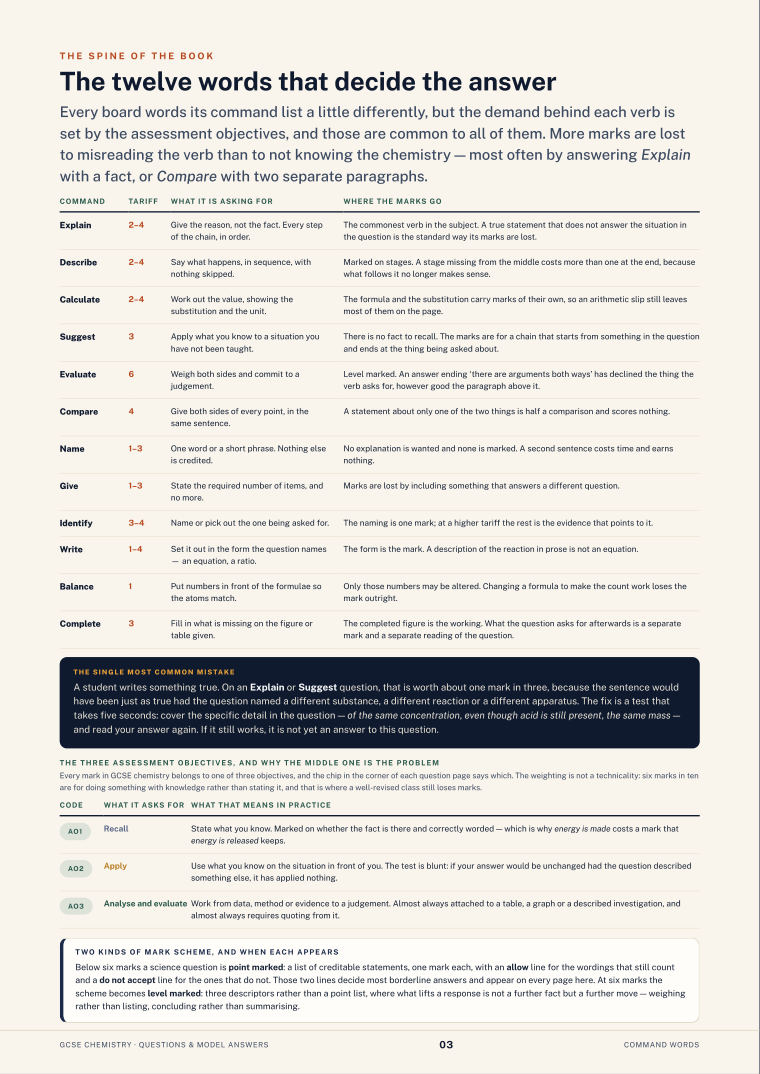
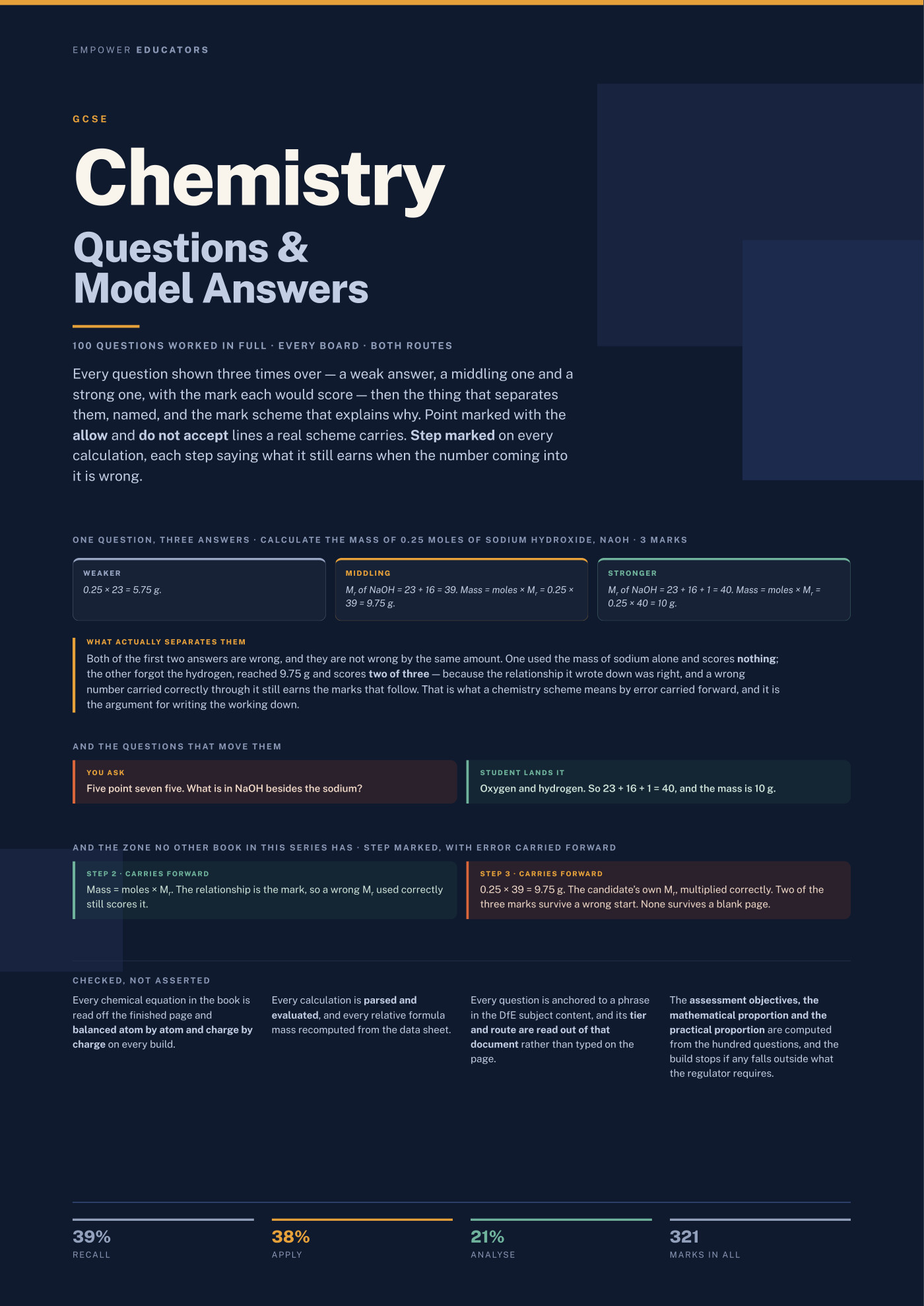
A student who reaches 9.75 g instead of 10 g because they forgot the hydrogen keeps two of the three marks — and one who writes 10 g with no working keeps none. That is error carried forward, and it is worth more marks in chemistry than in any other subject on the timetable. Every calculation here is marked step by step, each step saying what it still earns when the number coming into it is wrong; below six marks the schemes carry the allow and do not accept lines a real scheme has, and at six they become level descriptors.

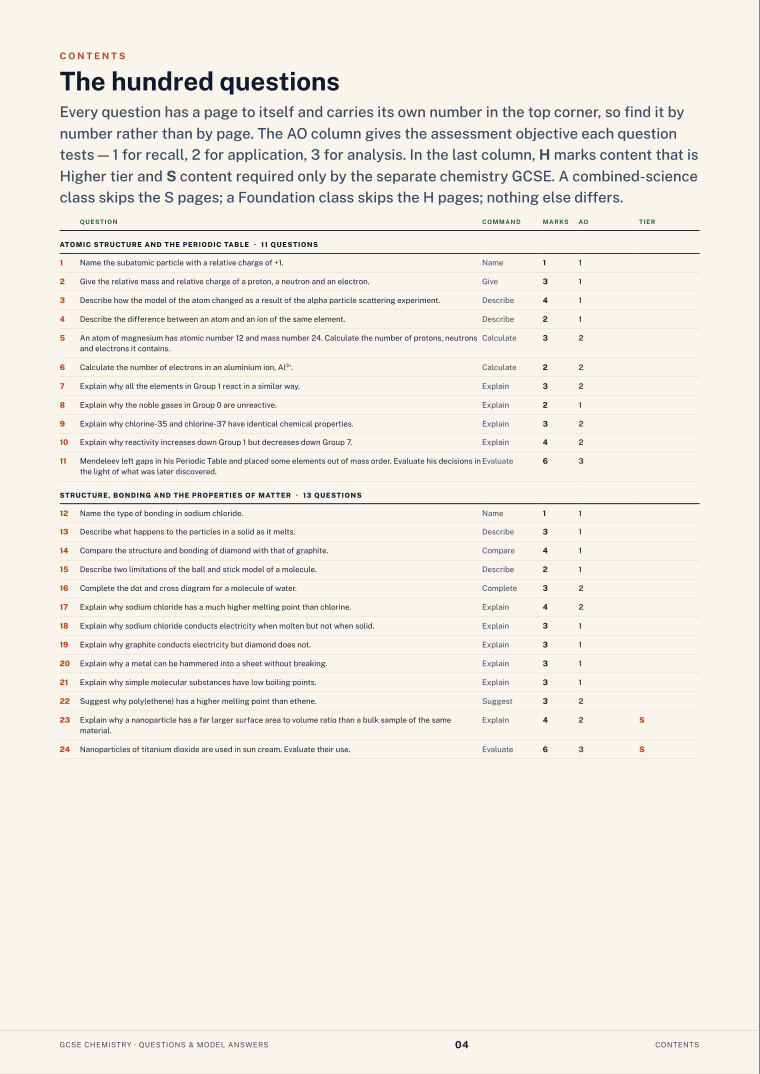
  1. 1 Atomic structure and the Periodic Table
  2. 2 Structure, bonding and the properties of matter
  3. 3 Chemical changes
  4. 4 Energy changes in chemistry
  5. 5 Rates and equilibrium
  6. 6 Quantitative chemistry
  7. 7 Chemical analysis
  8. 8 Industry, organic chemistry and the atmosphere
  9. 9 Apparatus and working scientifically

The GCSE subject content for chemistry published by the Department for Education, which every board builds its specification on, and the assessment objectives and mathematical requirements set by Ofqual · 107 pages, 9 sections · For chemistry and science teachers and heads of department — used with a class, not a student revision guide
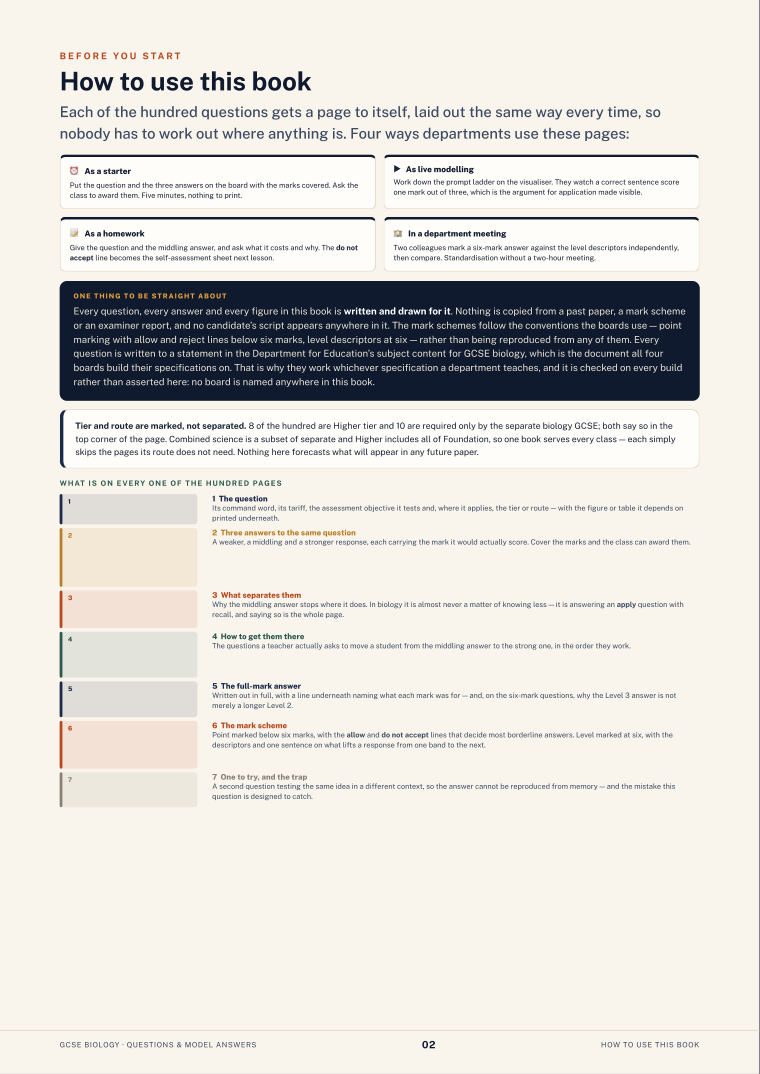
Preview — first 14 pages

🔒 93 more pages unlock on purchase

Cover of GCSE Physics Questions & Model Answers

Physics · GCSE £4.99

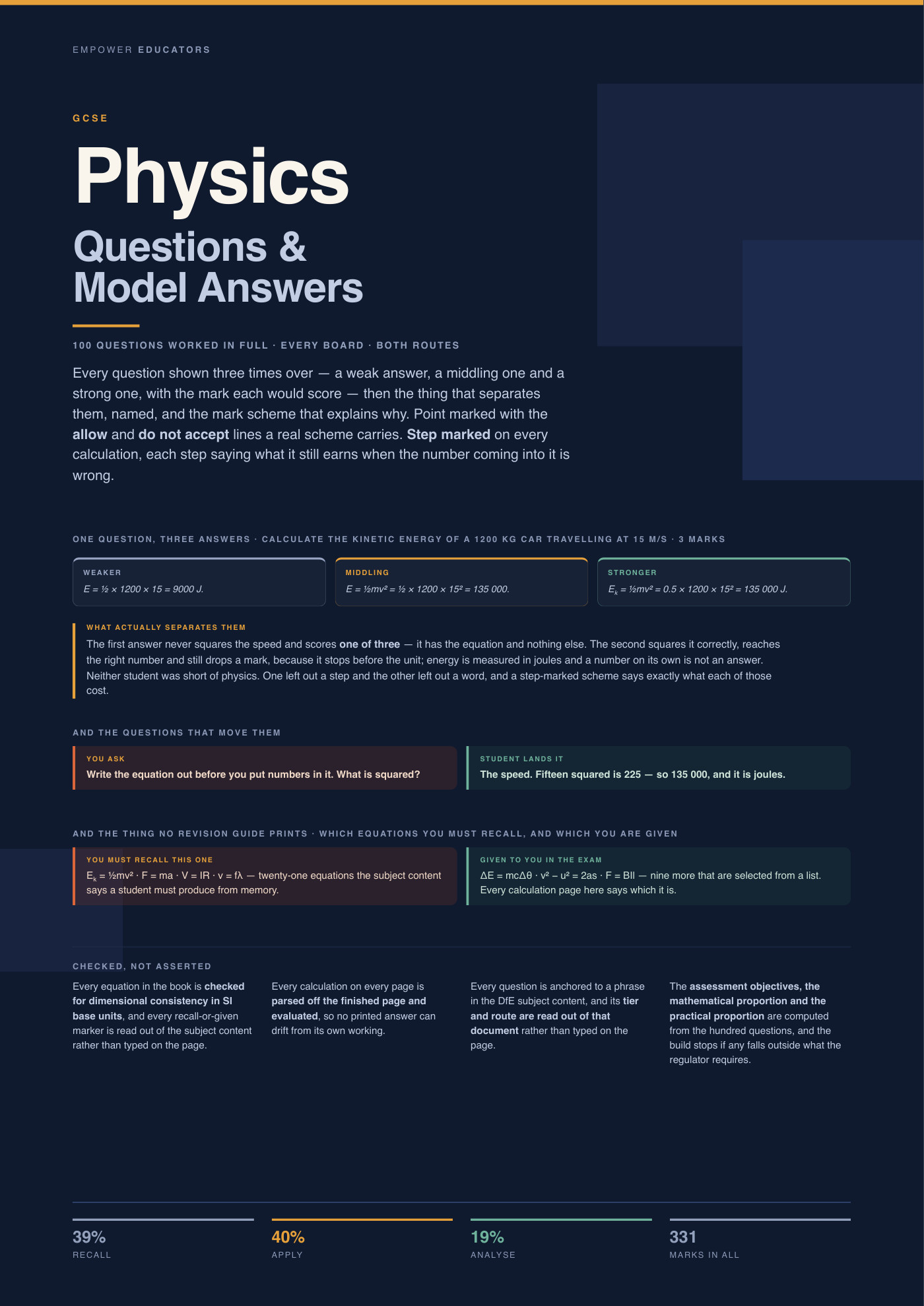
GCSE Physics Questions & Model Answers

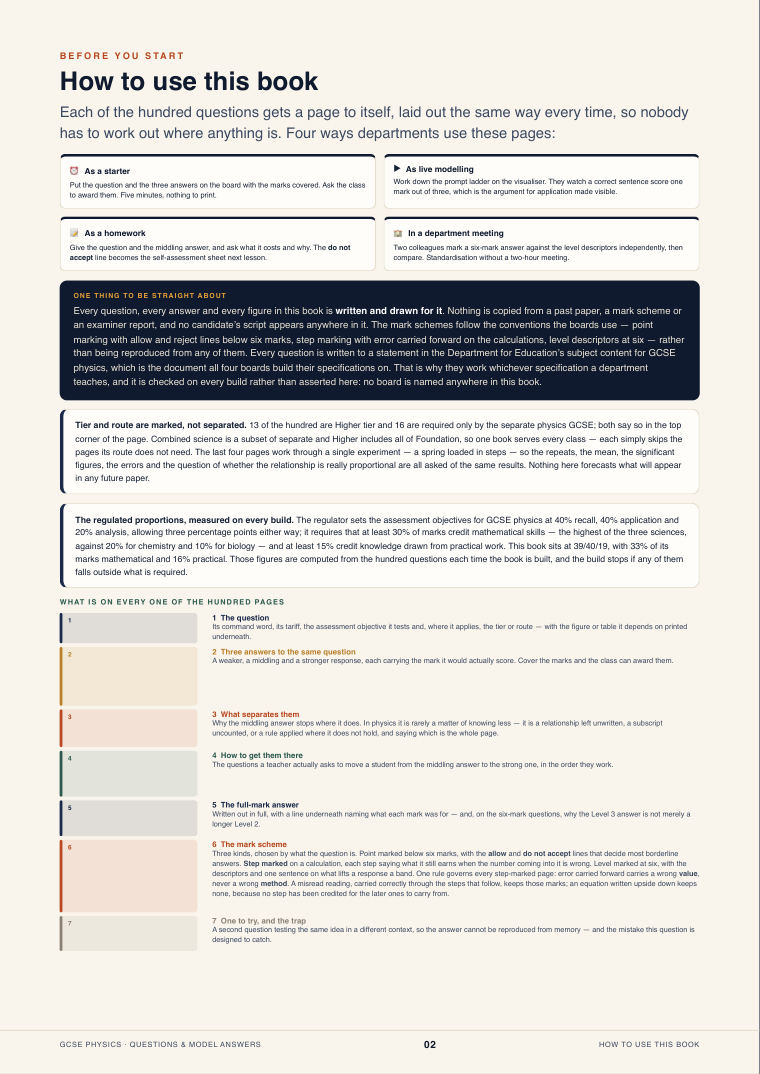
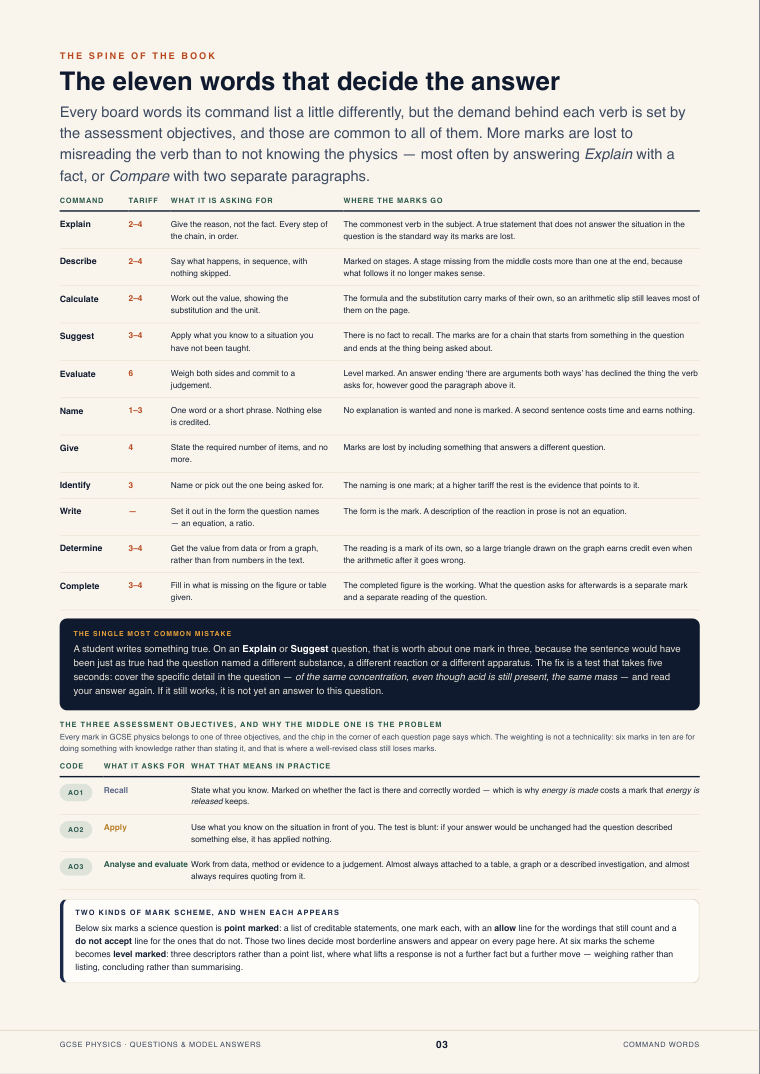
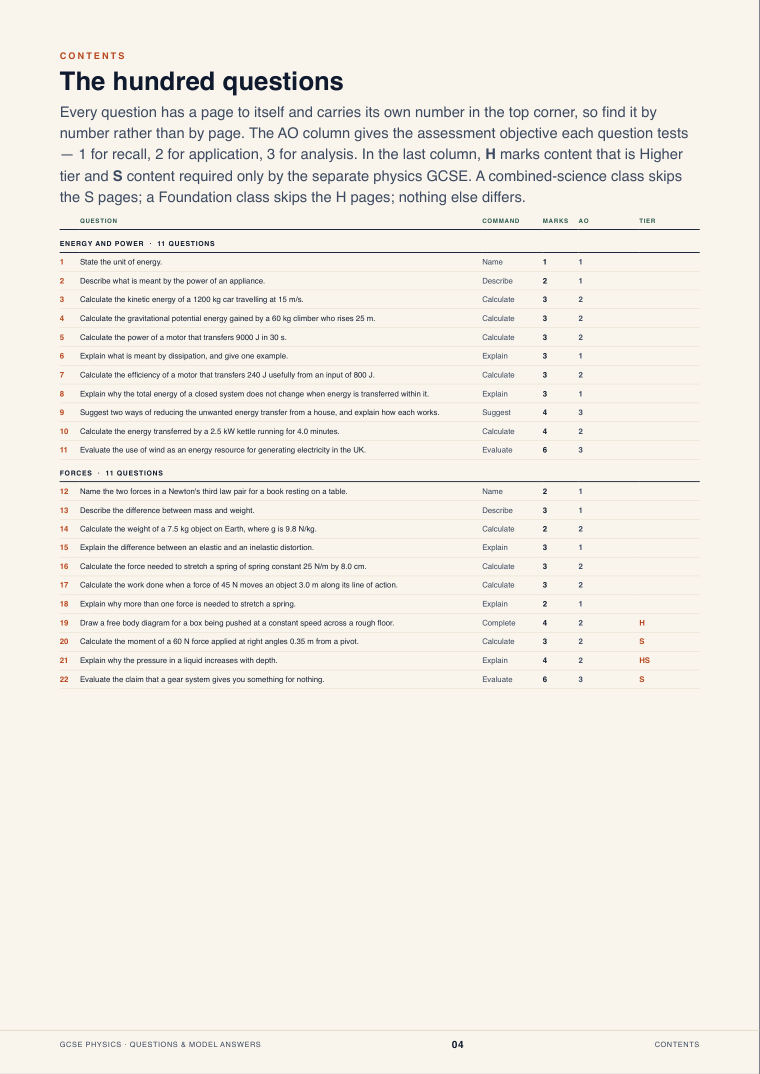
Of the equations in GCSE physics, some must be recalled and the rest are given to you in the exam — and no revision guide tells a student which is which. Every calculation page here opens with the equation set large and a chip saying which side it falls on, read out of the subject content rather than typed on the page. Below six marks the schemes carry the allow and do not accept lines a real scheme has; on every calculation they are step marked, each step saying what it still earns when the number coming into it is wrong.

  1. 1 Energy and power
  2. 2 Forces
  3. 3 Motion
  4. 4 Waves and the electromagnetic spectrum
  5. 5 Electricity
  6. 6 Magnetism and electromagnetism
  7. 7 Particle model of matter
  8. 8 Atomic structure, radioactivity and space
  9. 9 Apparatus and working scientifically

The GCSE subject content for physics published by the Department for Education, which every board builds its specification on, and the assessment objectives and mathematical requirements set by Ofqual · 107 pages, 9 sections · For physics and science teachers and heads of department — used with a class, not a student revision guide
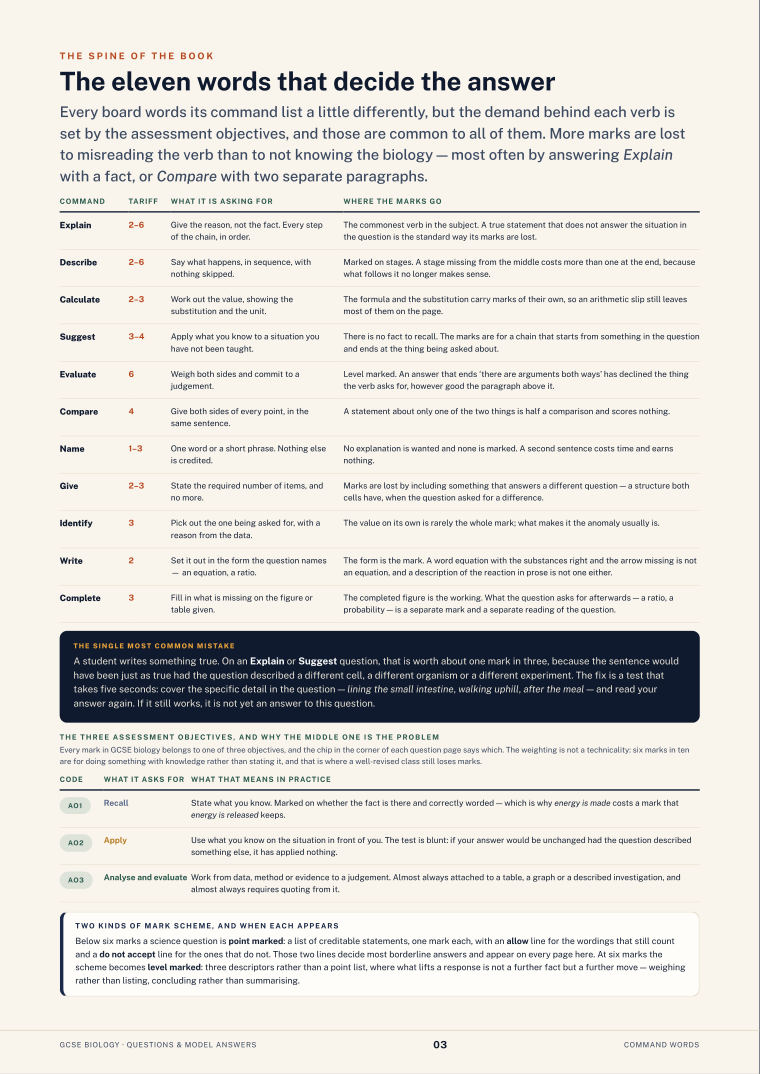
Preview — first 14 pages

🔒 93 more pages unlock on purchase

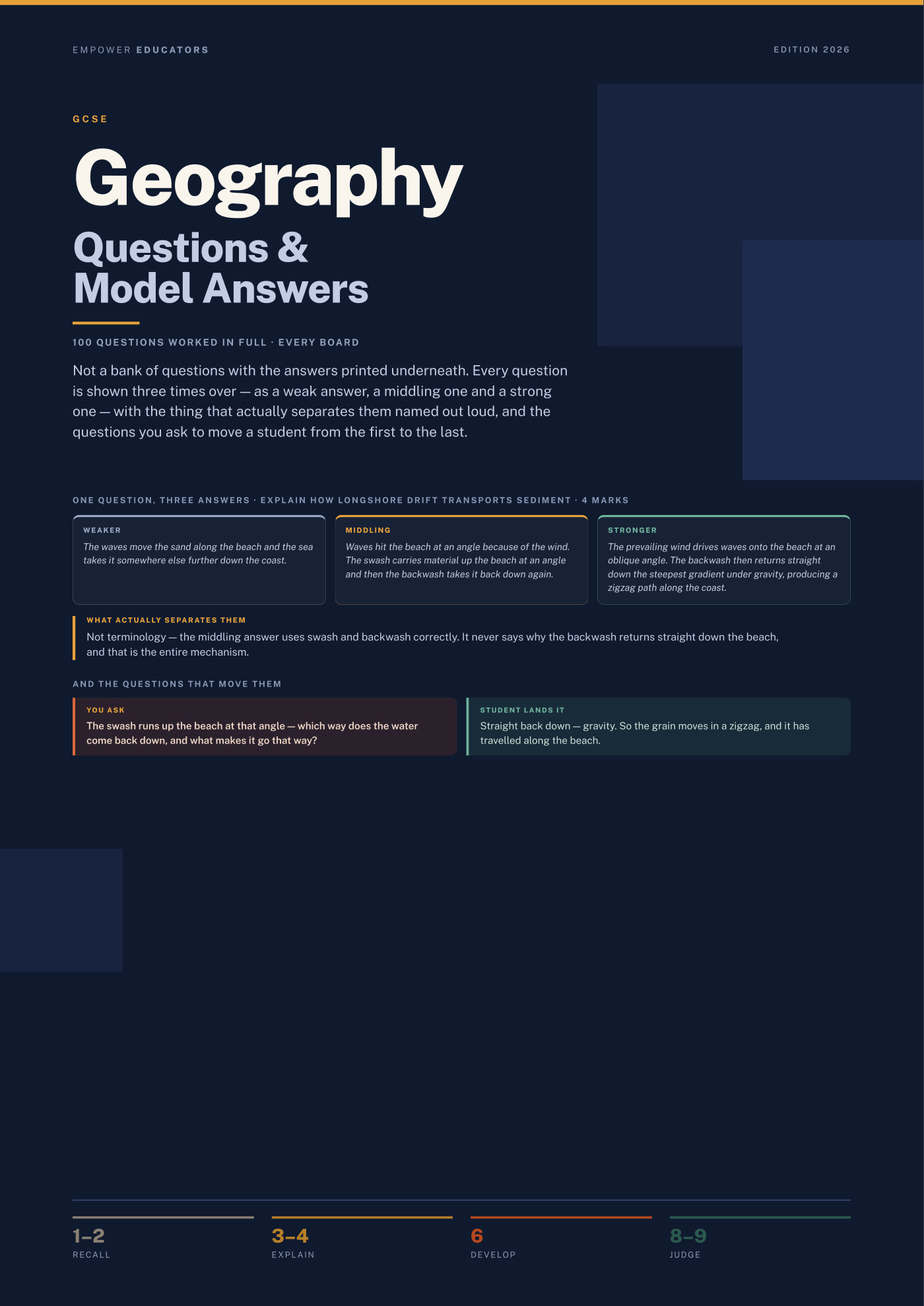
Cover of GCSE Geography Questions & Model Answers

Geography · GCSE £4.99

GCSE Geography Questions & Model Answers

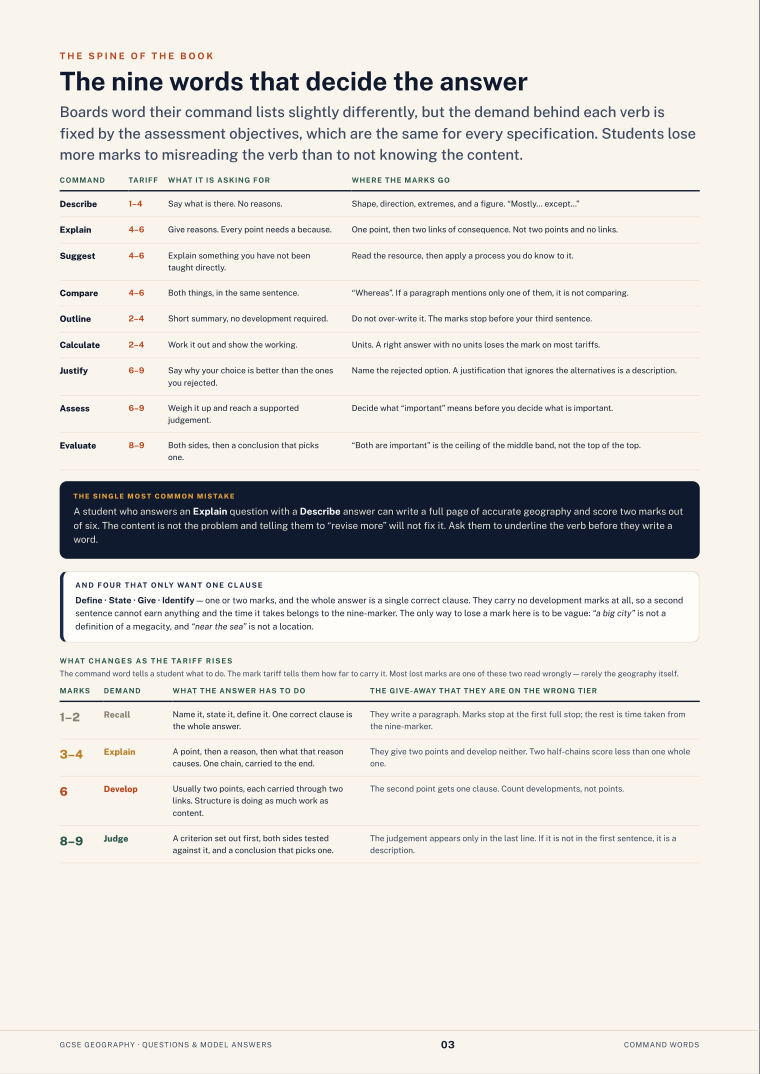
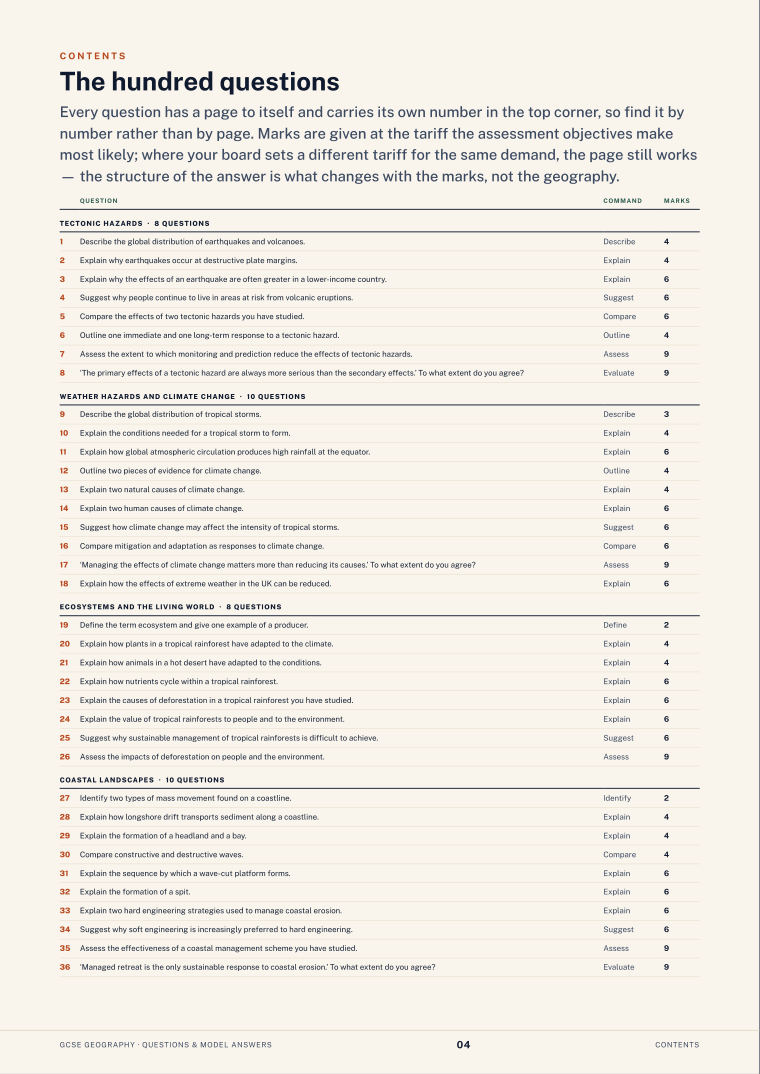
In geography the middling answer is rarely the one that knows less — it is the one whose chain of reasoning stops a link short, and naming that is what each of these hundred pages does. Ten figures are drawn in code rather than sourced, so the hydrograph, the choropleth and the map extract carry no licensing question; and where a misconception is spatial it is drawn twice, the version most students produce beside the version that is correct.

  1. 1 Tectonic hazards
  2. 2 Weather hazards and climate change
  3. 3 Ecosystems and the living world
  4. 4 Coastal landscapes
  5. 5 River landscapes
  6. 6 Glacial landscapes
  7. 7 Urban issues and challenges
  8. 8 The changing economic world
  9. 9 Resource management
  10. 10 Fieldwork
  11. 11 Geographical skills

The GCSE subject content for geography (DfE) and the four assessment objectives set by Ofqual, which are worded identically across AQA, Edexcel, OCR and Eduqas · 106 pages, 11 sections · For geography teachers and heads of department — used with a class, not a student revision guide
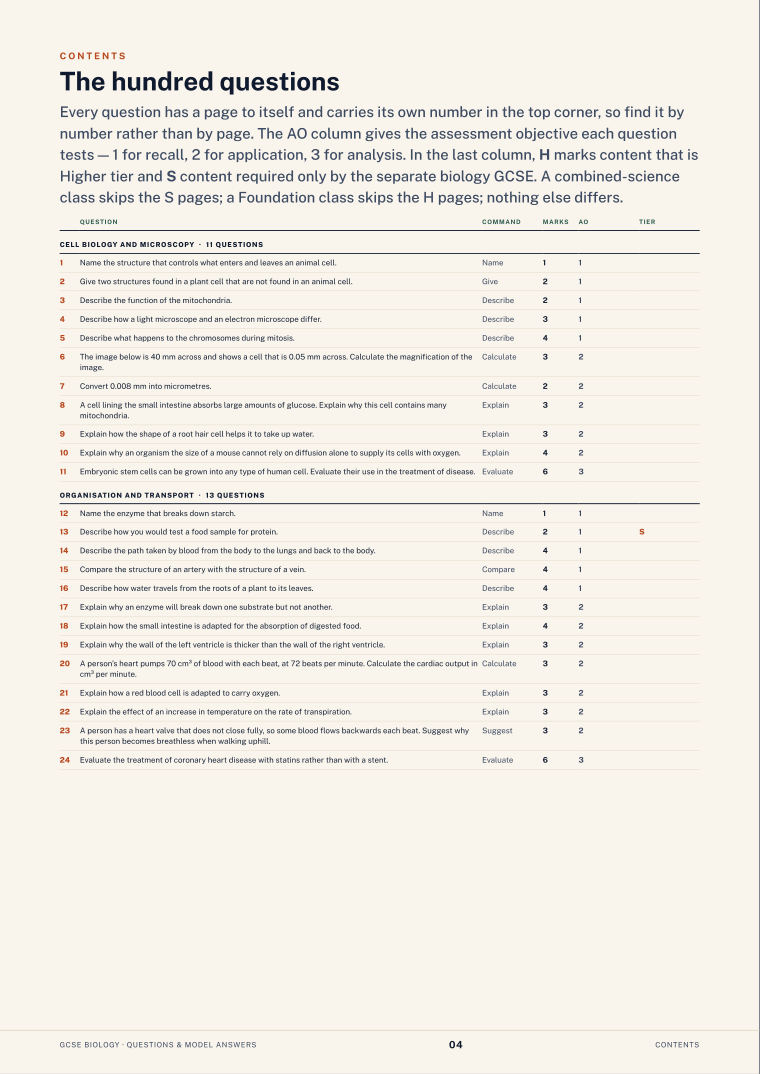
Preview — first 14 pages

🔒 92 more pages unlock on purchase

Questions

  1. Which exam board are these written for?

    All of them. No board is named anywhere in the book. A subject’s assessment objectives are set by Ofqual and worded identically for AQA, Edexcel, OCR and Eduqas, so a question written to the objectives works whichever specification a department teaches.

  2. Are these real past-paper questions?

    No, and deliberately not. Every question and every answer is written for the book — nothing is taken from a past paper, a mark scheme or an examiner report, and no candidate’s script appears anywhere. What they carry is the wording, the command word, the mark tariff and the structure the assessment objectives require.

  3. Is this a student revision guide?

    No. It is used with a class. Each page gives three answers to the same question, the mark each would score, and the prompts a teacher asks to move a student from the weakest to the best — which is the part a revision guide has no room for.

  4. How is it used in a lesson?

    Four ways, and a page is laid out for all of them: as a starter with the band labels covered so the class sorts the answers, as live modelling down the prompt ladder on a visualiser, as a homework with the full-mark answer as the next lesson’s mark scheme, or as a standardisation exercise for two colleagues marking the middling answer.

  5. What format do I get?

    A PDF, typeset for A4 and ready to print. It downloads immediately after payment, and the link stays valid so you can come back to it.

  6. Can I share it with my department?

    Yes. Every resource is free to reproduce inside the school that buys it — print it, copy it, hand it round a department. The licence covers one school.

  7. Can I see it before I buy?

    Yes. The opening pages of every paid title are readable in the browser, free and without signing up. The behaviour playbook is free in full for a name and an email.

  8. Is it a subscription?

    No. One payment, and the file is yours. There is nothing to cancel.

  9. What if it is not what I expected?

    If the file is broken, wrong, or never arrived, you get a refund — email info@empowereducators.co.uk with the receipt number.

Your basket

Nothing in it yet.

Total £0.00

Checkout